Seems fun. Do you carry a backpack or somehting that makes it more challenging? I have only tried to freewheel ride with a small hydratation bag, but I can’t imagine to ride with a guitar or a big backpack with computer, food, clothes as I usually do with my normal unicycles both for the risk of breaking something and for
extra weight in the back.
I’m also curious about the pedals you use. When I started learning to coast in my free uni when I had a UPD I could just put my feets in the ground easily, but when I started using the freewheel uni I noticed that sometimes I struggled to put off my feets on time as I was using five tens and metal pins. Now I switched to bmx plastic pedals and vans, but yesterday I fell backwards hitting my head to the ground (hopefully I was wearing a good helmet and I’m ok) while passing through a garage entrance where the sidewalk was lowered as I lost my balanced and couldn’t place my right foot in the ground at time. Now when I was rewatching your freewheel videos I noticed that you use some weird perfectly flat pedals.
I’ve watched AJs videos about riding brakeless which makes perfect sense but in reality crazy hard.
The level that you’re riding at and in the time you’ve been riding FW is incredible.
I was riding plastic flat pedals but have changed to flat metal as since riding light Muni I found the plastic pedals too slippery. Shoe wise I’m wearing trainers if on tarmac and 5/10s for Muni.
Sometimes I carry a hydration pack on my back but it’s only a small 1.5lt so I don’t notice any difference with it on.
For my 1 km commute to work, I have a backpack, but it’s often very lightly loaded. I don’t like having weight on my back when I ride a unicycle with or without a freewheel.
I think that trail backpacks with weight in front and behind are interesting. At the moment, I like my salomon high pulse trail belt. I can carry phone, drone, keys, water…
Concerning pedals, in my opinion, pedals with metal pins are to be banned.
There have been too many occasions when my foot has involuntarily stayed on the pedal.
I use plastic pedals, look trail grip pedals with vibram surface combined with basic running shoes. I think running shoes are appropriate to run in case of a fall. The five ten have a sole that’s too rigid, and I had trouble absorbing repeated UPDs, which caused me injuries.
I’m really happy with the pedal model I’m using. When it’s wet, they don’t slip much.
What’s more, they’re quite durable. They have suffered numerous falls, the back of my saddle is not in such good condition 
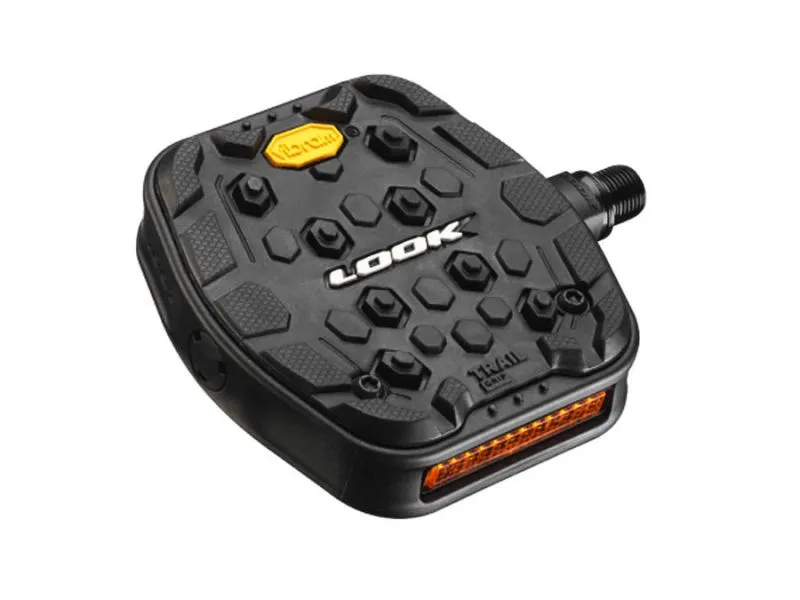
There’s a flatter model that I’ve also tested (look geo city grip), but it’s really slippery in the rain. I have a pair that I use on a 24" indoors.
EDIT: in a BMX flat competition I watched on TV, one participant was using MOTO pedals. These are plastic or wooden pedals with a coating like a skateboard. I wanted to try these out, but they were expensive and some users seemed to say they had durability problems.
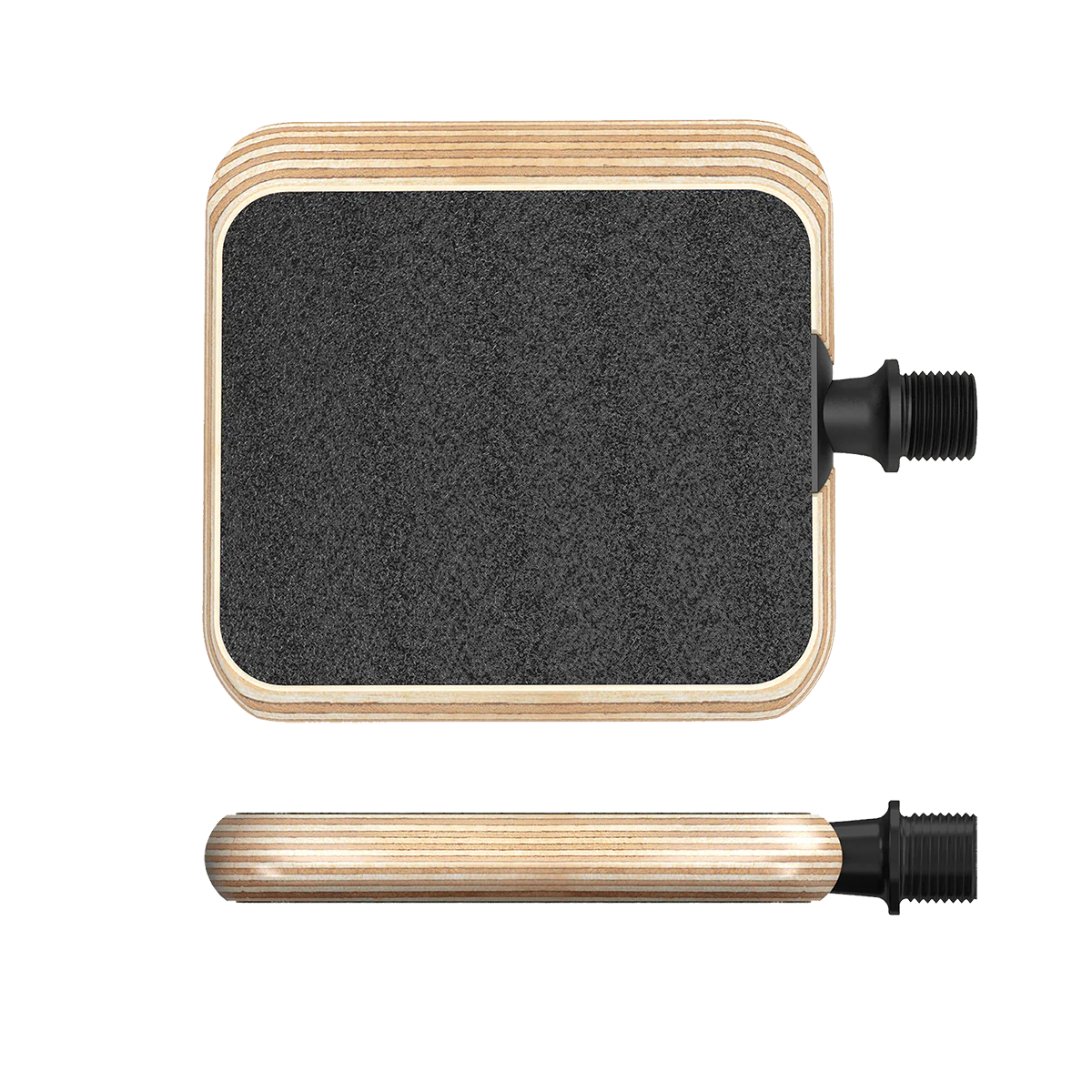
Marie had some of these on her freestyle unicycle, and the bearings felt wrecked from limited use.
The fact they claim you’ve got to grease the bearings (removing and replacing the grip tape) every couple of hundred kms says it all really. No decent bearing needs that, and it’ll be an easy way for them to get our of warranty claims.
I didn’t get what you said perfectly, but I do have a similar feeling from my testing without brake. I can do wide turns intuitively though I sometimes fail to estimate how much do I need to lean forward as at the moment of turnign the unicycle accelerates. For tighter turns I feel like I need to direct the turn more like from the legs, while the upper body just needs to get in a position where after doing the turn with the legs, you’ll end up being in a confortable position for continue coasting. The part of turning with the legs was easy to get for me, but I still struggle with the part of adjusting the body because if I don’t do it right I can either loose my balance or end up being in an awkward body position where I might be able to continue in the unicycle, though probably I won’t complete the turn. Generally what I try to do is to stretch the arm of the direction where I want to turn to that direction before I do the turn and after that I turn until that arm return to its position.
With respect to the part of only being able to do 1 turn, I think that I experience something similar. If I just want to move the wheel a little bit right, left, right, left, I can do it if I keep my body kinda centered all the time, but for significant turns I need to prepare (what I said above), so if I won’t be able to do one turn after another as easily as in a fixed uni.
Team Ursli rider Urs Bless on his hardest singletrail so far (I can’t ride all of it with my fixed wheel…):
Amazing - and so exhilarating to watch! I’m a bit unreliable even going down a street kerb so Urs’s skills produce a mix of awe, inspiration and a belief in magic 
2:20 onwards is where it’s at for me.
As I’ve got older (with wrist and ankle problems), the rocky stuff appeals less and less, but some of my favourite moments on my freewheel have been bombing down fire-roads and easy XC routes. I wish there were more trails in the UK with lifts…
Pretty much the same as mowcius as the rocky sections are super impressive but i like the long coasts down the fire roads.
Im kind of getting there myself and have progressed to riding mild off road areas now with good coasts down the length of the hills i have to ride.
Hi all,
Just wondering if anyone give me some help with an issue i am having with my freewheel riding.
My general riding is coming on fine, getting better at riding without needing to brake, brake control is fine.
The issue im having is with my coasting i am falling backwards , i can save it on the brake in a controlled fashion but this obviously slows the coast , The more i fall backwards the more i brake and the less distance the coast is.
I have tried things like different amounts of pressure on either my saddle or on the pedals , Leaning forwards more.My coasting is done with pedals horizontal.
The only thing that kinda helps is what i call punch in the stomach position where i drop my shoulders and tense my core as if doing a sit/crunch if that makes sense.
If anyone else has had this and could offer some tips on this i would be most grateful.
Thanks
@toutestbon may have some insights on this topic, as he may be the guy who has done the longest coasts here 
I am also currently working on coasting on my newly-built 36er freewheel. I try and focus on the seated coast, as it lets me access the brake lever more easily which seems to be important for coasting off-road and downhill. However, it seems to be harder to balance in this position. So, if you currently try and coast while being seated, you may try to stand up on the pedals.
For me, the most important thing is to practise without having to stop because of injury.
My learning curve has accelerated over the last few months, but I’ve been freewheeling for years.
If you mainly fall backwards, it’s because you’re not leaning forward enough.
Before practising outdoors, I used to ride a lot in the gym; it’s perfectly flat and the ground is softer than in the street. I practised gaining speed and keeping it as much as possible until I came to a complete stop (= the crash).
The position with the 2 cranks horizontal is the best. For the arms, I strongly recommend using the 2 arms in front to balance yourself. Balancing with just one arm is much more difficult and only makes sense if you’re in an unsafe environment (the slope is too steep (you want to slow down) or you have to stop suddenly because of a car or pedestrian, etc.).
It’s worth practising on a slight incline when you’re already capable of doing a ‘long’ coast on the flat (>50m).
As you progress, you strengthen your abdominal muscles and it becomes easier to balance with just one arm or without arms (I can’t hold it for long).
I’m also practising coasting in the 2 horizontal crank positions.
Thanks Maxence, Not fully stood up but i have tried standing up to the point my weight is off the saddle and through the pedals instead.
Hi Toutestbon , I am getting lots better at riding without using the brake and i manage to get my finger fully off the brake whilst riding but im not confident enough yet to fully take my hand away from the brake lever enough to commit to throwing my hands up in the air!!
Riding in a gym must be great , I have a few car parks i use which have different surfaces and inclines to make most of.
I have a short video of my coasts but sure how to attach videos , I just tried doing it through dropbox but it came up as not supported.
You definitely don’t commit enough to the front. It can be scary, but you have to get a bit in front of the uni. Otherwise, you fall backwards.
As said by Toutestbon, it’s much easier with both hands in the air. Especially on such a flat and smooth ground
I can’t see the video, but if you want to progress, you have to consider using the brake as a failure. Even if it’s a softer failure than a UPD, it’s a more significant failure because you’ve given up.
That’s why you need to practice in a safe environment where falling is as little synonymous with injury as possible: suitable protective equipment, soft shoes or shoes with cushioning, pedals without metal pins, soft ground, etc.
Probably one solution is to remove the brake… for me that’s too radical and too difficult for someone who doesn’t already know how to coast on a fixed unicycle.
When I’m coasting with one hand near the brake, it’s sometimes difficult to control myself so as not to brake.
Lets see if vimeo works as dropbox didnt work!
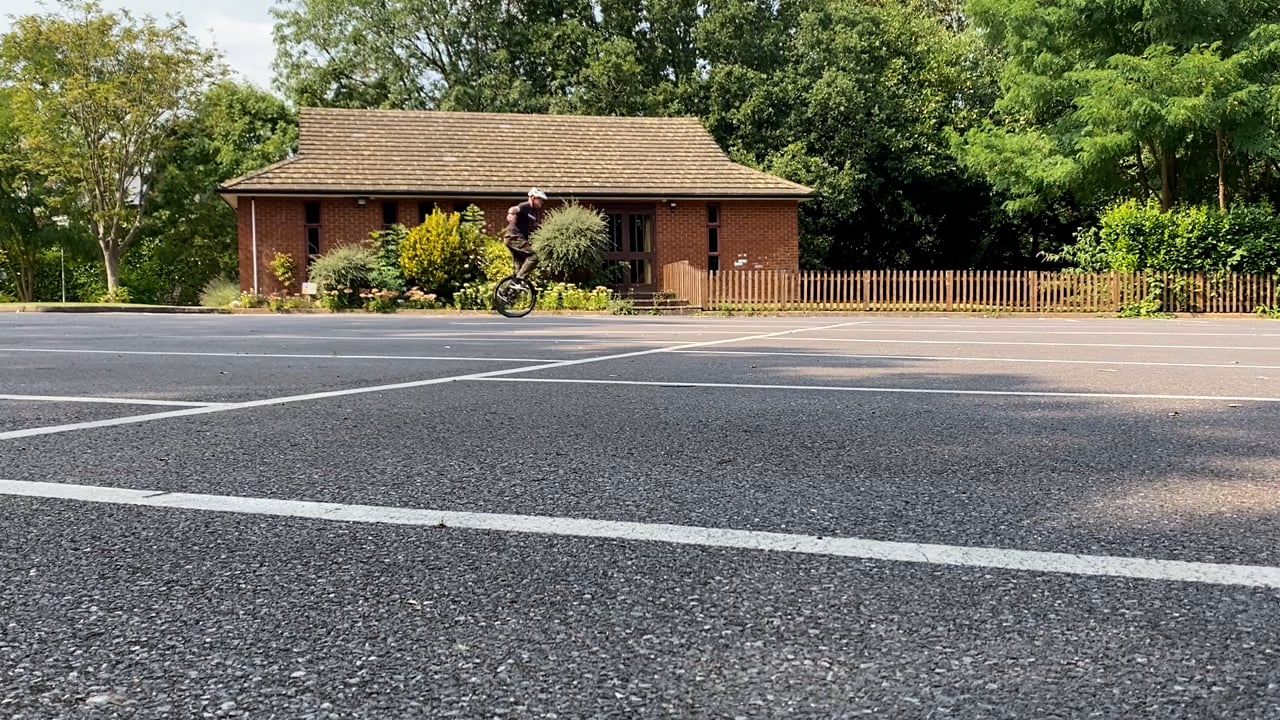
When you’re coasting, if you don’t take your hand off the saddle, it’s going to be difficult to progress. Your centre of gravity is way back, so you can’t coast in this position. Another tip is not to sit still in the saddle. It’s easier to coast with strong pressure on the pedals.
But you can have fun doing tricks with the brake to gain confidence.
You can also work on basic elements that can help you learn:
- one foot riding (both sides),
- exposure on slackline (someone recently talked about this on a facebook group, personally I’ve practised slackline and in particular the exposure position, the front-back balance is similar and it’s safer).
Thanks for your tips and advise which is appreciated , the target for your help seams to be for flatland riding of a freewheel.
My aim is for trail riding and being able to coast on incline/downhill sections so i will need a brake and to be holding a hand on the saddle for this.
I have been trail riding my freewheel recently and i am definitely making improvements with riding it. I am still falling backwards with my coasts but trying to lean into it more which is slowly getting better.
I think we misunderstood each other because of the term “coast”.
On a fixed unicycle, unicyclists first spoke of “brake coasting” to designate the technique of braking with the feet in the air. A technique similar to that of braking without pedaling on a freewheel unicycle.
To avoid confusion, it would be better to talk about “brake gliding” or “gliding”, because using the brake to keep your balance is closer to glide with the foot on a fixed unicycle.
If I understand correctly, wasn’t your intention to keep balance without using the brake? 