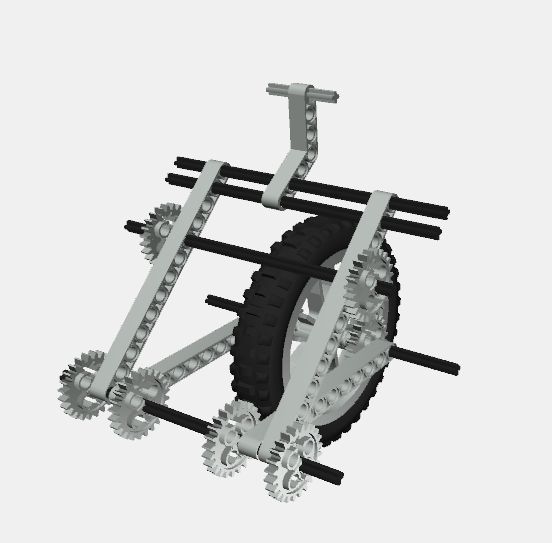
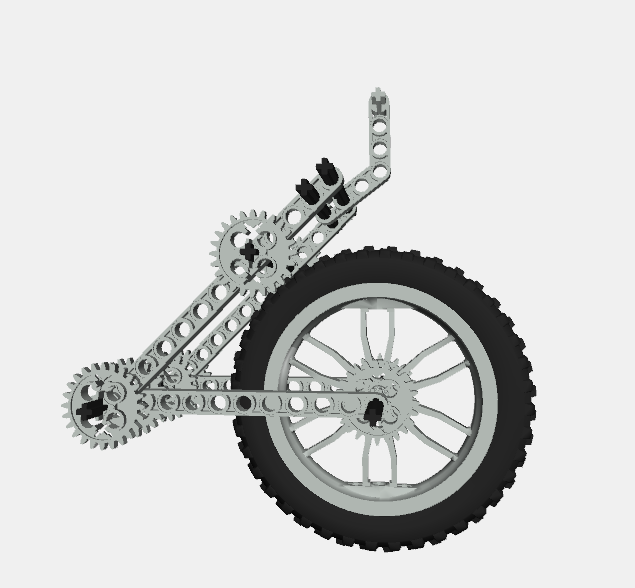
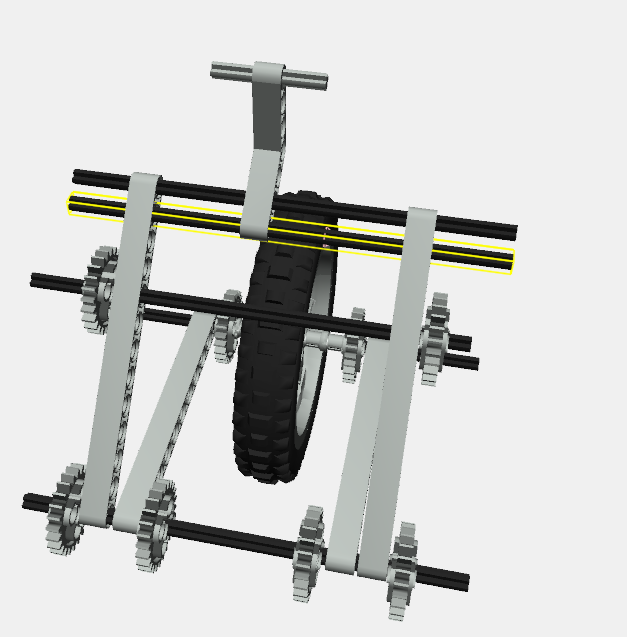
I was recently introduced to the Huni Rex geared unicycle by some friends in a local unicycle club, and I am wondering if a suspension unicycle of a similar design to the huni rex has been tried before. I have tried looking at other suspension designs on these forums, but it seems all the designs available have relied on some variant of “suspokesian”, or allowed the distance between the seat and pedals to vary. If I am wrong feel free to correct me in the comments.
It appears to me that the idea of pedal cranks and the wheel axle being separate can potentially allow for the wheel to be suspended independently of the rider and pedals, similarly to a suspension bicycle. The hope is that the distance between the rider and the pedals can remain fixed even as the wheel articulates. I have tried my best to convey my idea in this 3d model I made, the idea being that the armature holding the wheel would hinge at the bearings that hold the two frontmost chain cogs.
There have been variants of this suggested before and I considered it myself for a while. If you think about it though it doesn’t actually work to dissociate the up-down movement of the axle from the rotation of the cranks, so the wheel moving up and down will cause the pedals to rotate. If you consider your feet and legs on the pedals resisting this and you sitting on the seat, it is still essentially rigid, probably with a lot more stress on your knees. Think of hitting a bump, this will cause the suspension to move up, causing kickback in the cranks – if your hip position is essentially fixed because you are sitting on the seat, one leg needs to get shorter and the other longer so you will not be able to smoothly pedal the unicycle. You could counter this by not sitting in the seat and keeping your feet on the pedals but you’ve then essentially removed the suspension from the system.
See the post I’ve linked below for another explanation and various other discussion.
Wouldn’t this work both ways? Engaging the suspension when accelerating or decelerating, introducing a spongy pedaling feeling, and possibly affecting your balance?
Bottom line is that the only feasible suspension is in your tire/tube, which actually also make balance and control more work when going low on pressure, when I think about it.
Yes, I think you are right insofar as it would work ‘both ways’ – basically I think it would be very difficult to ride and have no suspension effect.
I’m not sure about that, the shaft drive idea I mentioned in the linked thread could maybe be made to work, but would be pretty inefficient I think.
However, I still think that the Schmidt Coupling idea I also put forward on the same thread would work (look up Schmidt Coupling on YouTube, they are really neat) with the challenge of making it narrow enough.
Edit – here is the first one I came across – two of these connected together with the wheel in the middle and you’re done!
The idea is that the chain line is always parallel to the linkages in the system, so that way the forces exerted by the pedals and chain is always absorbed the stiffness of the linkages themselves rather than the suspension.
Do you have any links to prior projects where this type of approach to suspension unicycles was tried? I am very curious if such projects reached the point of fabricating a prototype.
No, I have no links and know of no prototypes. I did give this a bit of thought at one point. Like you I thought it would be a neat solution.
Consider the case of wheel being stationary (and hence cannot rotate) and you stand beside the unicycle and push down on the seat to move it up and down, compressing and extending the suspension. The pedals will rotate.
This is because the intermediate pivot point will also move up and down. Since this is connected to the bottom sprocket which cannot rotate (as the wheel is stationary) with a chain, it must move around the bottom sprocket, resulting in it rotating. This rotation is then transmitted to the pedal sprocket by the upper chain. So moving the suspension up and down with the wheel stationary (ie non-slipping) and the pedals unconstrained will result in pedal rotation.
If you now consider the wheel being ‘fixed’ on the gound and the pedals being ‘fixed’ to the rider’s feet and legs, the distance between the pedal sprocket and the wheel sprocket cannot change since neither end can rotate and you essentially have a fixed system. You also essentially transmit the weight of the rider minus the resistance of the suspension through the chains, and hence also probably end up breaking chains.
The upshot is that any movement of the wheel on the ground is transmitted to the riders legs, potentially feeling like kick-back. Likewise pedalling torque may well try to extend the suspension (I’d need to think about that a bit more to be sure), which I think is what PedalSprell is pointing out above.
I appreciate the input. I think that designing of a suspension unicycle is much more complex than I initially thought. I will keep you all updated if I have any further ideas. From the input I got here, it seems to me that the suspokesian approach with the suspension being inside a custom wheel is currently the most promising approach.
I think your analysis is incorrect. Try stretching a rubber band between the pointer fingers of your left and right hands. You can change the angle of the band without rotating your fingers. The result should be the same in a 2 linkage system. You can also test this with more rubber bands and more fingers, but you might need a 3rd hand.
Compression of the proposed shock system won’t cause rotation of the pedals
I"m still not fully convinced either way. I had considered this suspension setup a few years ago but convinced myself at the time it wouldn’t work as it would lock up. I have some Lego Technic gears and chain put away somewhere, I was going to use that to model it but it never happened. I should perhaps go and look for it I like your approach with the rubber bands though.
I’m with Maximus on this; the crank sprocket would be connected to the drive sprocket via a chain, so an upward force on the wheel (a bump) will cause the chain to rotate around the chainring, not exert a pushing or pulling force on the chainring. It doesn’t seem that it should be any different than what a rider on a rear-suspension fixie bike would experience. Not that many of those exist, but the problem doesn’t seem intractable.
There would certainly be slop in the system and that would make riding it difficult. But probably easier than a freewheel uni, or other crazy things people have done.
Here’s a post about a single speed suspension bike:
One thing it mentions is having the pivot “concentric” with the bottom bracket, so that the curve which the rear hub follows as it pivots stays the same distance from the bottom bracket. That should be possible to do with a uni suspension, too.
I was worried that I would need to hand craft concentric bearings if I were to tackle this project. I am glad that is not the case, but I wonder how I can get any pre made concentric bottom brackets.
This is a 3d model I made using the lego sr3d program. I am not sure how to generate chains or belts in the program, but I am hoping that by using different holes in the bricks I can adjust the tension in any chain that meshes with the gears, with the goal for four separate chains in total. Next step is to go to a local lego store and see if I can find any suitable parts.
That looks good, I didn’t know there was CAD software for Lego Technic, I looked it up after your last message.
You should be okay with the chains when you build something, as I recall it is all designed to work with the gear sizes and hole spacing, it was all pretty neat. I really need to try to remember where I put all my old stuff and dig it out. You may have more luck buying stuff online, the Lego stores I have been in seemed more into selling the latest kits than parts.
I am maybe completely wrong about things locking up and kicking back. I had tried to work out any issues before I went and made something (in steel) and convinced myself that it would all be problematic. It was after that that I thought about the Lego, but as I say I never got round to looking for it and trying it out.
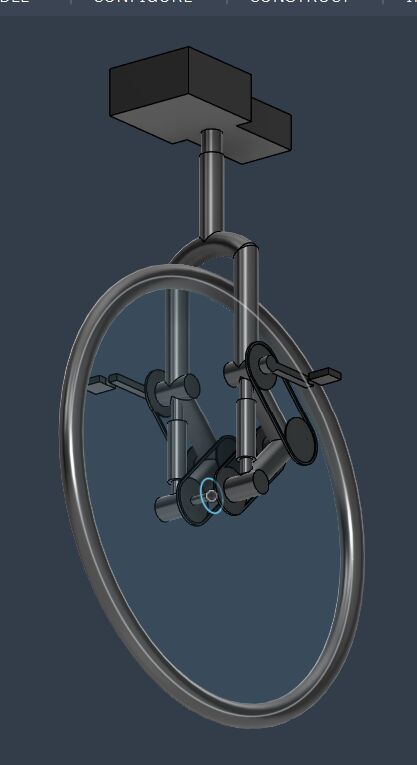
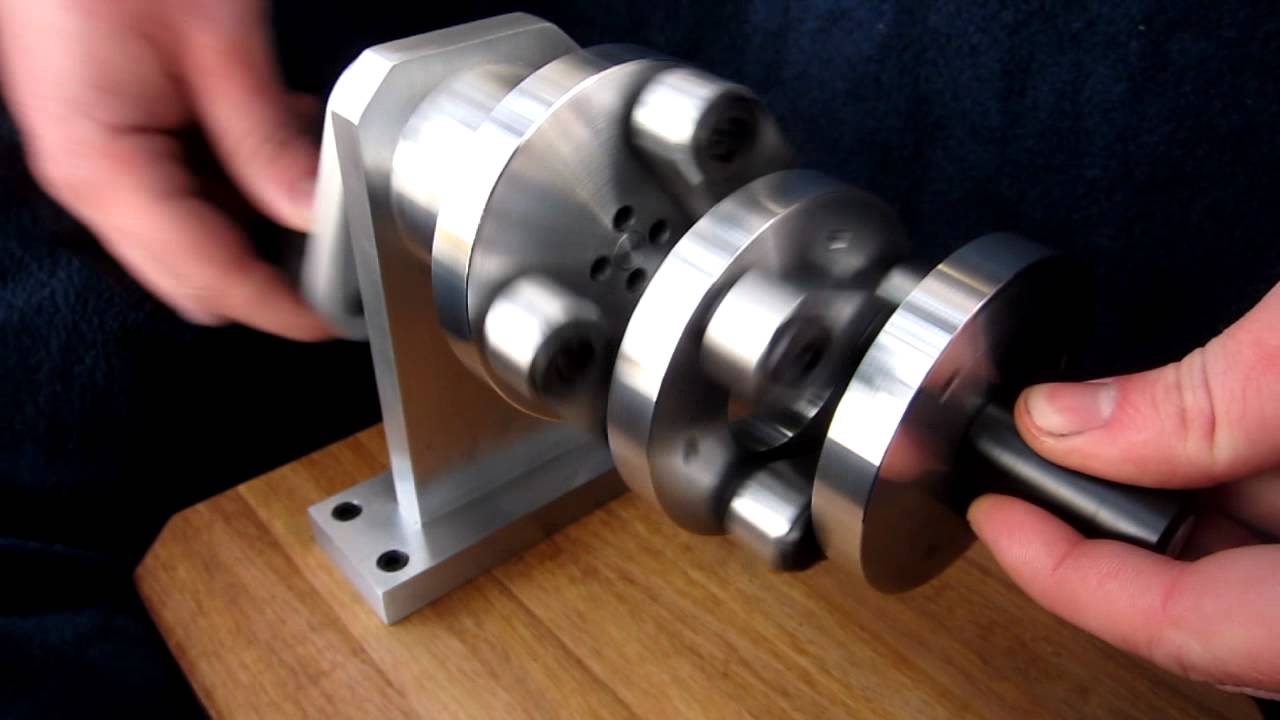
 I like your approach with the rubber bands though.