I got back into the bike seat and handle thing the other day. Brought some parts from home and converted my 26" Muni to a street machine.
Specs are DX32 rim, 26X2.5 hookworm, 114mm cranks, my (bike) top-tube/T7 handle and a cheapish but nicely shaped bike seat.
I first started out with 102s on it yesterday and it felt fairly unstable. I rode it around for a few hours but never totally got used to it. I felt the same freeness and comfort that I stated at the start of this thread.
I swapped out the 102s for 114s from my freestyle and it made a huge difference. The whole unicycle felt much more natural and I could see how Turtle likes the bike seat for MUni if the handle is nice and close like that.
I did have my first good fall with the bike seat setup I think it would have been exactly the same with a unicycle seat. I was going pretty fast and didn’t notice a speed bump. Hit it with pedals vertical and instinctively went into a roll. Glad I have lots of practice falling or it could have been bad. I did get a charlie-horse on my leg from my multi-tool in my pocket.
So other than the fall the ride has been going great. I stopped a the grocery store and bought a few things then tried mounting in-front of these two good looking native girls and came off the front. Tried again and the thing wanted to veer wildly to the side and I came off the back. Walked across the street and tried again, was really wobbly until I had my hand with the grocery bags on the handle. It was OK until I went to avoid a large pothole and the swinging of the bags threw me off again. Ended up just walking the rest of the way home.
So I found it really comfortable for general riding around. It handled going up and down curbs very well and I can see myself putting something like this on a 36er. Only problem was that it definitely is not a very good grocery getter unless you put the groceries on your back.
My 36" V frame has something like a 27 degree angle. It kind of depends on how you measure it. Different reference points produce different measurements.
60 degrees sounds really large. You might want a large angle if you are building a V frame for a 26" or 29" wheel. For a 36" you would probably want a smaller angle. The reason being that a smaller angle on a large wheel will get the handle bars just as far in front of the seat (in centimeters/inches) as will a larger angle on a smaller wheel.
One thing you could do is try and decide roughly how far forward you want your handle bars to be and then pick an angle that will allow you to achieve that. Then design handle bars that are adjustable so that you can fine tune their position.
Of course, knowing where you will want to put your hands and therefore handle bars is not an easy question to answer without actually trying out a uni with an existing handle bar set up. Make good use of your neighboring unicyclists.
Does anyone know the exact dimensions of a 36" Tire? Like Rim ERD exact tire width, things of that nature? I am going to build one up in sketchup that has quite an inventive frame idea.
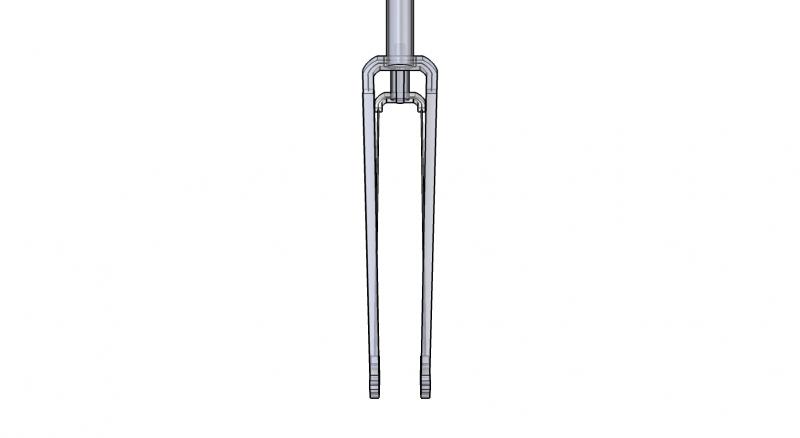
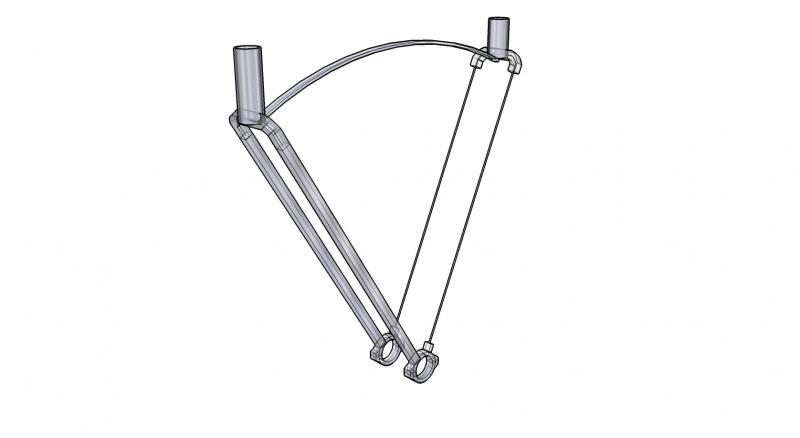
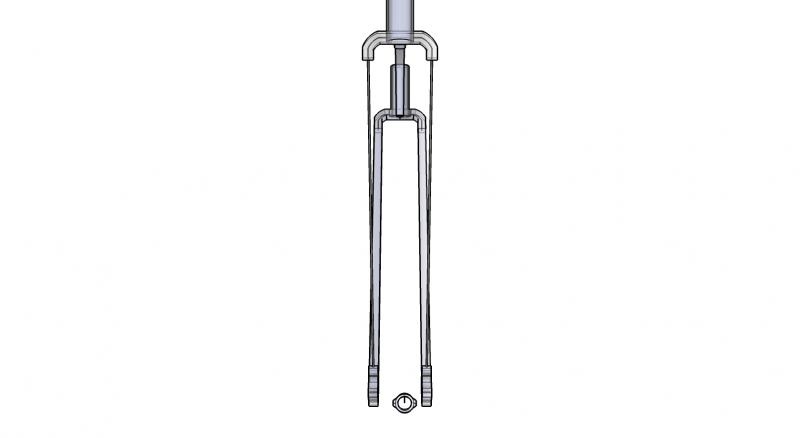
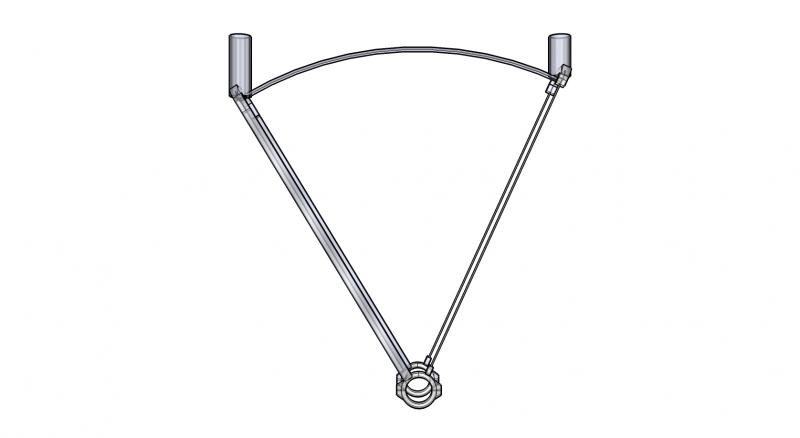
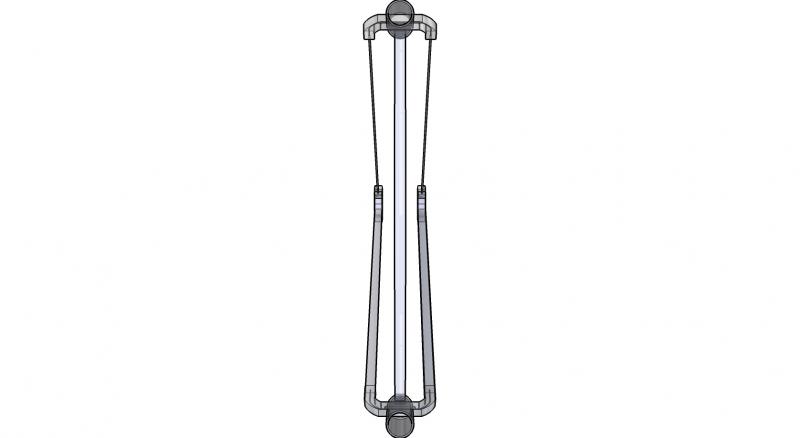
Well, here’s my new design with some quick sketchup photos attatched. The problem I am trying to solve is that I want to acheive the comfort and stiffness of a V frame but with the weight of a typical flat crown shaped frame. I acheive this by replacing the second tubes with 2 tensioned stainless steel cables anchored where the forward frame legs should be. I have a bar running to the handlebar tube and back to the seat tube to triangulate the frame to achieve this shape. While it isn’t in the pictures, I plan on attaching a mechanism to remove the top tube, enabling the entire forward piece to be removed and enabling the frame to be ridden in V mode and as a normal frame. Cable tension is adjusted at the bearing clamp anchor with a simple nut and bolt tensioning arrangement. Comments, questions, complaints, I’d be glad to hear them.
Maybe I’m missing something, but I can’t figure out any way that this would work. It seems the cables will essentially be pulling the crown down toward the bearing holders, so not only is the forward crown unsopported, the cables are actually creating more downward force on the forward crown than you would have in a reverse 7-style frame. Pressure on the grips would loosen the cables.
The lightest design I can think of would be something resembling the rear triangle of a traditional bike frame. If your weight is divided between the bars and the seat, the tubing could be much thinner than a traditional uni frame. If the weight distro is not 50/50, the back tubes could be made heavier w/ lighter ones up front. Unfortunately, it would not be a very good modular design, b/c neither set of tubes would be heavy enough for a stand alone frame. One solution would be: standard tubing in back (under seat), and superlight stays under the bars that could be removed w/ the bars for use as a normal uni frame. Clear as mud, I guess, lol! Hopefully some of that makes sense.
Austin
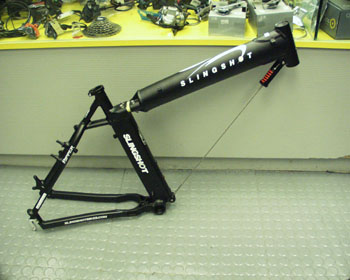
The bar bridging the gap would also have a force upward because of the way it is bent, sort of like a spring. I may also put an elastomer in the center to give a suspension feeling to it, sort of like having a suspension front fork, in a way working out like slingshot bike frames (photo attached).
I have a friend with one of those slingshot frames, and he wouldn’t trade it for anything in the world! The only reason that those frames work is that there is pressure from the fork forcing the toptube up.
On your design, the cables would be pointless. If your bridge was strong enough to support the weight placed on the bars, it would effectively be a reverse 7 frame. Your cables would exert force in the wrong direction, merely assisting gravity in pulling the bars toward the ground.
i think thats true, also from what i can tell frem my V-frame. to make it better or lighter i think also the front fork could be much lighter.
i use know the handlebar, the tube to it of cf, so it ios very light, i put alo the brake at the outside of the bar, so if you come to a longer technical downhill, i can just take the handlebar and the tube off (only one screw, or a clamp), put it in the backpack… the only problem at the moment, like this i’ve no brake, and on the 29" i would prefer one i guess..
I thought the main purpose of a v-frame is to keep the seat/handles stiff, but using cables like in the design you posted pretty much eliminates this feature. Also, a frame that is rigid enough to support the load from the tensioned cables would probably be strong enough to support a rider by itself. I can’t see any advantage you could gain from them, except for the ‘coolness’ factor of having cables on your frame.
There’s not a lot you can do to a simple v shaped frame to save drastic amounts of weight… that’s the tradeoff you get for having a stiff frame. But you might be able to play with different frame support geometries to come up with a lighter (than a v-frame), but stiffer (than the t7) frame design.
Kerosian,
Excellent plans. Very creative. Now you’ve got the whole R & D team working out the kinks before you’ve spent a dime on metal. I agree with pretty much all the previous comments. One more that I’d like to add is that I think it would be better to have the seat and handle bar-mounting tubes to be following the angle of the V frame. You have both tubes pointing vertical and parallel. (Calling these tubes vertical assumes that weight is being distributed equally between the seat and the handlebar. That weight distribution would result in each of the arms of the “V” having the same angle with respect to gravity. In my experience my weight is not even close to being distributed equally. I would guess that I might put 10% of my weight on the bars. Much of the time I have less. This unequal weight distribution results in the rear arm of the “V” being much closer to vertical than the front arm of the “V”)
There are two reasons that I don’t think this parallel positioning of the tubes is optimal. The seat tube: Imagine sitting on the unicycle when you are not holding on to the handlebars. You are sitting straight up just like on a regular unicycle. The rear arm of the V is nearly vertical. Instead of a nice straight line of force being transmitted from the seat down through the seat post and into the frame, you’ve got an angle in the line. This is inherently weaker than a straight line. I’m sure it could be made strong enough but more strength requires more weight in materials. Keeping it simple is a good thing. The handlebar tube. By having it parallel to the seat tube you diminish one of the goals of the V frame, that of extending the handlebars farther out in front. If you were to keep the handlebar tube in line with the front arm of the V you could gain an inch or so of forward reach, depending on the length of the handlebar tube. An inch is a long way in the handlebar world. Maybe I’m getting nit picky and I’m being too much of a weight weenie but bear with me. You could probably save a few grams by closing the angle of the V by a couple degrees and keeping the handlebar tube in line with the front arm of the V and still maintain the same reach. Or you could maintain the same angle of the V and just gain another inch of reach.
Keep up the good work. You’ve got us all thinking about new designs again.
I’d love to see the prototype before making up my mind. At first glance I thought it would lack any stiffness also.
But thinking about it, you would achieve some lateral stiffness because of the force of the two tension wires pulling on either side. I guess that depends on how far apart the tension wires are.
Also, if the top tube was a wide, flat structure, that should add lateral stiffness also.
There might be springiness when you push down hard on it, but that perhaps is not all that different to riding a mountainbike with a suspension fork?
I love how this thread is bringing out all sorts of creative ideas. I’ve started a monster
Yes but unlike a mountain bike, the “suspension” does nothing for the rest of your body and puts more stress on the top tube.
One thing that I would be interested in testing is whether a straight or curved top tube is the way to go. The curved one is lower and more out of the way, but maybe the straight one would be stronger? I don’t know enough about these kind of things, but it seems like a triangle would be stronger than a circle sector (“pie piece”).