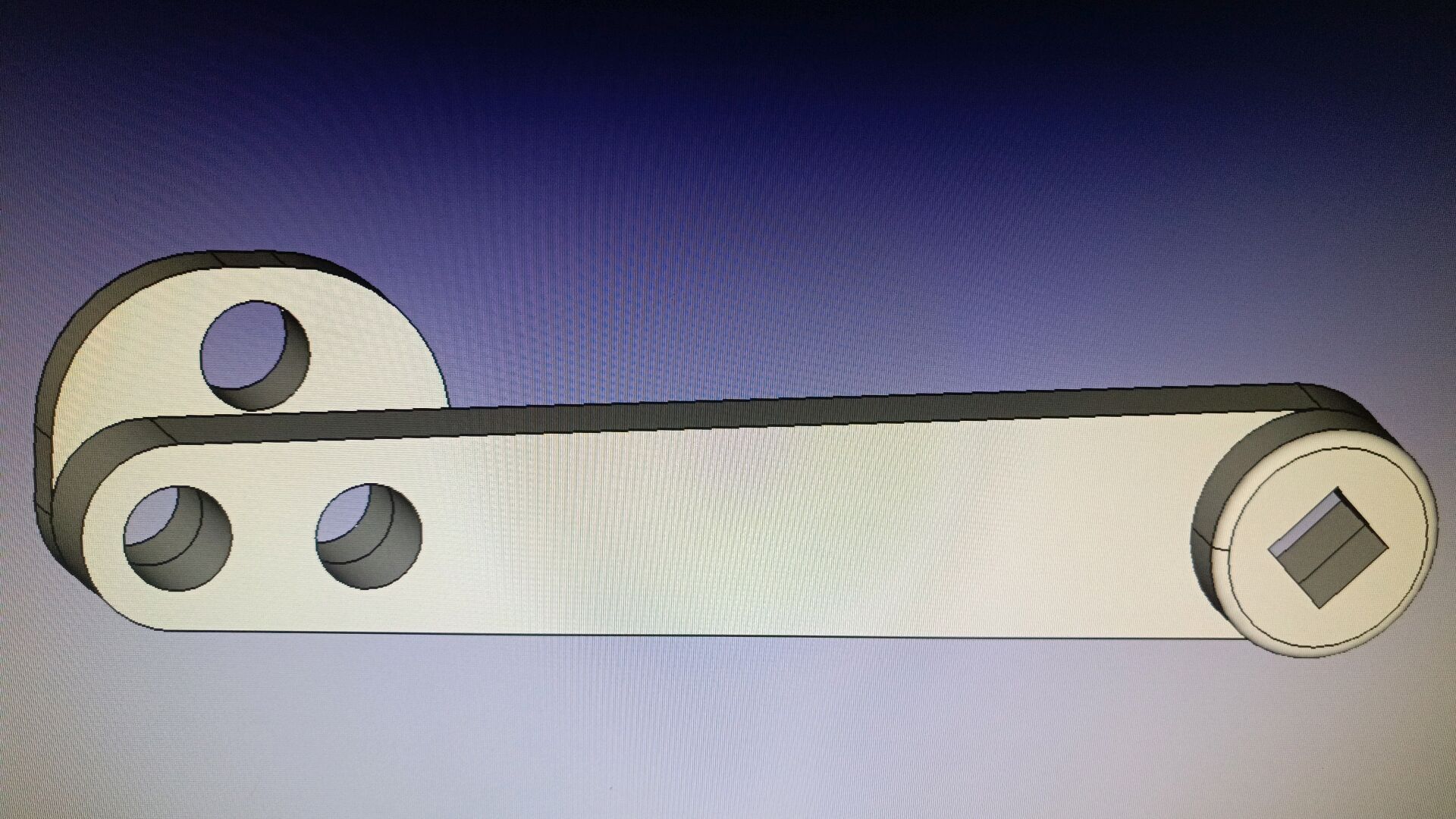
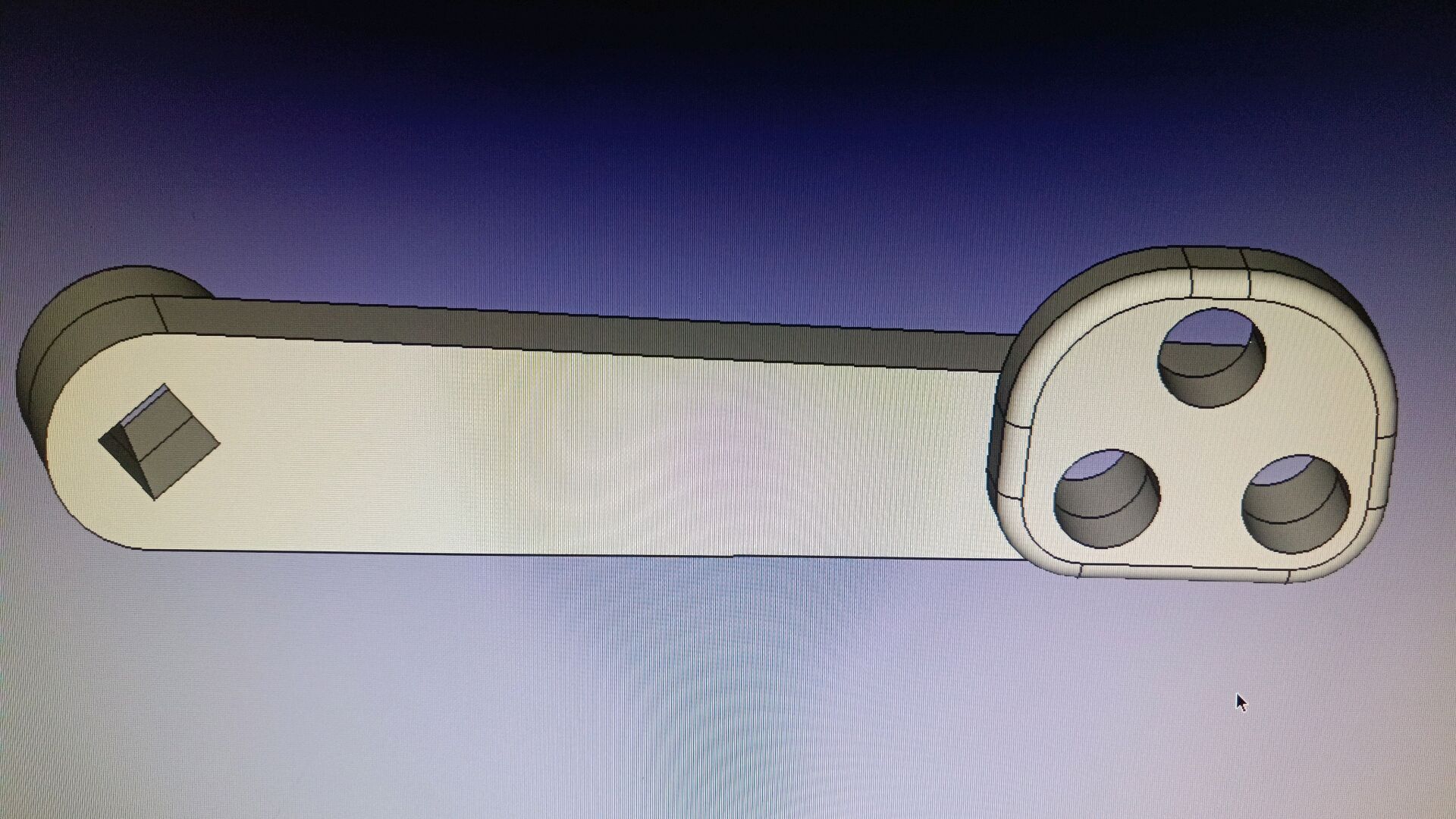
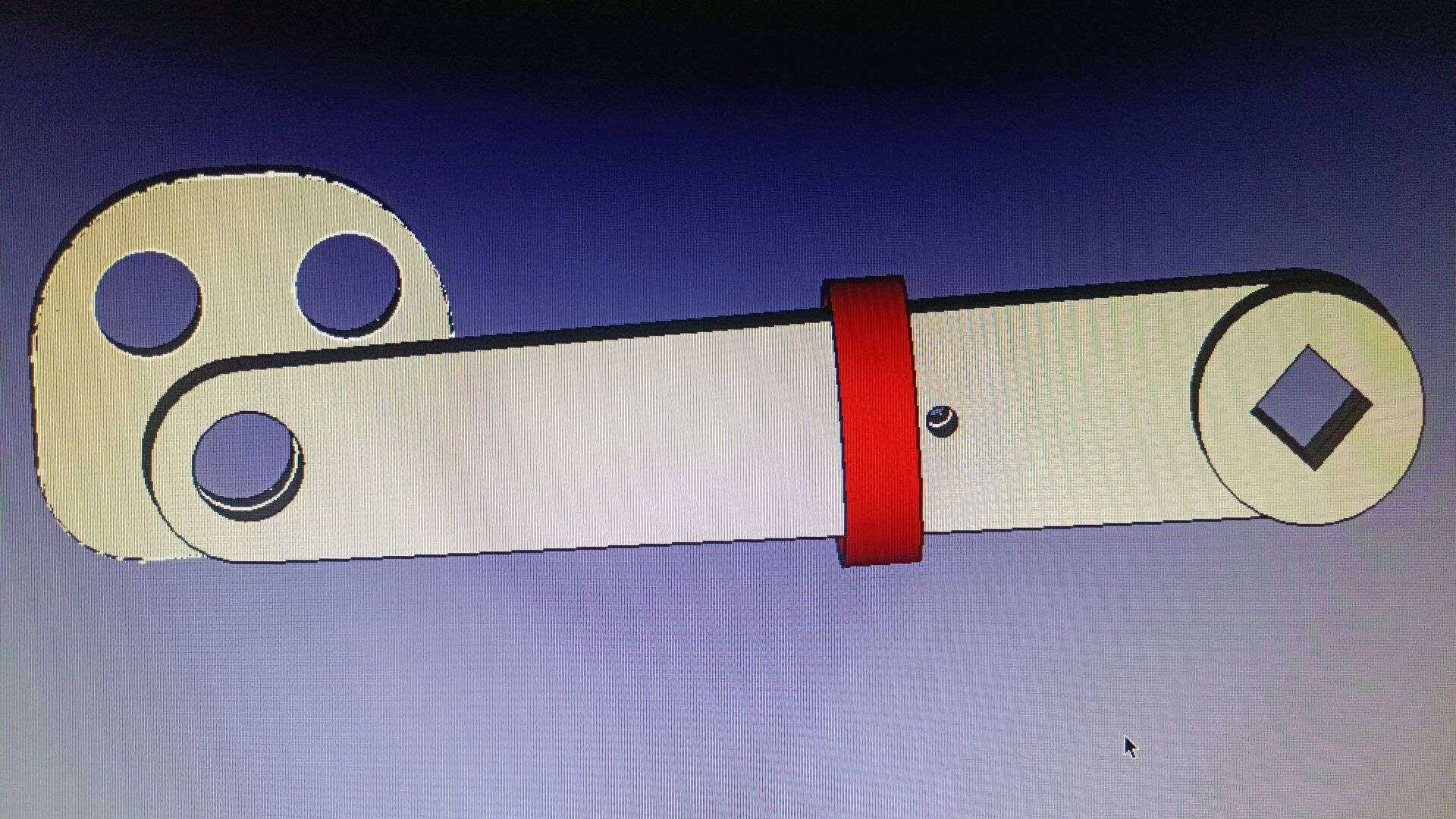
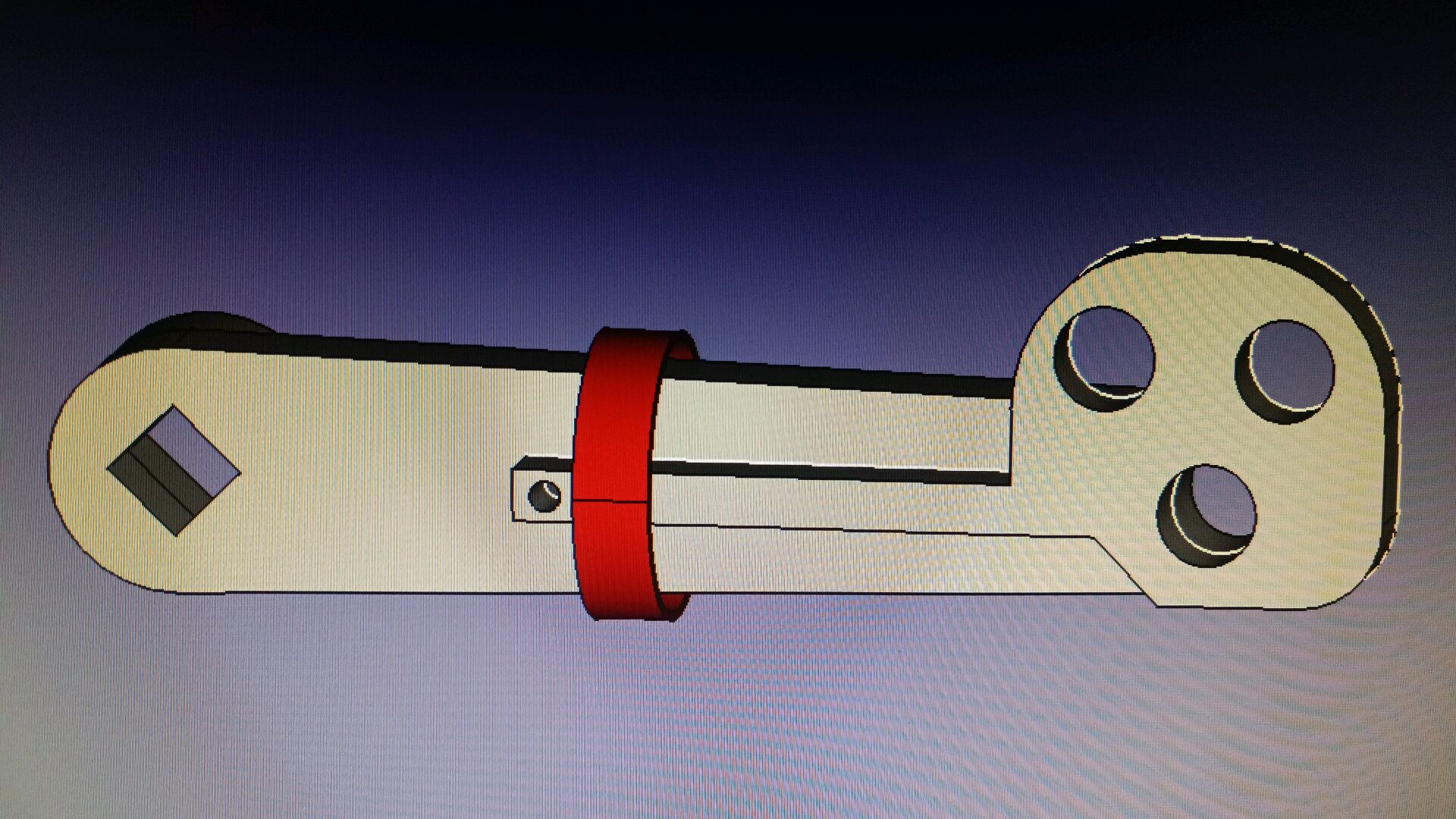
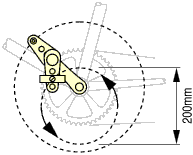
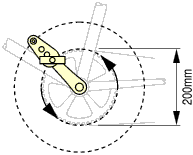
I am not involved in dual/triple cranks, but I just felt the desire to draw something meaningless.
Let’s combine your desired Q factor and 127mm/140mm/152mm cranks by a metal plate welded or screwed to a dual hole crank.
Man, you screwed it to the wrong side of the crank
Since your original crank has insane Q-factor, you can make your new holes to lower the Q-factor instead of further increasing it.
I would question the strength of this design though
If it is welded on top, Im sure it will hold, but won’t your feet rub the long section in the third pic. Also you should draw it with ISIS cranks. We don’t do square tapered.
KH Spirit already has 12mm Q-factor. According to @Hammer, these Prowheel cranks have ~3mm more. That gives us 15mm Q-factor from unmodified Prowheel crank. @Ulkicycling suggests to weld a plate with holes to screw-in pedals. I am too lazy to look for minimal crank-pedal interface thickness, but let’s conservatively assume that it is at least 10mm (I think it is actually a few mm more).
Your modified crank has now at least 25mm Q-factor. Your feet are at least 5cm extra distance apart. Do you really think this is not noticeable?
There is a reason behind M4O developing (and selling) hubs, cranks and hub-crank interface to reduce Q-factor by a few mm. You can read some of @MAD4ONE thoughts about on his website.
By the way, even KH reduced Q-factor by 4mm replacing Spirit by Boundary.
I reckon I need to feel it for myself. 5 cm doesn’t sound like a lot. If the seat is a bit on the wider side, you can also have a wider Q-factor on the cranks and I don’t think you will notice so much.
Well, this reminded me of crank shorteners that you used to get for stokers on tandems – and the reminder that most things in cycling have been thought about before…
Looking around you can find various ones on eBay and also new ones like these (quite how they stand up to unicycle ‘misuse’ is anyone’s guess however):
HighPath can also do custom shortening for you to seems.
One difference I’ve noticed is that a higher Q factor results in more torque such that the unicycle wants to steer away from the pedal being engaged, particularly the stronger the force you apply
Would be interesting to see how much Q Factor once they’re installed on the uni. There is some tolerance in the precision of the ISIS splines, so they could either bolt in closer to the frame (with thinner spacers obviously) and therefore have less Q than on paper. Or the opposite.
5cm is a lot.
A few real life examples from my garage:
Mad4One Race ISIS + Agile (85mm Hub) — 15.5 cm
Nimbus Eclipse + Venture (92mm Hub) — 16.7 cm
Nimbus E-Sport + VCX (90mm Hub) — 17.2 cm
Nimbus II + VCX — 17.9 cm
Trainer + United — 18.2 cm
Torker DX + splinted BMX style — 23.6 cm
KH-24 + VCX+ — 18.5 cm
KH-26 + Spirit — 20.5 cm
KH-36 + Moment — 19.6 cm
My commuter bike — 19.2 cm
Extra 5 cm means +25-35% more distance between pedals, hence generally less efficient pedaling.
That is less critical for some applications (imagine wheel walk ), but double digit percentage is noticeable, and even critical for competitive riders.
On my old MTB I used the Shotgun seat for my daughter. To not hit her with my knees on every pedal stroke, I also needed more Q-factor. I used Jtek Q+ Pedal Extenders which are available in 20, 25 and 30 mm, translating to 40, 50 or 60 mm more Q-factor. So if the Q-factor is not needed for brake caliper clearance, those would also be an option. The downside is, that they tend to rust a bit and are quite heavy (weight per pair: 20mm = 100g , 25mm = 129g , 30mm = 159g).
I did not measure the KH-26 with Spirit cranks, but I expect it to be in the 19-20 cm range. KH-26 with Spirit cranks is 20.5 cm (vs 19.6 cm KH-36 with dual-hole Moments).
I general, total Q-factor depends on several independent variables:
hub width
spacers (the distance between bearing and crank interface / crank)
crank thickness and crank angle (these two define crank Q-factor)
Stock 36ers use either 125mm hubs with low Q-factor cranks (UDC/Nimbus) or 100mm hubs with high Q-factor cranks (KH). As a result, these unicycles do have larger Q-factor compared to many (but not all) smaller wheeled unis.
Why are your expectations?
Their idea of the swing allows you to lower your seat (assuming you do not have these medical conditions they are targeting). Not sure if that gives you any valuable advantage, and I can imagine lots of disadvantages.
Yes, they would be pretty ‘interesting’ to say the least, I suppose it would be a bit like a Hunirex insofar that they would lower the pedalling axis below the centre of the wheel. I’m guessing it would be worse to ride than a freewheel though…
I hadn’t seen those before, I thought there was a fairly high chance of hurting an ankle even on a bike though.
changing (shortening) the diameter of the circle of the foot path,
moving the center of of the circle of the foot path down,
increasing Q-factor (side effect of this particular design)
You can achieve 1. by simply shortening the cranks. On a unicycle we simply install shorter cranks (we have plenty of short cranks options available thanks to the crank development by KH, UDC, M4O, Qu-Ax and some other former brands). Bike industry has some challenges, and it gives room for Highpath Engineering crank shortener products.
If you install swing cranks on your unicycle and configure it to Crank Shortener: short position + Swing Crank: long position you get the same foot movement as you get by putting 100mm cranks on the same unicycle. The only difference is that the 100mm radius circle with swing cranks will be lower compared to regular 100mm cranks (by lengh of your original cranks minus 100).
Essentially, you can set your seat lower (again, compared to a unicycle with 100mm unicycle cranks).
What you get with swing cranks (note that the bottom pedal position does not necessarily stay the same):
You assume that the swinging part will always be perfectly vertical. But as soon as you apply some forward force it won‘t stay vertical - at least that’s my understanding of this device.
I suspect it to make a zwätschgoid movement (yeah, I like that word… I mean a somewhat oval motion, but not very regular in shape, since the forward and backward forced will never be applied perfectly symmetrical). And the fact that there‘s an additional degree of motion (due to the swinging part) prolly means many UPDs because you can‘t keep fore / aft balance the way you‘re used to - the linkage between your feet and the wheel just isn‘t that firm and predictable anymore.