Big wheel yet short unicycle

You know we’re getting into the weeds when we have to differentiate between normal “mainstream” unicycles and weird bespoke unicycles! :woozy_face:


Now as much as I would like for this to be true (I do appreciate any sort of innovation or cool unicycle builds!), I think your claims of better efficiency, lighter weight, etc. would hold much more credibility once a prototype or two is built. A comparison between something that exists only on paper and something that’s been designed, prototyped, tested, and ridden doesn’t hold much weight in my opinion.

That being said, if you do build a prototype, I am willing to volunteer riding it if there’s any difficulty in finding test riders :uni:

1 Like

You’re again comparing a product which does exist (but is widely considered as a highly flawed product) to two (they’re not the same) which right now only exist as basic geometric designs.

I think the main problem you’re going to have with your idea in terms of actually riding them is the pedals that remain parallel to the ground at all times. I assume you’re not a unicyclist as that’s not really how pedals on unicycles work. That’s not even how pedals work on a bicycle.

I’ve also only just thought about the mounting situation. How do you freemount a unicycle with pedals that are permanently parallel to the saddle ? It’s not quite true to say that the “pedals” as pictured are always parallel to the ground.

1 Like

Hello DrD

You write: “hopefully this statement doesn’t get me kicked off of here”.

I win… I am in this forum less than four days and I’ve been already banned for a few hours.

Seriously now: thank you for your polite / thoughtful reply.

You also write: “I don’t think that should stop you from pursuing them though, in my mind at least it is not really about shipping units.”

Exactly.

Thanks

Manolis Pattakos

Hello mowcius.

mowcius: “You’re again comparing a product which does exist (but is widely considered as a highly flawed product) to two (they’re not the same) which right now only exist as basic geometric designs.”

Yet the Huni-Rex, no matter how good or bad is, is a useful reference point. Some members of this forum, like MrHyndra, have it and ride it and know how it behaves.

Everything starts as a thought, then goes to sketching, then to basic geometric design (drawings) and then to prototype for tests. Talking for drawings, did you achieve to see stereoscopically the drawings?

mowcius: “I think the main problem you’re going to have with your idea in terms of actually riding them is the pedals that remain parallel to the ground at all times. I assume you’re not a unicyclist as that’s not really how pedals on unicycles work. That’s not even how pedals work on a bicycle.”

No, the pedals can, optionally, remain parallel to the ground, which is not possible for the conventional unicycles. If you prefer conventional pedals (like those rotatably mounted to the cranks), they fit fine. By the way, and as you can see in the drawings, the parallel to the ground pedals have a flat region and then they progresively lower to fit with foot direction - motion.

mowcius: “I’ve also only just thought about the mounting situation. How do you freemount a unicycle with pedals that are permanently parallel to the saddle ? It’s not quite true to say that the “pedals” as pictured are always parallel to the ground”

The correct is that these unconventional pedals keep their orientation relative to the frame constant.

Thanks

Manolis Pattakos

.

.

Hello MrHydra.

MrHydra: “A comparison between something that exists only on paper and something that’s been designed, prototyped, tested, and ridden doesn’t hold much weight in my opinion.”

With several passages of the energy and the substantially increased loads resulting from the separation of the crankshaft and the independent support of the two halves, it is not required a prototype to confirm the increased friction loss, neither the increased weight.

MrHydra: “That being said, if you do build a prototype, I am willing to volunteer riding it if there’s any difficulty in finding test riders”.

Deal. Hope soon.

Thanks

Manolis Pattakos

2 Likes

The spam detector decided that it was weird that you would post a link to your photos (in post nr1) instead of uploading them directly to this forum. It’s got nothing to do with the content of your posts. :wink:

I think that this idea and the Huni-Rex may have missed an opportunity to correct an inherit problem with a normal uni. Unlike a bicycle the cranks on a unicycle are directly below the saddle. This forces the rider to have the legs also directly below the saddle and tends to put more pressure on the crotch then the sit bones. With the pedals moved forward in the direction of a recumbent setup, but not to that extreme would aid in the age-old problem of limited time in the saddle.

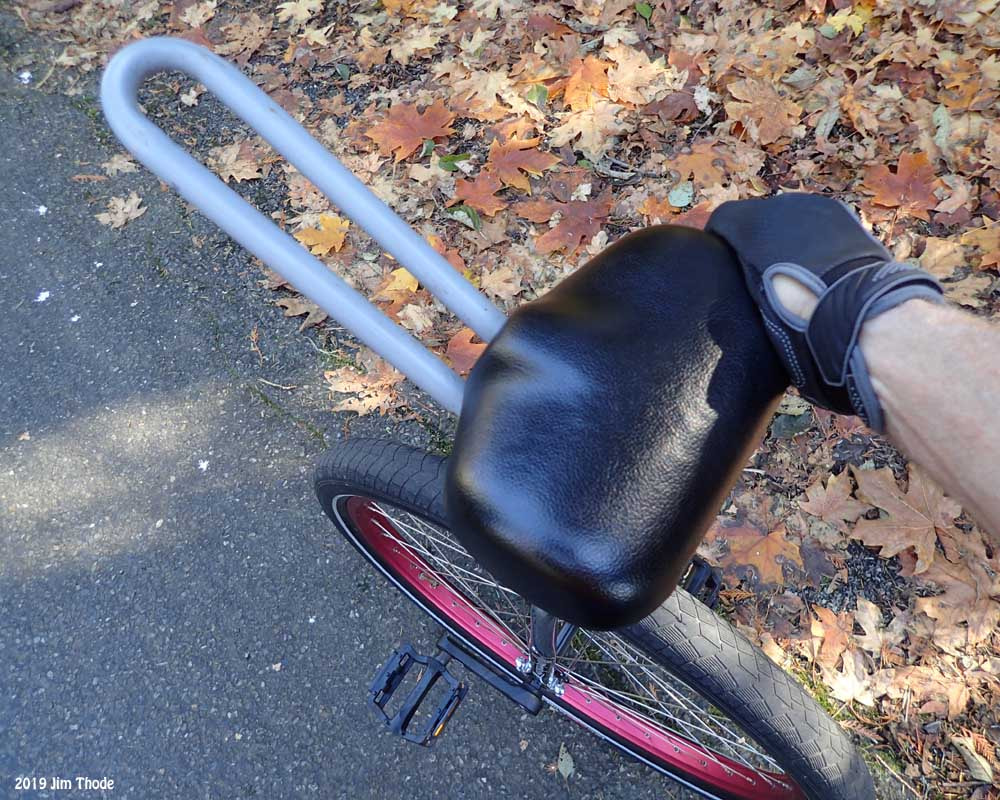
I have tried a noseless saddle on my uni that works fine on my bike but because my pedals are directly below the saddle I can not ride without lowering the saddle too much or quite a bit of force pushing back from a handlebar. Full recumbent unicycles have been made but are vary hard to mount and ride. Maybe just moving the pedals on a uni forward a little, similar to a bike would help to eliminate the long distance/time in the saddle problem of a unicycle.

This uni is very easy on the butt however it puts more pressure on the legs or arms to stay on the noseless saddle.

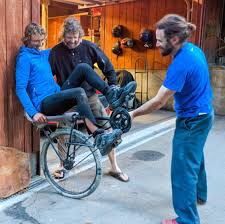
This is a recumbent uni but is very hard to mount and turn to maintain left-right balance.

2 Likes

Isn’t it better to go for a V frame or even a tilted saddle to resolve this issue rather than introducing all the complexity needed to move the pedals away from the Hub? Lots of ppl on the forum have experience with the V frames, and could share their experiences on this matter.

No matter what the configuration of the frame is you still end up with the center of the riders weight directly over the center of the wheel. Tilting the saddle back may help some but you still have the nose of the saddle to deal with. With the crank/pedals forward of the riders weight as a bike, a noseless saddle would work on a uni as it does on a bike.

Doesn’t a V frame effectively move the seat behind the Center of mass, like you want it to be?

I expect the result to be that each pedal stroke pushes you a bit back into the saddle, unless you just sit upright in the saddle, which would be the situation of merely tilting the seat, as you discussed.

A flaw with the recumbent design in the picture, and also with offsetting the pedal position enough forward with the Huni-rex would be to expose the chains and cogs to a UPD-related impact. This is not the part I would want hitting the ground first.

Offsetting the crank axle from the wheel axle in horizontal direction would introduce an additional momentum, messing with your balancing. The V-frame seems like the way to go for a more bike-ish posture.

1 Like

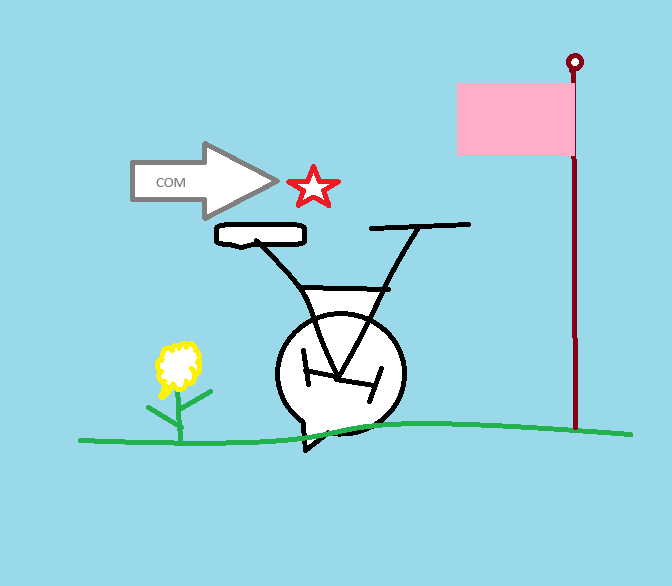
doesn’t the balance with your example push the seat against your crutch more, while you are hunched forward. What’s with the flag?

Also doesn’t a uni with handle bars do the same, so you don’t necessarily need a V-frame. I do feel a difference when transitioning to the handlebars and then back to sit straight up again.

I think you can see the problem, making unicycle like a bike is not straight forward.

You always need to consider where the centre of mass is and on many concept V frame designs this is not considered. The centre of mass needs to be above or even slightly in front of the contact point of the wheel.

The best solutions for V frame designs produce a rigid structure for body to rest on, it does not change the riding position as much as people expect it would.

2 Likes

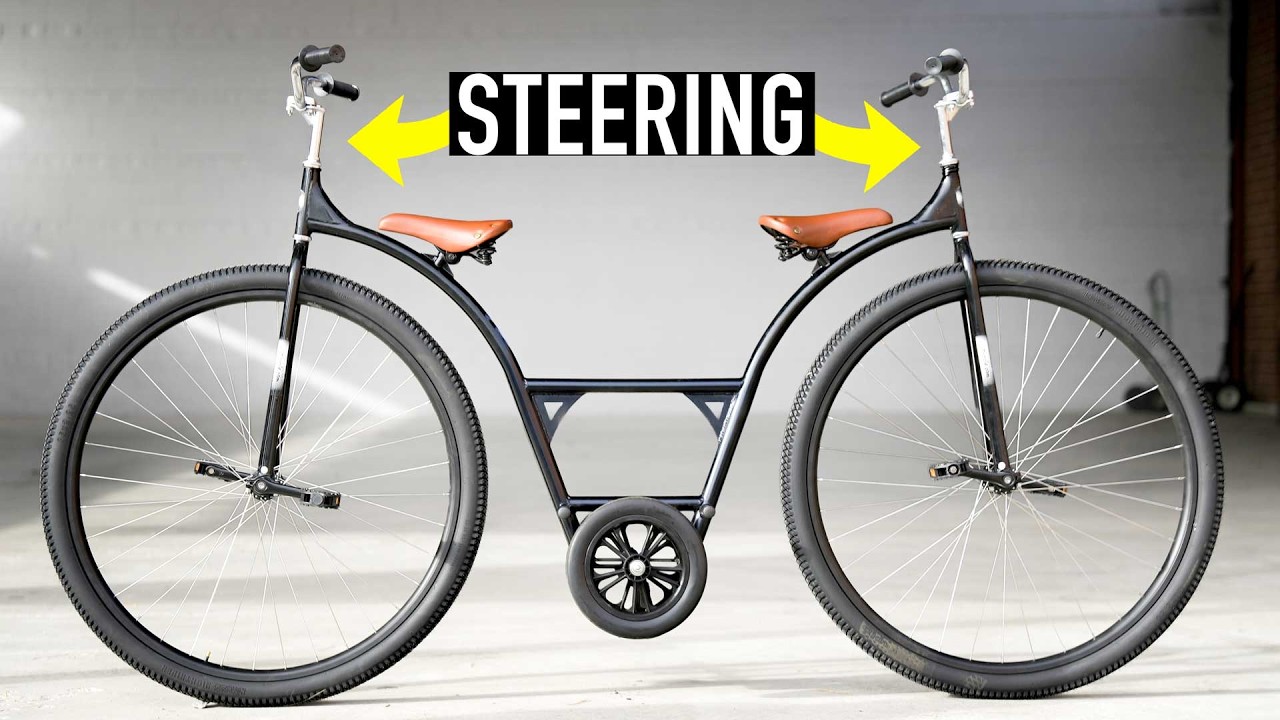
The video linked by PedalSprell on an other thread has an interesting historical clip of a Penny Farthing with a treadle arrangement (at about 25 - 30 seconds in; it isn’t really related to the back-to-back penny in the video), I had not seen something like this before. It looks like this setup is to allow the rider to ride a bigger wheel and also to make the bike more stable. It immediately made me think of this thread.

My guess is that there are good reasons for that. I think I have been standing on some similar mechanism, and I guess it feels like treading on Pistons, not giving a smooth sensation, and you have to apply the force at the correct angle/moment or you mess things up.

The main reason for this seems to be the leg reach due to the saddle being so far back. And as pointed out this would mess with your balance on a uni (and if I am correct, make riding one horrendous).

Hello all.

A few questions:

Where can I buy a 40 inches wheel? (external tire diameter 1016mm). What I really need is the rim (a custom hub will be made; with the new hub the spokes from a 29 inches wheel will be used).

Where can I buy a tire for the 40 inches wheel?

Also: are there geared unicycles having three ratios? (one direct, one substantially shorter than direct and one substantially longer than direct).

.

A 40 inches wheel is good for the P@Uni because with the saddle almost touching the tire (say, 1" clearance), the pedals and the saddle will be as low as in my conventional 20" unicycle.

.

Why 3 gear ratios?

With a 40 inches wheel and direct drive, even light uphills will be exhausting. Having a short transmission ratio, say 26/40, the big wheel unicycle will be as good for uphills as the 26’’ unicycles. With one more ratio (say 60/40) the unicycle will be capable for high speeds, too. Most of the time the unicycle will run on direct drive (1:1); at lower speeds, rough terrains and uphills the low transmission ratio will be used; for higher speeds (say above 20 Km/h) the long ratio will make rider’s life easier and comfort.

Thanks

Manolis Pattakos

You are able to find unis with bigger wheels than 36, and rims for penny farthings in different sizes can be found on unicycle.com etc. These might be designed for solid rubber tires, however.

Since you are an unafraid inventor, I would suggest checking out this thread where @Ulkicycling reshaped and spliced two smaller rims into a bigger one:

Well, some issues with the actual number of spoke holes might arise, when I think about it. I am unsure if that was addressed in the post.

Oh, and people have been splicing tires as well to custom sizes. You can also cut down and rethread longer spokes, getting basically any wheel size you like from 54" and below with easily available parts.

There exists custom complexe unicycles like the Red Menace (search the forum) with a full range of gears. Also, there might be rumors about compact Planetary Schlumpf like hubs with 3 gears.

On a side note: You can simply highlight text from an earlier post, and you will get the option to quote it like I did in this post. That will also notify the one you are quoting, and link back to the quoted post.

I want one for the family. I couldn’t help but laugh out loud with the vid. Could be cool to do on the road

Thanks PedalSprell. Quite useful info.

Manolis Pattakos

1 Like

If you are in the UK, this has been on sale for a while, it as a 42" wheel in a Nightfox frame and could be a starting point for your project. It is collection only though.

https://www.ebay.co.uk/itm/177314886671

Hello DrD.

I am in Greece, not in the UK.

Instead of starting with an existing bigger rim, or with two smaller rims, I prefer to buy an aluminum U-profile bar (or PI-profile), curve it, weld its two ends and drill 36 holes for the spokes.

The other way is expensive and needs to drill holes for the spokes because the existing holes cannot be at the right angles.

Thanks

Manolis Pattakos

1 Like