@Setonix
“Doesn’t that make the unicycle wider?”
Just a little.
Above is a photo of a 20” Unicycle (Terra Bike) that shows the large clearance between each crank and the fork. This empty space can host the gears. What is left is the arm.
“What about the force when keeping the unicycle stead with heavy wind or municycling.”
I can’t see a problem. A 20” unicycle has its pedals at the same height with a 36er P@Uni. And the 20” are OK with heavy wind. The big diameter wheel of the 36er improves the rolling at rough terrains.
“you’re introducing multiple friction points, that need to be quite solid, so they don’t break or unscrew.”
The forces are heavy only between the arms and the cranks, which keep unchanged the number of heavily loaded bearings (case with pedals secured to their arms). The rest forces are dozens of times weaker leaving the “synchronizing” bearings / gearing actually unloaded.
“Does it improve balance having the rotation point away from the middle?”
The riders of Huni-Rex unicycle (center of rotation of pedals substantially lower than wheel center) can reply to this question. Are there any?
“On a conventional uni, you just put your seat higher or lower.”
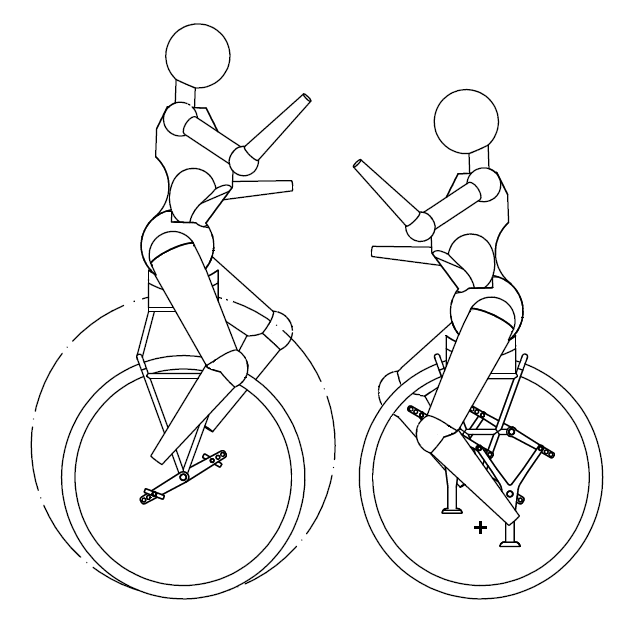
On the P@Uni unicycle you can do the same, however you have also the option to lower the height of the pedals instead of lifting the saddle (case of tall rider). So while in the conventional unicycles the taller the rider, the higher the saddle / seat and so the higher the center of gravity of the rider, with the P@Uni you can, if you like, maintain the center of gravity of the rider low despite rider’s height.
Reasonably without a post the frame becomes simpler, cheaper, more lightweight and less flexible (having a saddle at the top of a long post is not the best for overall rigidity). It is also that the unicycle becomes more compact to transport / carry (with the saddle almost touching the wheel, and acting as a fender too, the maximum dimension is only a couple of inches larger than the wheel diameter).
Falling from a tall horse is way more risky than falling from a pony. Mounting on a tall horse is more difficult than mounting on a pony. But the tall horse runs faster and passes easily over rough terrains. The idea is to combine the best of the two (big wheel for improved rolling and higher speeds (geared or not), with low saddle and pedals for easy mounting – dismounting and less risky falls).
@PedalSprell
“Why would you want the pedal position to be low? To make it less intimidating to ride? Stability?
For improved safety. Also for easy of use (mounting – dismounting). Also for enabling not tall riders to safely ride 36er (or 40er etc) big wheel unicycles and enjoy the advantages of the big wheel rolling quality and speed.
“The Huni Rex has similarity lower position, and the result is increased chances of pedal strike on sharp turns, and also lower reaction time when UPDing.”.
The pedals of the P@Uni are adjustable in height. If they are too low, you simply lift them.
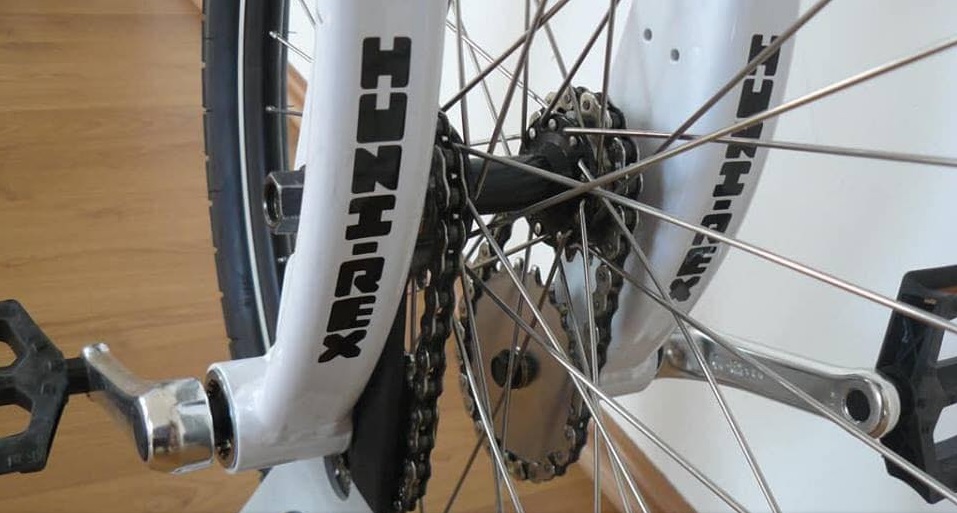
Above is a photo of the kinematic mechanism of the Huni Rex unicycle. The solution works but the crankshaft (i.e. the strongest part of a unicycle) is divided (=sacrificed) and each half is independently supported on its own half of the fork which needs to be substantially stronger / rigid / heavy to take the resulting bending loads. The unicycle becomes a lot wider. The power from the pedals passes from gearwheels and chains (backlash) to finally arrive to the wheel. The load on the outer central bearing of each crank doubles, and there is another central bearing (the inner one) to milk power. Compare the case with a geared P@Uni 36er.
And on the topic of UPD, how will the frame and machinery hold up with the forces from the seat slamming the ground at high speeds?
I can’t see the problem. As the conventional unicycles do, I would say.
Thanks
Manolis Pattakos.
 What an interesting concept! I don’t really have much I can contribute with technically here, but I curious about a few things. Why would you want the pedal position to be low? To make it less intimidating to ride? Stability? The Huni Rex has similarity lower position, and the result is increased chances of pedal strike on sharp turns, and also lower reaction time when UPDing.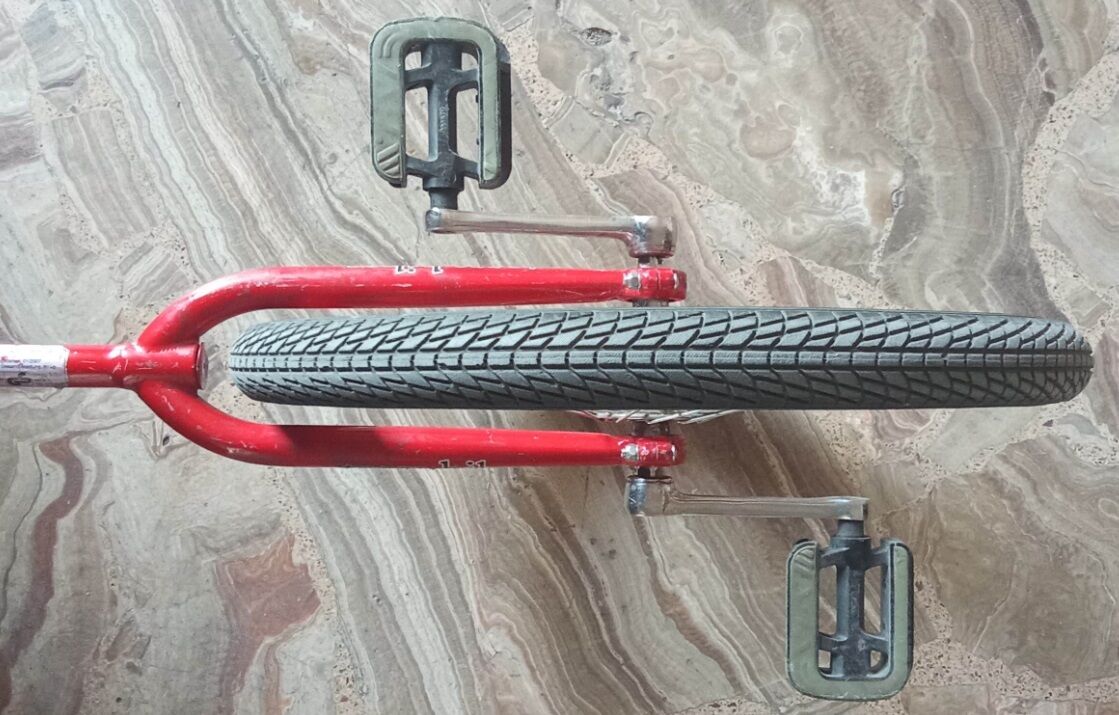
 .
. ) In many ways the pointlessness of it is also worthwhile for me as an escape from real-world engineering challenges I actually get paid to solve! Overall though, the level of complexity obviates any tangible benefit, but that said, in the grand scheme of things a unicycle is not the most practical method of transport, so that maybe doesn’t matter (hopefully this statement doesn’t get me kicked off of here
  ).
). . I’ve never looked at (or been qualified to look at) the internals of the Schlumpf hub, but that might be a way to put more gear ratios in there?