I need your expertise on the history of Nimbus unicycles. Can you identify what kind of bike this is? What year was it made, what are its technical features, and what are its predecessors or successors? Some components are from Nimbus, such as the hub and the seat clamp, while others, like the seat and the crank, are from Kris Holm.
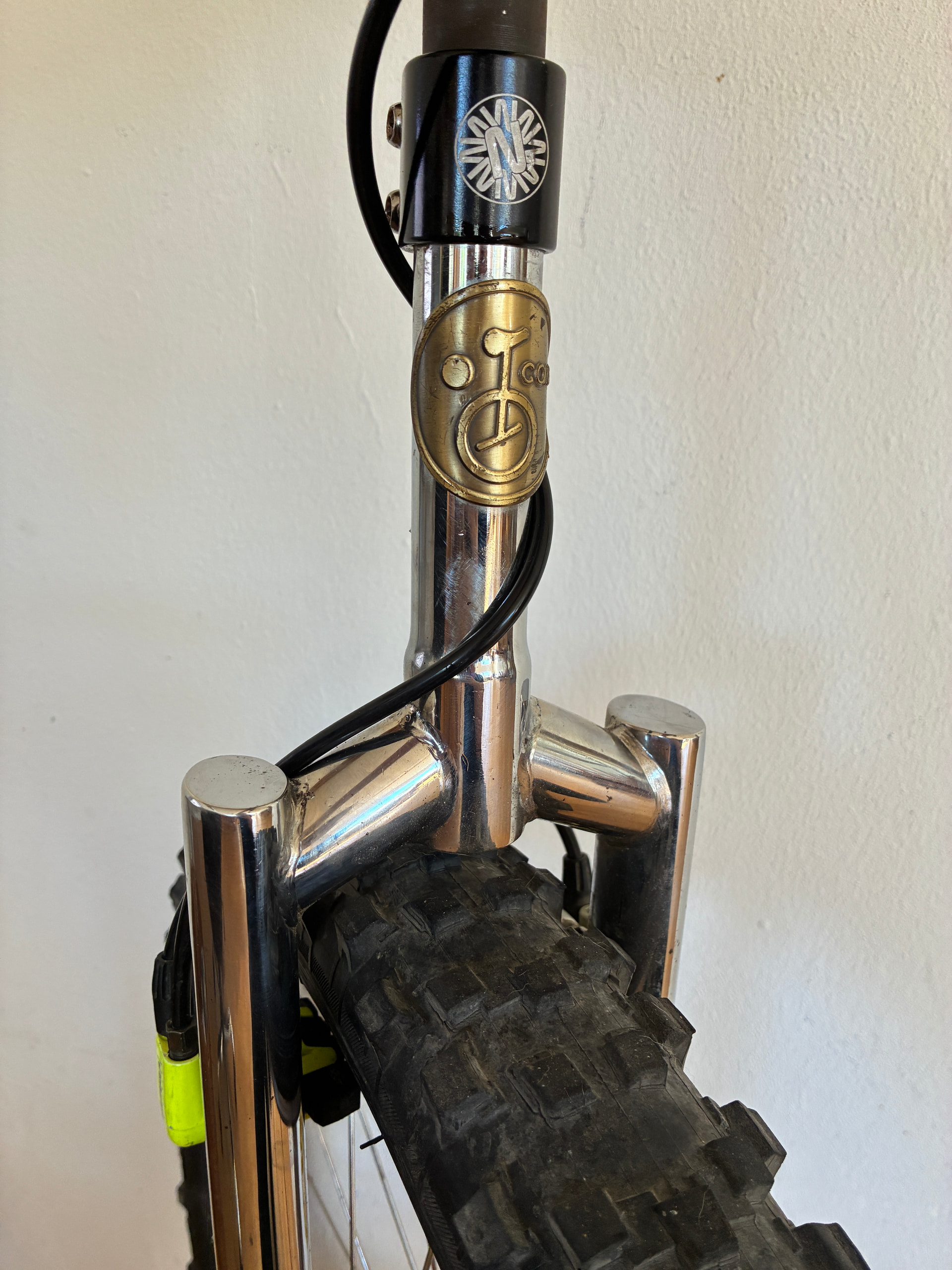
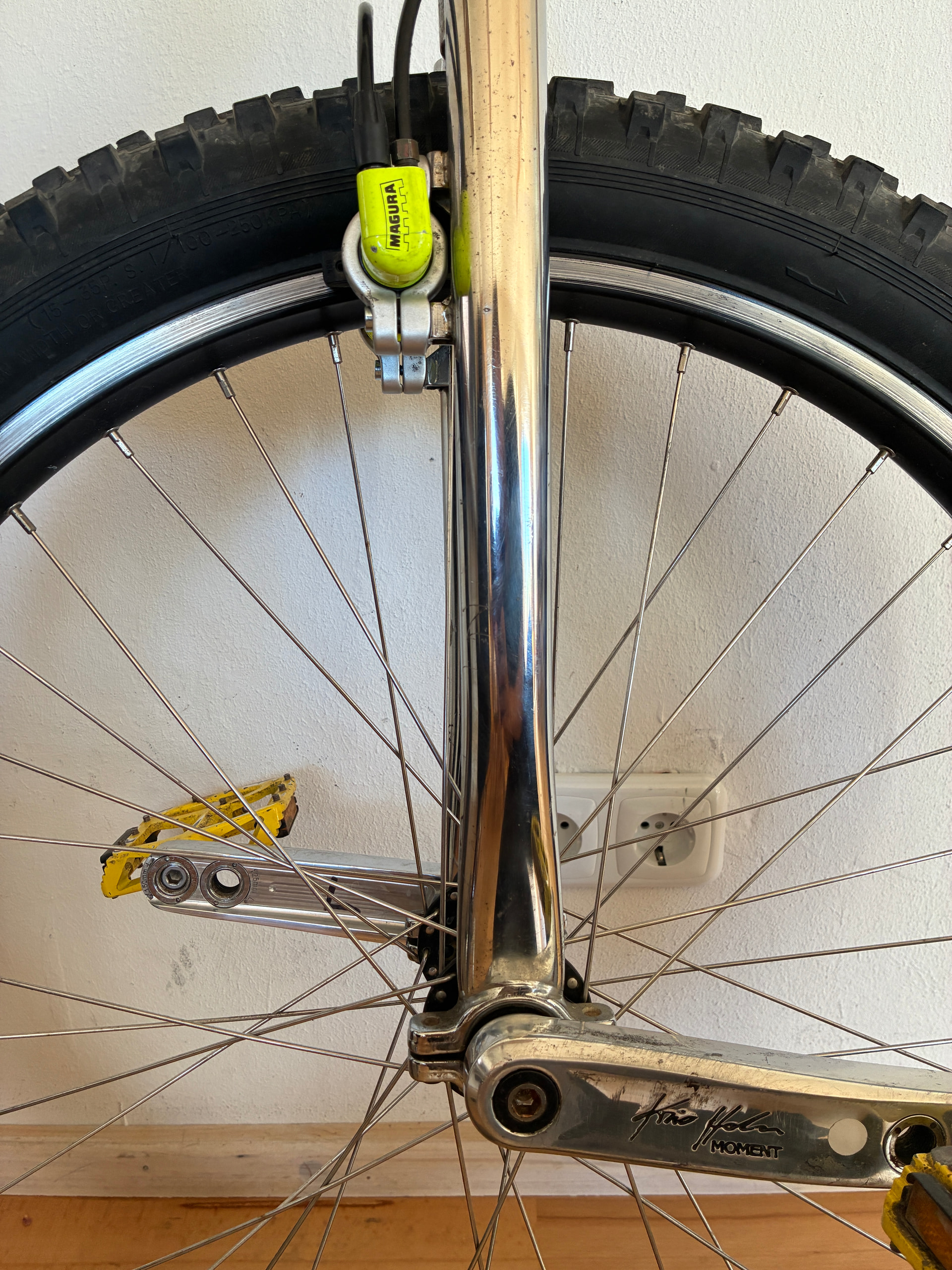
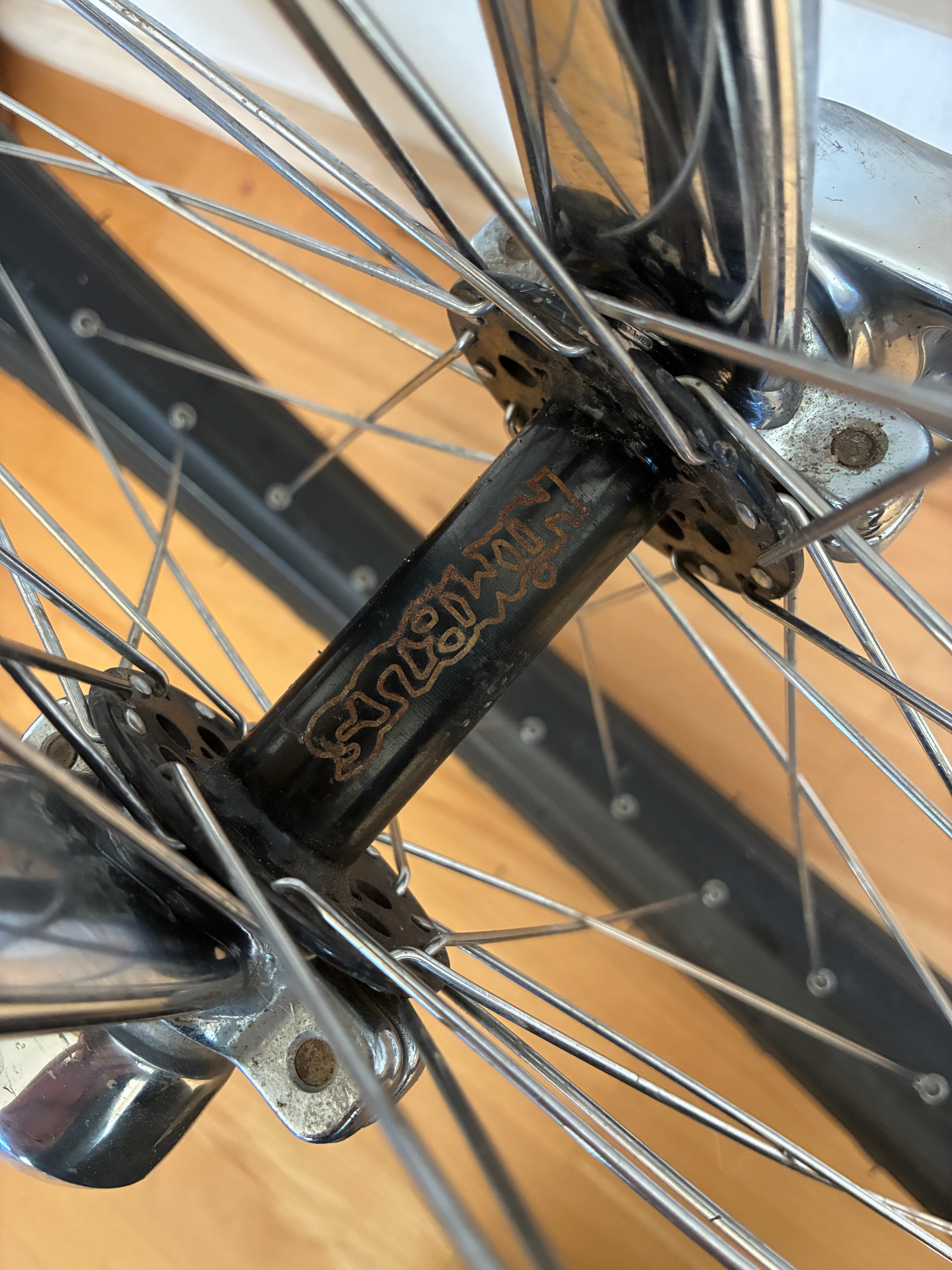
It looks like a standard Nimbus muni (Nimbus II?) with a some upgraded parts, probably 12+ years old. It’s a solid steel framed muni but is going to be quite heavy. You can still buy newer versions but alas not with a chrome finish - BRING CHROME BACK.
Moment cranks are probably still the strongest cranks made for unicycles. This would have been a solid upgrade choice for the Venture cranks fitted. Downside is they are heavy. They were replaced by Sprits (still on ISIS but lighter and not quite as strong) then Boundary (different hub interface). Fortunately not coupled with a Moment hub as these weren’t as good (creaking).
KH saddles at the time were a definite comfort upgrade to the Velo based Nimbus saddle that would have been fitted. Seatpost clamp has also been replaced at some point (original would have had the same lettering as the hub).
The Magura rim brake is again a solid upgrade for someone wanting to Muni hard, just not as smooth as the disc brakes that came in with the Spirit Cranks. Given both Spirits and the D-Brake adaptor are now out of production, a disc brake upgrade would not be worthwhile.
Effectively it’s been replaced by the Nimbus Oracle line. If it’s in good repair, a very solid unicycle, just a bit on the heavy side.
2 Likes
Hello,
many thanks for the explanation. I weighed the bike and the scale reads 7.5 kg. This weight includes the brake and a Duro Wildlife Leopard tire, which weighs 1,680 grams. Thanks also for the link to the Nimbus II. It’s listed at 5.8 kg without the brake. The Hatchet on the site, with a 1625-gram Maxxis Minion FBR 26 x 4.80 tire, comes in at 7.8 kg. I’m just trying to figure out what’s heavy and what’s light. I have very little experience with unicycles, and I was able to get the old Nimbus secondhand. On my first few rides, I was very pleasantly surprised compared to my beginner 20" unicycle. Now, of course, the question arises as to how to evaluate this experience and whether there is a significant improvement with a more modern unicycle, or rather, where the development has gone.
regards Chris
I’d recommend you save money and just enjoy it. The best unicycle is the one you have, not the one you want!
Heavy vs light - This is something where it depends. You can spec a unicycle under 5kg or over 8kg depending on wheel size, handlebars etc. The rotating weight (hub out) is broadly going to be the same as a newer unicycle with that tyre but the static weight (frame up) is heavier. Rotating weight is far more important with static only coming into play when hopping, climbing or carrying. You can always try a lighter tyre if the routes you ride allow.
Modern Improvements - Unicycle development is rather slow and incremental. Excluding braking, you aren’t leaving massive improvement on the table. The principal use for brakes is saving your legs by drag braking down hills. The Maguras are still able to do that but not as smoothly as discs. If you’re not planning on riding up and down big hills constantly, there’s nothing wrong with what you have.
One thing i would potentially reccomend is changing the saddle if the KH one on there doesn’t work for you. The current Nimbus/Impact saddles (Stadium/Freestyle/Air/Naomi) have less curve and will work with your seatpost.
Thanks for your support. I understand the physics of rotating masses just as well as you do. I can’t judge the difference in how they ride, which is why I asked. If I’d known how much more interesting a 26" Muni is to ride compared to a 20" beginner’s bike, I’m sure I would have gone with the Muni sooner. Whether that’s due to off-road riding, the wheel size, or the bike’s stability—that, in turn, is hard for me to assess.
I wanted to find out what condition the bike is in and what options for improvement are still available. That’s why I asked that perhaps unfortunate opening question.
1 Like
This may be the area I most often recommend to change on older unicycles, but alas there’s no picture so I cannot advise!
You’ll see people still riding such unicycles at a pretty high level, although most of us are tempted by new shiny shiny far more often than we should be.
It’s looks like a great unicycle, and KH Moment cranks are still very popular and in demand on the second hand market.
Hello,
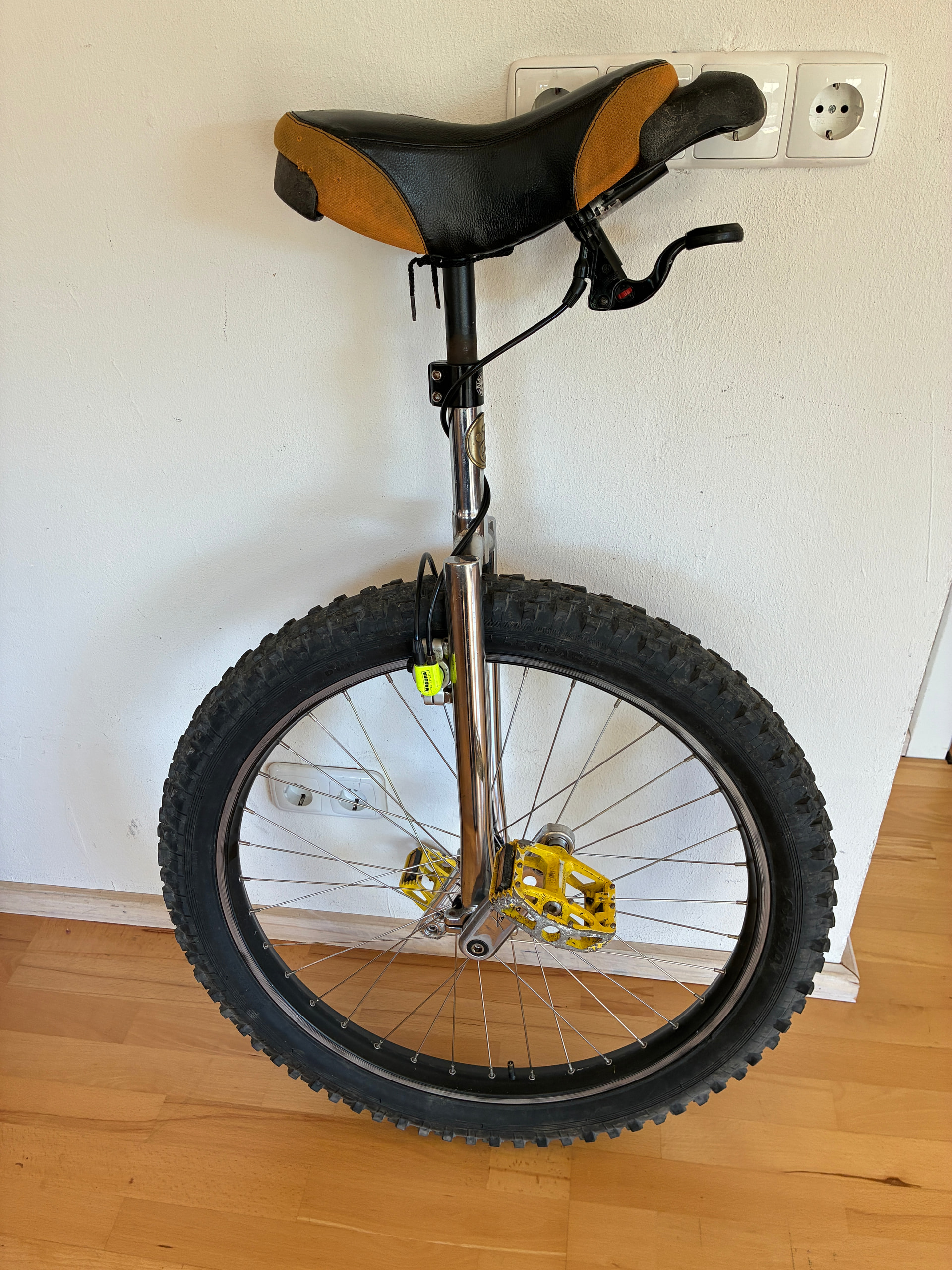
Thanks for pointing that out. You’re right—without seeing the whole bike, it’s hard to tell where the weak spots are. I’m attaching a photo showing the saddle.
I come from a downhill background and have experimented a lot with disc brakes. One of my road e-bikes has the HS33. Of all my bikes, I find the rim brake the easiest to maintain. It always works and, thanks to its low-pressure system, hardly ever needs to be bled.
For me, that was the reason I liked the brake on a unicycle. Given my riding skills, which are mostly limited to flat singletrack and forest trails, I haven’t found the braking control lacking so far. However, I’m now curious to try out a disc brake on a unicycle.
How practical is the saddle?
regards Chris
Modern hydraulic disk brake systems don’t tend to be particularly problematic to maintain.
The basic Shimano models are very popular on unicycles as they’re generally perfectly sufficient for most people’s riding, and if they do need bleeding it’s nice that it’s just mineral oil. The main advantage of disk brakes is their modularity but also absolute stopping power that varies very little no matter the conditions or how true your wheel is.
In wet mud HS33s can get a bit weak, but generally not problematically so unless you’re riding fast, at quite a high level. You’ll quickly be able to decide for yourself whether that’s a problem for you or not. Changing to a disk practically in your case would mean a whole different unicycle.
I’d call that saddle moderately OK. Some people love them, but many have moved to less cushy models that are perhaps a little thinner. If you’re getting chafing at the top of your inner thigh then that might be a sign to try something else.
Modern saddles also tend to be a little flatter, which also can be a bit more comfortable for some.
I have no experience riding a unicycle, but on my downhill bikes, the disc brake’s high-pressure systems require attention. It’s not uncommon for dirt on the brake rotor to cause squeaking. If you use organic pads, they wear out too quickly; if you use sintered pads, they always require a break-in period, and the brakes need to be bled more often than my HS33s do. The tendency for the pads to grind against the rotor is significantly greater due to the small clearance between the brake pads and the rotor. An HS 33 has roughly twice the clearance of a high-pressure disc brake. Leaks in the pistons or even cracks in the pistons are not uncommon due to the heat, which is why I only use ceramic pistons on my disc brakes. Even replacing a brake caliper or brake lever on the HS33 is possible without having to bleed the brakes again. With my disc brakes, that’s simply impossible. However, due to the performance requirements, I don’t have rim brakes on a downhill bike either, but rather 4-piston systems on 205mm discs. These experiences, gained exclusively on two-wheelers, ultimately led me to look for a unicycle with rim brakes, since I don’t plan to tackle 1200 meters of elevation gain downhill in a single ride on a unicycle. My rides so far on local fields and forest trails with the old Nimbus unicycle have, as expected, placed relatively low demands on the rim brakes, and so I suspect that my skills need to improve first before I require a different level of braking performance.
For your info, a bike has two wheels, the word is an abbreviation of bicycle. Calling a unicycle a “bike” is considered a no-go. Even the word is sometimes frowned upon, as if it were a curse word, and therefore often spelled b*ke, if it is necessary to talk about that thing at all.
4 Likes
For a non-english native User there might not be much difference between the words for unicycle and bike. Like the Scandinavian languages, where the term “bike” (sykkel) is valid for both cases. I also thought it was funny to read the term bike, but am willing to give it a lot of slack. Its not like anyone can misinterpreat the meaning here
Also, I just Love bikes. I absolutely frown upon that taboo. I also love my unis, but that is a more fluctuating and complicated love. I can’t live without my bike. I can’t say the same about my growing collecting of unis. Bikes are just so wonderful. A uni, however, is more beautiful.
Also, I have posted several posts about my actual bike on this forum and I am hardly ashamed 
1 Like
Here I would argue that sykkel / cykel is the same word as the english “cycle”, whether it be a bi-cycle or uni- or tri-, doesn’t matter. Norwegian and English as related as being Germanic languages.
Personally I hardly ever use my bikes, they feel a bit like cheating when I should be taking the uni, but now we bought a slightly bigger bike for my 5-yr-old son, I am now the slowest when riding together and always linger far behind. When he gets older, I am hoping we can ride mountain-bike together in the forest. I don’t push my kids to learn to ride unicycle. My daughter decided it is too difficult and doesn’t want to spend the time needed to learn. It is what it is.
Maybe that is why I enjoy riding bikes so much! I can just float effortlessly around, and cruise at my leisure. With unicycling being the reference 
However, unicycling kinda feels more natural somehow, I love the upright position and nailing the balance point. It’s like a part of my body. I would never make such claim regarding a bike.
1 Like
Maybe I should try that again and see if it feels the same for me. I should have a bunch of those two-wheeled vehicles somewhere.
1 Like
Actually it is not just with bikes that I feel I should be using the time to ride unicycle. I also have inline skates, free skates and a longboard, but in the rare times I have some time to myself, I’d rather just ride unicycle than anything else. I just wish I could use the electric unicycle more, but they are not allowed on the roads in NL and if the police see you, they can decide to take away the machine on top of giving a ticket.