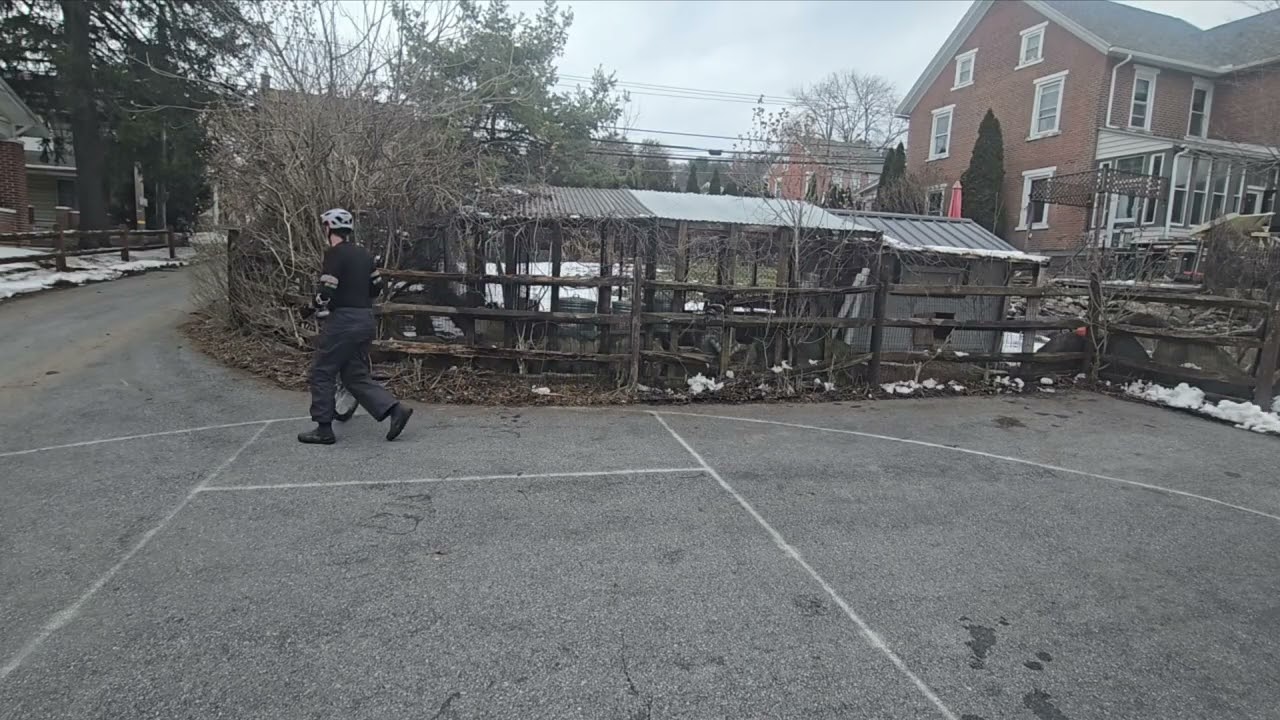
Ive been taking weekly videos of my “progress” here is this weeks. slamdance suggested lowering my seat and that seemed to really help. I can get 2 or 3 pedals without touching the fence and i get a few more every session. This week I really am starting to feel like im on the cusp of riding off in to the open but Im super frustrated I just cant. My brain panics immediately without support.
Looks like you’re making some good progress IMO This stage of learning is a bit of a grind, but I do feel like you aren’t too far away from a breakthrough!
There’s one pattern I’m seeing from the video: your dismounts consistently happen when your right foot (I assume it’s your dominant foot) is in the 6 o’clock position. It looks like at that point, your leg is applying pressure to the pedal and stopping the wheel as the crank continues its motion, causing the unplanned dismounts.
While you’re following the fence your pedal strokes actually look fairly smooth, so it’s probably an unconscious tensing of the leg at that 6 o’clock position. Attempting your first unassisted rides can be pretty scary, so that tensing is 100% expected I’d say focus on keeping the pedal unweighted at the 6 o’clock position and allow the pedal stroke to continue. I struggled with it too while I was learning. The act of pedaling a unicycle is a pretty delicate motion, so you’ll probably find more success when you ride relaxed.
Looks to me like you’re off to a great start! I’m no expert, but in my non-professional opinion, I think that at this point using the fence as a crutch is not helping your progress. You’ve got the basics down and you’ve proven to yourself that falling off is no big deal - you land on your feet every time like it’s a non-event. That will stay the same with our without the fence. Stay calm and push away from the fence - there’s no reason for you to panic, though it may be easier said than done. I have confidence you can overcome your fear and move on to the next phase of your learning process: riding away from the fence. Believe in your abilities, have confidence, and go for it! And please keep us posted on your progress.
Thanks. Im definitely aware of that pattern and when I release it get that right pedal and then step off with my left before getting that pedal most of the time. I didnt do it in this video but I have started consciously dismounting when my left foot is at 6 o clock for a few minutes when I practice to try and wire that in as safe. I feel close and I think thats the most frustrating part. Im too cautious to just send it and that would probably help but I’ll just keep at it.
Looks like great progress! Maybe try putting more weight in the seat before you leave the railing - it’ll help you later, and force the balance now. It looks to me like you’re off center before you let go, just compensating with occasional taps on the rail with your hand.
Or maybe start pushing off of the railing immediately. Just use it to mount. I agree that it doesn’t look like it’s doing you any favors, you’ve outgrown it!
Nice. For a beginner your posture looks really good.
One tip I always give: push your hips forward and keep your shoulders back (most beginners are hunched over which you are not).
Nevertheless, I would try and consciously push/rotate the hips forward more and then lean back a bit more. The straighter everything (seatpost, saddle, back, upper body), the easier it is to stay in balance.
The rest should come from developing muscle strength and muscle memory from repeated practice days.
I think you’ll be riding away from the fence soon.
Looks good to me so far. Do you have somebody, that could assist you? When i train kids and adults, i often give them a hand when leaving the wall for a light support. Even the knowledge, that you can hold on this hand in case you loose balance can help to overcome this point where you just step off. Later, the hand can be replaced with a rope that can be grabbed longer each time until it hangs lose. The longer you focus on that fence, the more your brain will need it.
Normally, in our club i let them first practice on the wall bars, but not too long. It’s often better to get away from the wall earlier than later. Then, i hold them one hand under the upper arm, one on the hand of that same arm. As riding stabilizes, I let go the upper arm and only support there if necessary. When the can ride with only holding one hand, I give them a jump rope to hold onto. First, I grab it as short as possible and the constantly increase it’s length until it hangs loose, always prepared to grab it short again with my other hand.With this method, progress seems to be faster than with the wall only. Practicing too lang on the wall / fence sometimes leads to weird habits in balance as on always tries to reach the wall, even if unnecessary at the moment.
Fun fact: we once had a girl who could ride very well. But when learning to ride the 6ft giraffe with the method described above, she immediately fell off when letting the rope go, despite she could already ride as far as she wanted with the rope hanging in an absolutely loose bow between us. This went to a point where even i could let the rope go without her dismounting, but she still had to hold it.
That might be silly, but when I learned (I was fairly younger tho) it helped me reminding myself that while I’m on a difficult balancing thing, I’m still 20 centimeters only above the ground. That doesn’t mean you can hurt yourself of course, but it puts things in perspective.
I concur 100% with what Eric_aus_Chemnitz wrote, especially regarding the use of a jump rope or similar.
Additionally, if there’s noone to assist you, there’s another tool that could potentially help: a rope, but not the thin jump rope style, no, a thick and heavy one. That could partially fulfill the job of a person assisting you in that it gives a certain amount of stabilisation without being as rigid as a fence. Thus, while you’re still forced to keep the balance on your own, you have that bit of additional support thanks to the weight pulling your arm down, thereby giving your arm “more leverage” when doing quick motions in order to keep the balance. This can help in getting you through difficult situations. Of course you’d have to ride in circles around the place where the rest of the rope lies on the ground.
If you don’t have such a rope (or something equivalent - maybe a chain could do the trick, but there’s a bigger risk of injuring yourself, with a chain!) I’d advise you to change the location where you practise. Find one or more different place(s). This should in my opinion help to break the routine of dismounting at the same spots; not because you had to dismount, but only because you got accustomed/trained to do this.
That looks good. I imagine you are already getting to the end of the fence and beyond. I do see the ‘resting hand’ is leading you rather than being beside you. wearing gloves helps the hand ‘glide’ over the support structure.(For other beginners)
You should plan on leaving them soon. I made that mistake and ended up learning to ride with poles. The second I would let them go, my body would dismount automatically. Somehow my brain had learned that they had to be part of the equation. Your mileage may vary, but it’s been experienced by many.
I left the wall a month ago. It’s rocky at first. You’ll feel like you are freemounting only to awkwardly stumble off 1.5 seconds later. Soon, you’ll get a few revs, then after that you’ll get dozens of revs.
What worked for me was to find someplace really flat like a tennis court. Once you get to where that works out, try a bumpy parking lot or something. Don’t give up, you’ll get better if you keep up with it. If you get frustrated, take a break, come back tomorrow. The key is consistency. Keep at it every day if possible, or even every couple of days.
I also used a wood fence to start with, but I didn’t have to worry about posts. Gloves solved the splinter problem. How about trying a different area, without posts, such as a tennis court? Rather than periodically grabbing the fence, feather your hand so that your ride is continuous rather than choppy.
From what I saw, you are always coming off ahead of the uni, always too far forward. Practice coming off the uni different ways (behind, left side, right side). Once you do learn to ride, you will have all kinds of dismounts and practice will help you learn to dismount safely. Also, alongside the fence, practice rocking backward and forward (1/2 revolution each way). Maybe, try to pedal backwards a revolution or two. This is to try and help with your body alignment.
I started with a fence. To start riding in to open air, I pushed off from a shed onto grass, a softer surface than concrete (however I didn’t fall until I was learning to free mount). I found I needed to build up speed (take off velocity) along the side of the shed before entering open air.
BTW, I started when I was 60. I have been riding for 7 years now. It helped greatly with back pain.
I think this is a good way to practise forward riding, once a rider has overcome the most basic struggles and has got a certain degree of knowing how the unicycle behaves:
Using a wall rather than a rail or fence,
riding along it, and when things seem right
gradually start to depart from it.
A wall offers less support than a fence or a rail, since you can’t really grab it, and it will only support you to either the right or the left side, but not to the other side and barely front and aft. Plus, if it’s a sleek wall (sometimes concrete walls can have a very smooth surface) you can continuously keep in contact with it, as opposed to intermittently grab some sort of support. Of course, a rail will allow this too, in that case it’s just important to make sure not to lean on it too heavily.
All of this helps the rider to get into a state of relative continuity and control before leaving the support, thus making for a smoother transition, which helps to stay balanced.
My first two paragraphs described the initial, assisted riding. The third paragraph, described the next step, what I described as “riding in to open air”. My apologies to anyone who thought I was promoting doing it all at once.
 This stage of learning is a bit of a grind, but I do feel like you aren’t too far away from a breakthrough!
 I’d say focus on keeping the pedal unweighted at the 6 o’clock position and allow the pedal stroke to continue. I struggled with it too while I was learning. The act of pedaling a unicycle is a pretty delicate motion, so you’ll probably find more success when you ride relaxed.