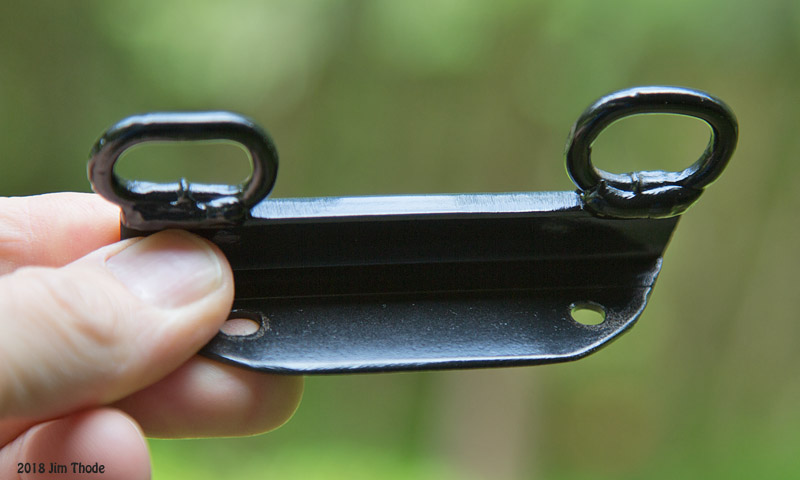
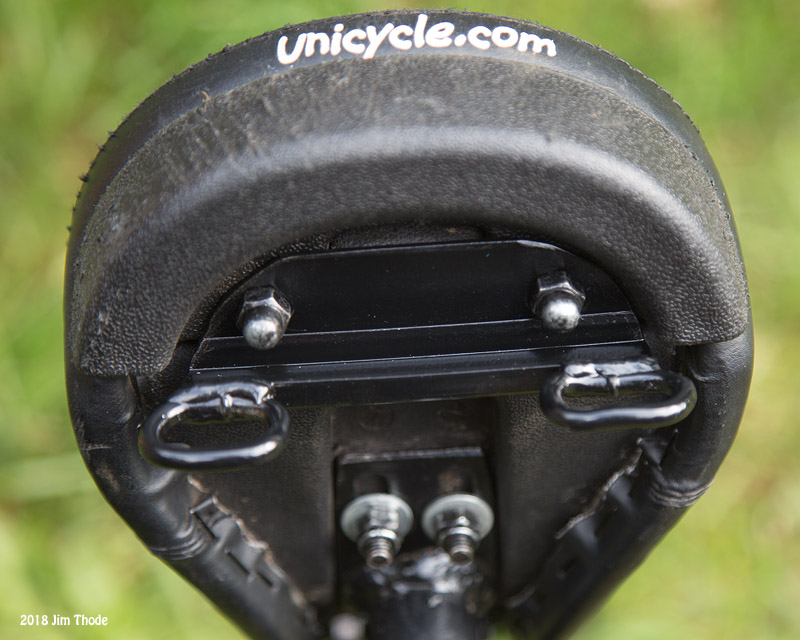
Here is the piece I added to the saddle.
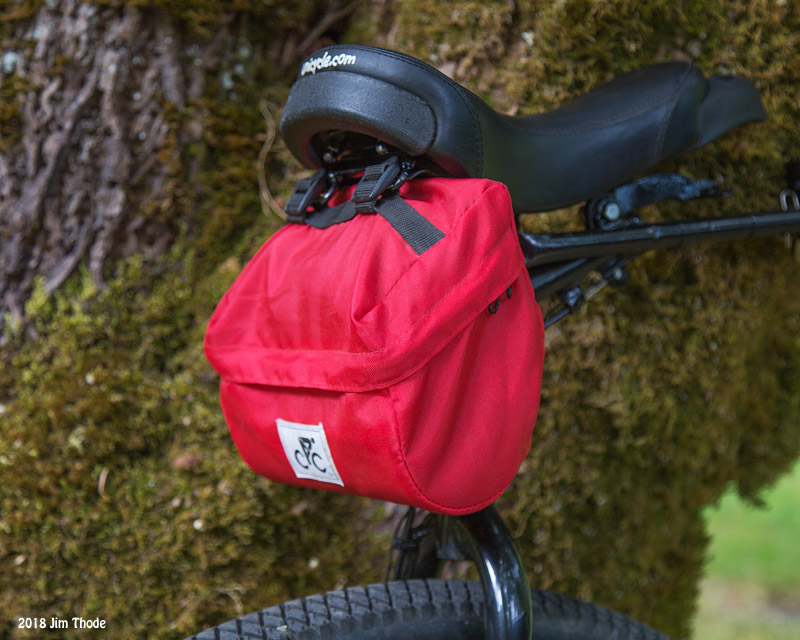
Does that get in the way of your legs? It looks like it’s out a bit.
I just have a small velcro affair that is pretty compact on my seat post.
No not in the least. Wider things on the back do not seem to be a problem. On the front may be a different thing.
2 Likes
Nice, I was wondering how you accomplished the rings. Did you weld that up yourself? It looks like maybe links from a chain welded to a steel L bracket. I like it.
1 Like
Yes, I welded on a couple chain links on a bracket I happened to have.
1 Like
Yes, it’s just basic cheap smart band. I bought it for call notifications and silent alarm to wake me up without waking my family.
For unicycling for me it basically adds only pulse and displays summary on its display during ride. For me even bare smartphone should be fine. With it I see increase of average speed and top speed from day to day. Actually I don’t pay attention to other factors like pulse.
How do I track my rides?
- Remember where I go.
- Map it out on Google Maps directions.
- Input the distance and time into a spreadsheet.
And that is the extent of the tracking I do 
2 Likes
I use Strava, have for most of my unicycle rides other little quick ones. It has good and bad points but so far nothing can replace it. Easy to use with phone app or via Garmin, and the unicycle groups are a really good way of seeing what others are doing around the world. I use one login for unicycle and another for bike rides (there aren’t many). This is not really necessary, but I wanted to ensure I didn’t put any bike rides in the unicycle groups. As many point out, there is no unicycle category in Strava (there must be more Nordic Skiers than unicyclists in the world). A unicycle category would be good to separate rides from bikes, but that’s all it would do. Strava does make a really good diary of what you have done and where you have been, adding pictures is a very nice touch. I’m a bit of a record keeping geek, and Strava does not provide good downloads. If you like to play with Chrome and json files, you can download all your rides to Excel (see How to Export Strava Workout Data - Scott Dawson). And it’s free, don’t need any of the paid functions.
First Strava ride recorded… the accuracy leaves a bit to be desired. I rode up and down the street a few times (about all I can do so far  ), at a slow noob pace. It thought I hit 15MPH max-- I wish! Maybe more like 6-7) and shows me all over the place. Was better than nothing though!
.3 mile ride, and I was spent afterwards, but hopefully I can see how far I’ve come later…
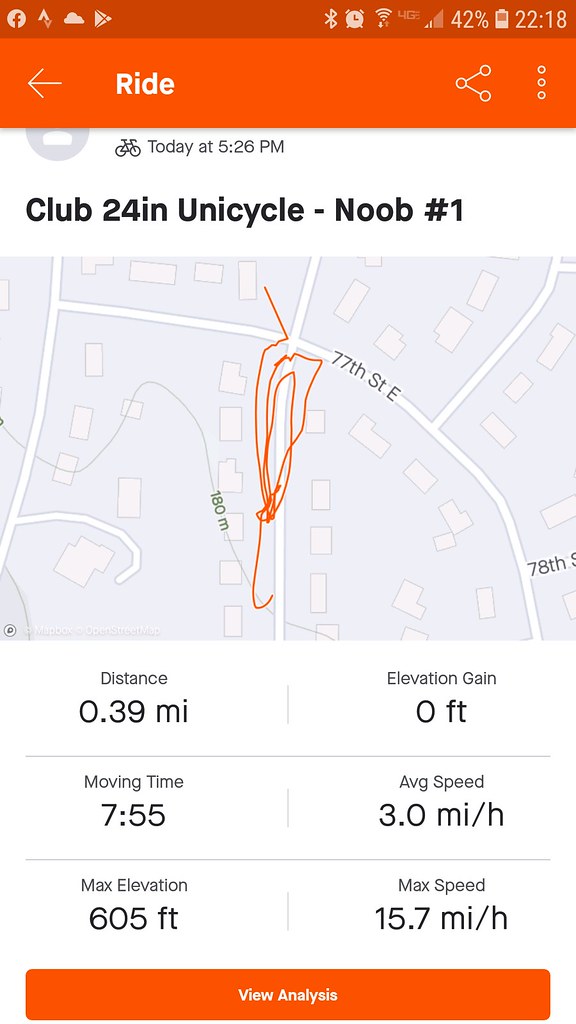
On short rides or when riding in a small area the GPS tracks doesn’t look so nice.
Soon you will be riding longer distances and the result will be much better.
Max speed is always way off because of GPS glitches.
The effect on average speed is limited, especially on longer rides.
GPS data is limited by your phone so don’t expect high resolution tracking. For that, use a bike GPS like Garmin, Wahoo etc. Strava, like any other ride recording app, just records what your phone tells it. Those ridiculous max speed readings are so obviously a GPS error and the speed is usually not recorded anywhere on the ride. For all it’s smarts, Strava still shows that erroneous figure, no idea why. Don’t bother asking Strava why, even if you are paying for their product. When I first bought my Garmin I used both it and the Strava app to record a few rides and the GPS is more accurate and more consistent by a long way. Doesn’t drain your phone’s battery either.
You might want to turning off your phones Wi-Fi when using it for positioning because this might be used for positioning as well. I am not sure when phones use it as fallback (I am sure it varies by OS and phone model) but on desktop it is the most common method, so it is quite possible that your mobile phone will use used it as a auxiliary (or fallback). Relatively position to cell towers might also come into play but I am not sure you can disable that separately without taking yourself off the network.
A good, pure GPS device that is designed for activities like sport will likely outperform a phone and certainly a cheap phone.
P.S. For the curious. On a PC location is (usually) worked out based on a scan of nearby Wi-Fi access points. All it takes is a scan of what is available and how strong the signal strength is. You do not need login credentials to any network to get your geolocation determined.
The list of Wi-Fi access points is then passed back to a location services provider who have built up lists of Wi-Fi access points and their physical location in the real world. Triangulation against these known locations is performed in combination with their relative signal strength to position you.
Whilst the results in cities are normally pretty good for a stationary machine (i.e. to pinpoint you on google maps), they can occasionally be widely off and can be less good for a moving target.
1 Like
Hello there, I’d like to revive this thread.
Currently, I use a combination of MiBand 3 with Samsung Galaxy S10, usually carried on my arm using a quad lock case for doing the tracking. I’m reasonably satisfied with this set up so far, as the S10 GPS seems to be reasonably precise.
Despite that, I’m considering buying some GPS watch to track my rides, as on the shorter ones I’m not really keen on bringing my phone with me. I like the Amazfit line (especially Amazfit T-Rex watch), as it is quite cheap and some of their models are renown for their battery capacity. However, I’m not sure about the quality of their GPS. The GPS precision and battery capacity are my two main criteria - I don’t care about other stuff, so I don’t need some high end, expensive smart watch.
Maybe if it would show the current speed, that could be nice also. I’m not really concerned about compatibility issues - the Zepp app seems to work well with Strava, aside from heart rate stuff and I’m not really keen on that anyway.
Does anyone have an experience with the Amazfit products for tracking purposes, especially in terms of their GPS accuracy? Or any other suggestions, aside from those very expensive Garmins?
Also, I find it interesting that when I measure the activity in the Zepp app (native app for Xiaomi products) and then upload the GPX file (either automatically or manually) to Strava, I get a bit different readouts. For example, on my last recorded ride, the differences were the following:
Workout time: Zepp - 19:38, Strava - 18:52 (perhaps some mounting attempts were discarded).
Distance: Zepp - 1.80 km, Strava - 1.81 km (on my previous trip that was 17 km long, the discrepancy was larger - Strava showing like 300 m more than Zepp)
Elevation gain: Zepp - 23 m, Strava - 26 m
Max speed: Zepp - 8.88 km/h, Strava - 10.4 km/h (this seems totally unrealistic).
I really wonder why this happens, if both apps get the same dataset - I guess it’s the difference between algorithms of each app in terms of processing the raw GPS data.
I used my phone before, got the forerunner 245 and never looked back.
1 Like
So how do you like to track your rides?The occasional photograph and happy memories.
Unless it’s a super long one and then I do like to have more of an idea of distance so I use a basic cycle computer.
1 Like

After a long ride, I sometimes sit in our community’s hot tub and reflect on the ride. I start by reflecting on the end of the ride, then I move incrementally backwards in time to the beginning of the ride. After a long ride, the reflection can take 20 minutes. It’s amazing the amount of detail I can recall using this method. What’s also interesting is how certain sections of a ride become lost to my memory. For example, I couldn’t remember crossing a certain street the other day. I knew I crossed it, because I could remember what happened before and after. I figure crossing the street was just too easy, there were no cars around, my mind was thinking of other things at the time…and therefore I couldn’t access the memory.
1 Like
That’s by far my favorite method. I regularly used local hot tubs on a bicycle tour through Iceland. (ok, I didn’t do the revisit of the whole day, just what popped up again).
At home I sadly have to use a GPS because I don’t have a community hot pot, and that’s the most essential part of this method! 
Thanks!
Well, to complete the circle, what I ended up with, was a Cateye Velo 7 mounted on the seat post, under the seat where it’s fairly protected by the seat. Even though I am American, I set it to Metric, since it’s much nicer that 100m happens to be 0.1km. (We really should have coverted to Metric!) It measures my distance attempts to nearest 10m, max/avg speed, and tracks total distance on the uni since I installed it. Inxpensive, good enough for me, and I don’t have to fuss with watch vs wrist guard interference, or carry a phone etc. It’s just always there, never needs charging etc.
I will try it.
Strava uses moving time as their main metric for example, while a lot of other apps use elapsed time, which will also affect the average speed. I’m also pretty sure Strava corrects speed and distance for elevation changes, which other apps usually don’t. If you were going up a theoretical 50% grade, at 10 km/h GPS “ground speed”, your wheel would be doing ~11.2 km/h of rolling on the ground, and as far as I understand it, strava corrects for that.
Used running watches. I have a Polar M400, that I mostly use for running, got it for 50€ or so I think. No fancy color display or many features, but it records GPS reliably, tells me speed, distance and heartrate (if I wear the sensor) and I can upload the data to their platform and Strava.
For the kind of riding I do, I find speed and distance usually quite irrelevant, so I don’t wear it on most of my rides. (And I like to use the good old reflect back, and sometimes take a video technique instead). Sometimes I’ll throw it into my backpack if I’m curious about total distance or elevation, and sharing stuff with the world on strava can be quite fun.