Show us your riding posture (Posture beginners vs experienced riders)

Probably true for many, especially people who post here, who seem to be a lot of deep thinkers. But “thinking too hard” can block you from feeling what’s happening while you’re trying to analyze everything like it’s in a physics book. Because a unicycle is way more dynamic than basic physics will account for.

So sometimes you have to turn off the analytic brain, and just feel what’s happening. How did it feel, what was happening when you lost control and/or dismounted, how to try to prevent that on your next attempt? This is closer to how kids learn.

In brief, to get them to sit up straight. In the early stages, people aren’t necessarily thinking so much about posture & such, and many tend to be really bent over or in various awkward positions. It is extremely rare for someone being coached in person to sit up “too straight”, so that simple advice works just fine for “live” coaching. But for people learning in isolation, especially if they are the “deep thinker” types like many of us here, they may take it too far and end up in a more precarious position by really pushing the straightness.

Typically when teaching, I will use lighter terminology. Instead of “sit up straight” I might say “Ride like you don’t have Osteoporosis.” That is, assuming the rider knows what that is. :slight_smile:

One of my rides has a switch back maybe 135 degrees on a fairly narrow path. It crests in the middle of the turn. I ride as tight a radius as I can to the high point which gest me about half way turned, come upright almost to a still stand, twist and throw myself hard towards the exit.

Maybe for some but I find studying the dynamics quite helpful. It really depends on the nature of the person.

I tend to use the same kind of analysis that is recommended in many sports. Study it to your hearts content then forget what you were thinking about and just get out there and do it. If there is anything your brain can use from your thoughts it will be subconsciously integrated into your actions.

To much consciousness during the doing can be counterproductive.

That would be me…
Chief

Seeing as this is a forum where we write about unicycling, I think over-analyzing is okay. If our analytical brains get in the way of responding to our environment while riding, that’s a problem. But sitting here, sipping my coffee, not a problem.

I wanted to add something…that may or may not be a legitimate factor in “sitting up straight.” If the difference between sitting up straight and slouching is a few vertical inches, then sitting up straight makes us ready for a sudden, downward, unweighting balance adjustment. If we are not already sitting up straight, this will not happen. In this regard, sitting up straight is a source of potential energy that can be released very quickly…by letting our upper bodies collapse those few inches from upright to less-upright.

Tried today turning around a tree uphill: if I use 2 flying hands I can turn easily during the downstroke, but I cannot avoid to stand and loose speed! If I grab the handle I can downstroke stronger, better continue the uphill, but cannot make the same sharp turn… maybe more skilled unicyclist usually turn uphill swapping hands on the handle (related to which side they turn) or maybe using 2 hands on the handle?

I think there are three situations where I personally found looking at my posture very helpful.

  1. Spins/Pirouettes. When I was primarily a Flatland/Street/Trials rider, I didn’t care about posture at all. I ended up doing some Freestyle, and to learn spins, I really had to watch my posture to get it straight. Most freestyle tricks you can do in “ugly” posture, freestylers just need to make them pretty for competitions, but for spins, it’s important to be really straight up. That’s for a lot of reasons I think, it does somehow change your sense of orientation, makes the unicycle turn quicker, and also reduces your polar moment of inertia.

  2. When you are in a track race, especially a sprint, leaning forward while pushing down on the saddle get’s your weight forward, and means you have to pedal faster to catch up.

  3. For fast straight downhills, leaning forward the right amount is really an important bit to not get thrown of when hitting bumps, allows you to “hinge” from the hips, instead of just getting thrown of. I copied this from a really fast rider, and was astonished how much it mattered.

Posture surely is a part of succes for a lot of other things in riding, but there I learned to do the right thing “organically” there.

The key is getting the “big theory” down to small, manageable cues, and also identifying what is most important right now. I don’t think any of that happens automatically (at least not for me), to get from conciously knowing what to do, to doing it takes:

Breaking it down into parts
Unispins are nice and illustrative, so I guess I’ll use those as an example.

  1. Hopping, and getting your feet up and away from the seat.
  2. Spinning the unicycle (including hand placement and stopping the spin)
  3. Landing (spotting the position of the uni, and getting your feet in place.

Not all tricks are as nicely separable as unispins (you can pretty much even practice all of those parts by itself). But if it’s possible, it can help to find ways to practice those parts individually.

Finding cues Those are small, easy things to focus on. Some of them you can even put into words and tell yourself while you are doing the trick. With unispins, concentrating on getting my feet in was what I needed to focus on, and sometimes, just the thought “feet in” mid air would help me land them.

Visualizing Visualizing what happens when you do the trick can really help to go from knowing how to do it, to doing it. Especially helps to get the timing right.

Lot’s of work to go from knowing what to do, to doing it I think. Also, I think everyone who is honest to themselves, and has a good amount of skills learned, was wrong at some point and didn’t really know what they needed to do at some point. I’ve certainly had it happen that I was struggling with a trick, and just a single tip from another rider made them easy…

From what I’ve noticed, when I tell people to “sit upright” they will get their back straight (not hunched), and lean very slightly forward. Which is pretty much the position everyone rides in as standard. If you get into detail, you have to seperate “hunching” (having your back in an arc), and leaning forward/backward/straight at the hip. When I tell a beginner at a training “sit straighter”, it’s because they are hunched over, which I think is the part that is not desireable, the slight forward lean from the hips tends to come natural. Most people you need to coach probably aren’t able to seperate the two anyway. I’ve also told people “they don’t need to overdo it”, when it looked like they were much to focussed on posture. I probably would have said that to everyone on this forum who says that it hindered their progress as a beginner.

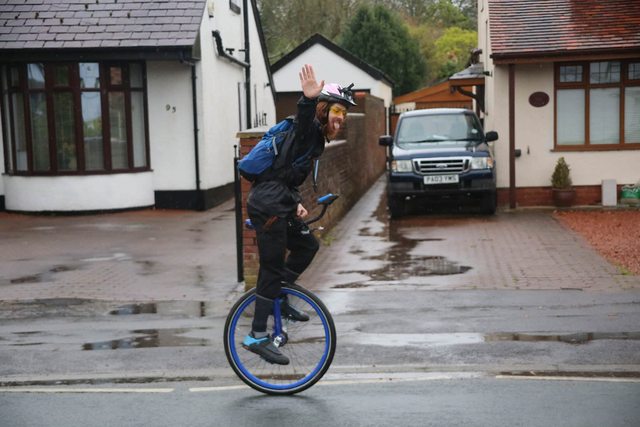
1 Like

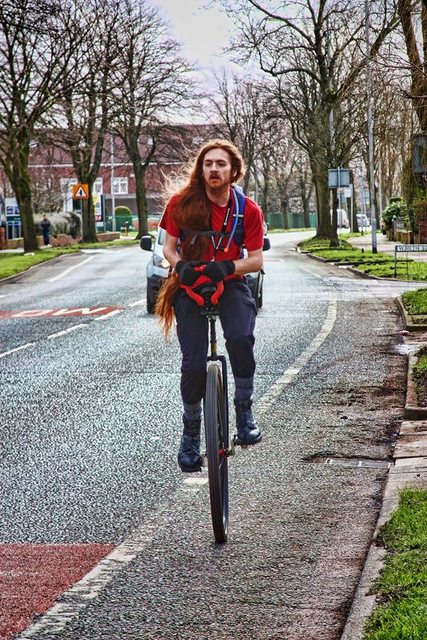
Not long after setting off on a ~45 miler, so not up to speed and probably stood up and pedalling hard to get the high gear spinning properly:

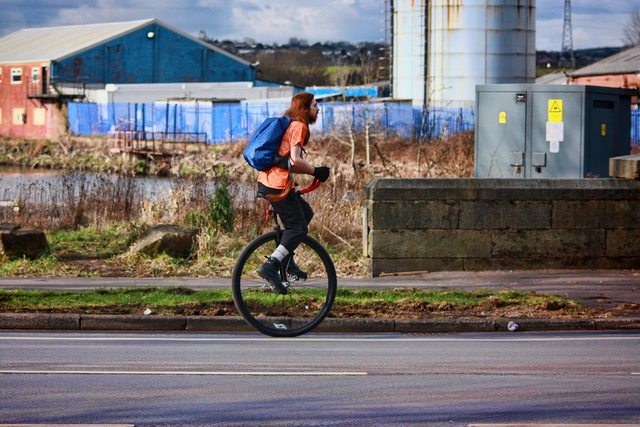
These two were taken on my work commute by some dude. A bit less relaxed as this is a nice long, flat road with minimal distractions (Only one set of traffic lights for the whole stretch!) so I’m tucked in and bombing it :smiley:


Yes, spins/pirouettes make a great example because the more bent over you are, the harder it is to make a decent spin, and especially a good-looking one. This is even more true if you’re going for a pirouette, which is where you wind your circle all the way to the center and rotate on one spot. Three full rotations to satisfy the Skill Levels or Standard Skill definition!

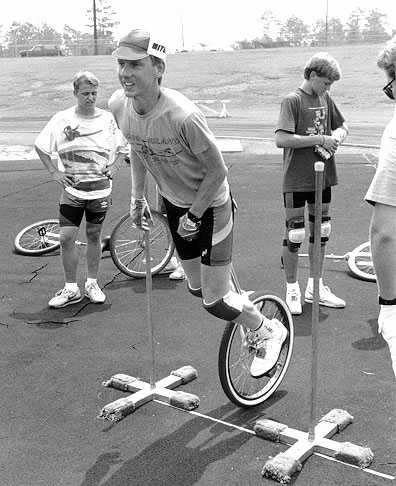
That’s interesting, in a sprint, the fast riders really have to pull up on their saddles to hold themselves down while they mash on the pedals. This one also seems to lead to a straighter posture, at least for the acceleration phase. See photo below.

Absolutely. No hinge when riding fast on bumps, one big rock or little root can literally bounce you off the seat and pedals!

This has definitely worked for me as well. I even remember a few times where I would dream about doing a trick and in the dream my body went through all the necessary motions. It was like practicing the trick in VR. :slight_smile: The same can also be applied to a sporting event, like a race, where you rehearse it in your head, to put together all the different movements you’ll need to make, including winning at the end!

Photo:
That’s me taking off in the “Obstacle Course”, now called the IUF Slalom, at the 1989 USA National Meet. In fact, that was the first year of the updated course, which is what we use today. Before that it was a larger layout, but times were about the same due to the course layout. Hard acceleration means pulling up on the seat, while going super hard on the pedals, while getting the right amount of forward lean and riding up under it.

1 Like

This is a very interesting topic.

When I took riding a while back now, it didn’t take long before I took my uni to the paths in the local forests and parks. So my first couple of years were only on packed soil with little bumps. Therefore I adapted to it and naturally developed the “hinged” posture. But I also spent a lot of the time riding with some weight on the pedals, -more than necessary, especially on tarmac- because there is always that little bump that’s going to throw you off.

Years later, I have ingrained bad habits that I’m struggling against, especially when road riding: I ride behind the wheel. If I (over)analyse my riding, I’m using a lot of back pressure on the pedals to keep me on the wheel, but I’m rarely ahead of the wheel. It’s more like a constant “pendulum” effect where I would be behind the wheel, apply back pressure not to fall back and to bring the CG over the wheel, pedal until I’m behind again, and so on. I’ve mastered this technique to a point that it’s virtually invisible to most observers. But inside, I’m struggling: having some pedal pressure means the hips don’t do the direction and balance they should do. And when I’m on a side slope, it’s even harder.

Also, when I’m tense I tend to have my right shoulder shifting to the front, which means my upper body twists to the left, while my body angles at the hips to compensate and ride in a straight line. And since I’m not fully resting on the saddle (I can actually feel that only my right buttock is really pressing hard on the saddle), I fall suddenly if I lose balance to the left because I’m in a position that doesn’t give me a chance to react to that.
Any exercices welcomed.

All this long rant on myself to say that yes, riding straight is only seen in gymnasiums with freestyle artists. But beware that the angle and the bending can lead to bad habits if not corrected early.

1 Like

Whenever I scroll through this thread and pass your picture, I wonder how you come to a stop. Do you let momentum take you over the uni or maybe straight up and then you can step off, or do you step off at that angle? Do you have a vid of it?

I seen a video of this kind of higher speed stop but can’t find it now. On the one I saw the rider simply and gently steps off the back when the wheel stops. A brake is handy for nice controlled stops on a large uni. I do it al the time but not the extend shown in the photo above.

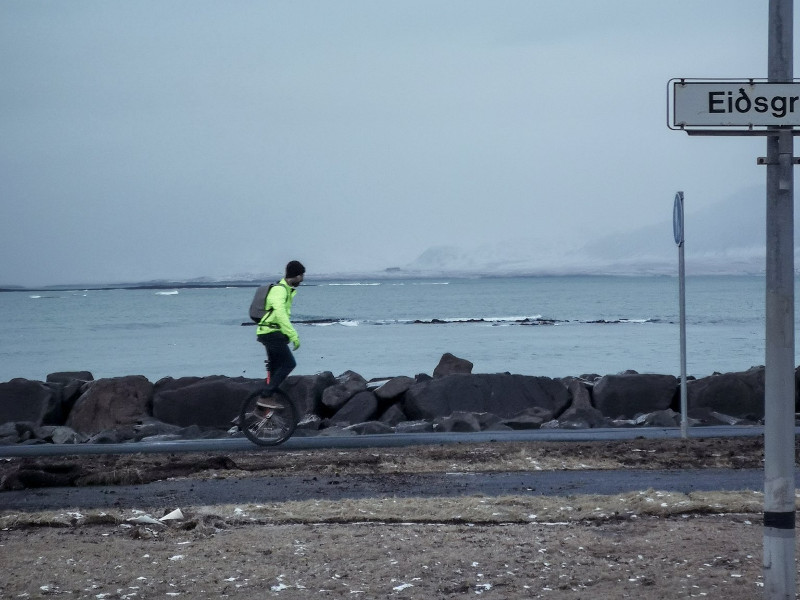
Fairly upright I suppose. I suspect there might have been a headwind or perhaps I was accelerating.

I stay in this leaning back position until I come to a stop and just put my feet down. Sorry I don’t have a video of it.