This thread looks like the best place to ask. And yes I’ve used the search function to hoover up advice.
I’ve recently been riding my G29er a ton and feel like I’ve basically overcome my fear of shifting up. Never tried down yet.
I’ve been able to do shifts sometimes first time and with several in a row or after a bad fall or the like. So generally speaking I’ve turned a corner from my earlier very cautious self.
My PB is now 40km with about 50% of this in high gear.
I’d rank my favourite terrain to shift as follows:
Flat smooth
Slight uphill
Slight downhill
—
Major up hills and downhills I wouldn’t even attempt - but the one that brings the greatest fear would be downhills. Uphill mis-shifts have led to a sudden forward jolting UPD - whereas downhill ones are way way more sketchy.
What I’m curious about is how people here avoid flat on your back UPDs.
After all this success today’s ride started with a casual shift attempt on a very slight downward slope. And bam! Flat on my back. I think the hub freewheeled big time as it didn’t fully engage.
And yes my confidence was shaken. I did try again and it shifted but I was holding back and landed backwards on my rear foot - stalling the hub/wheel in high on the upward pedal rotation with the other pedal.
I know having a forward body position helps and while the hub doesn’t shift when under load - it kind of helps to have some load forward to ensure that’s where you UPD if you get things wrong.
My basic question really is there a technique for shifting well / better on slight or more than slight downhills and uphills? This would be wonderful to know if there is - and it would equally help me beat myself up less if I hear people don’t attempt shifts on this type of terrain.
If you use an internal disc brake, then apply a slight pressure on your lever. It may help slow down the wheel and help the gear engage.
Regarding the type of terrain you can shift on… Well, basically, anywhere, whether upshift or downshift. The higher the gradient, the harder it is to shift. But as long as the wheel keeps rollirg, you should be able to shift, especially using the brake.
Another point I thought about today, when riding my G36: when I want to shift, I naturally push my seat backwards, then forwards thanks to the handlebars. I don’t do it consciously, but it seems to help the mechanism to engage. As far as I understand it, this movement temporarily increases the load on the internal mechanism, before reducing it for a fraction of second. This may be enough for the mechanism to engage, without having to release too much pressure from the pedals.
I would be happy to receive experiences from other Schlumpf riders as I have never discussed this tech with anyone before.
Cool; It’s pretty much the same for up and downhill – you have to relieve some of the pressure on the pedals to allow the shift to happen. Going downhill is easier, because you just “pause” your cadence for a brief moment.
If you can’t brake while shifting (inboard rotor or rim brake), I find it harder to shift downhill. Because it means going freewheel in downhill without being able to brake. It may take only a fraction of second, but I definitely feel unsafe.
Following the shorter crank advice in Corbin’s video and from others, for the first time ever I moved my pedals from the 150 holes to 127 on my Spirit cranks.
WOW! My shifting improved incredibly!
Great advice
I instantly went from like 60% upshift success and 30% downshift to 90%+ for both!
I’ve had a Schlumpf in the past and was never great at shifting. I’d make do but I’d have lot of misses and often end up dismounting due to too many failed attempts in a row, often as I approached a road or mud path being stuck in high gear.
I just built my G27.5 and have been experiencing the same on the 4 or 5 rides I’ve taken so far, until this evening.
I even did a few intentional upshift-downshift in a single rotation.
I guess with success you mean hitting the button at the right time. Continue to ride was already at 90%?
I move my foot backwards before shifting on 150mm steel cranks. With 140mm aluminium cranks I don’t have to move the feet, but the very seldom unwanted switching during mounts also increases a bit. I went back to steel cranks because they don’t get loose on my square taper Schlumpf hub. With long bike cranks also on professional racing bikes in mind, I think that longer cranks might be more ergonomic. The professionals won’t be that wrong. I don’t ride fast enough in 2nd gear to require shorter cranks.
Yes, success to me is hitting the button and shifting on the first attempt. Actually, continuing to ride was not already at 90% after missed shifts because there was usually a change in terrain that warranted the shift, and fumbling with shifting made things worse. For example approaching a thick muddy section. In high gear, I slow down as I approach, then shift fail 3 or 4 times, and by then I’m practically at a stop and starting to fight the mud while stuck in high gear, so upd.
Yeah, moving your foot makes sense, if you can do it. And obviously foot size, shoe style, shoe grip, pedal grip, button protrusion, rider ability, and more, have an impact. Crank length had a huge impact for me, so I thought I’d share.
I translate this to approaching a red tragfic light, a crossroad or the beginning of a steep bridge in traffic. That is the reason why Schlumpf riders sometimes have priority in traffic
I am thankful that my area generally has roads with wide shoulders or bike lanes. But also bike paths and trails. I can avoid traffic for the most part. Mostly I’m just on the road as a means to get to a path or trail.
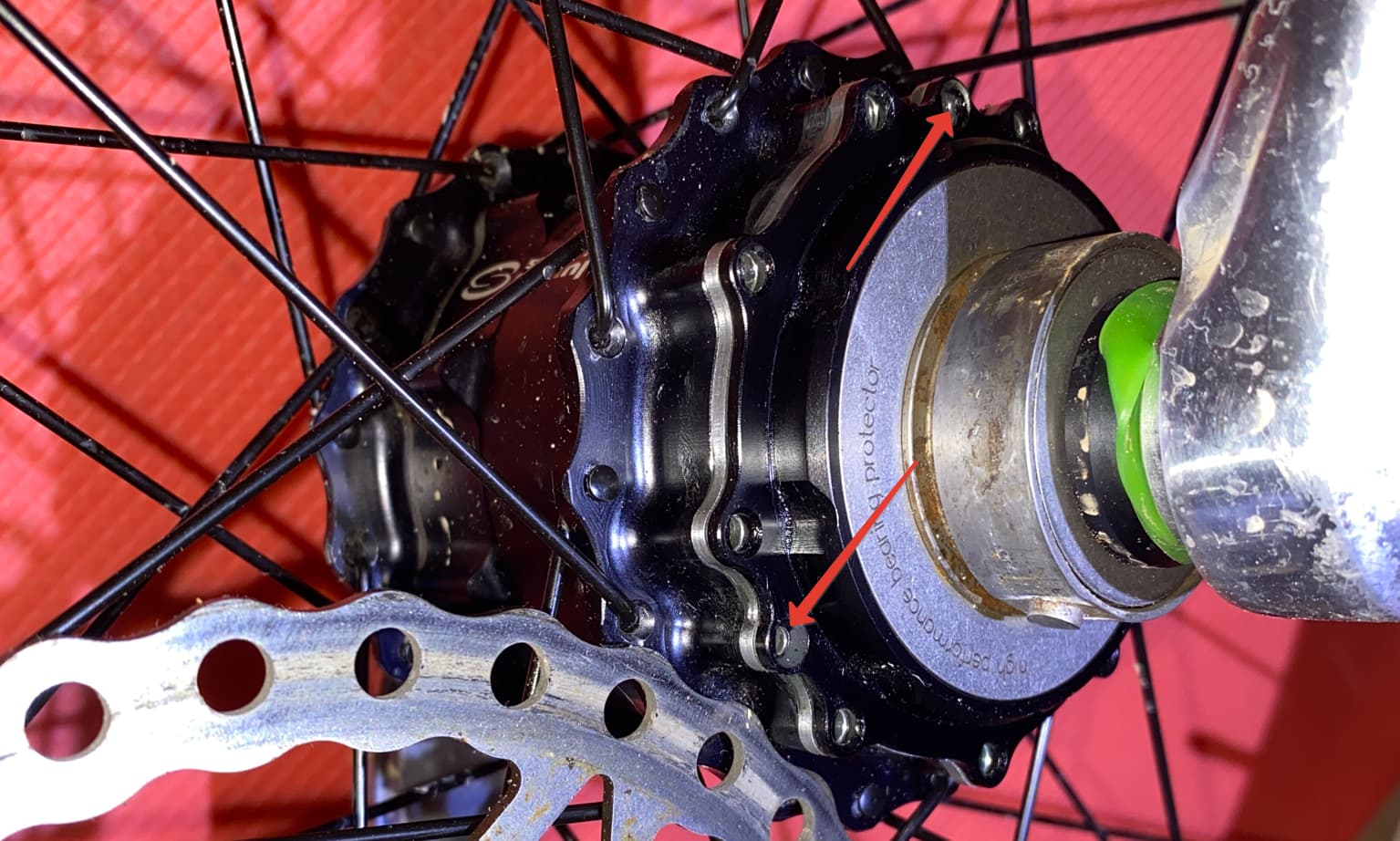
Hi. I have a Schlumpf hub with the serial number M1260, which I received in December 2024. Yesterday, I built a new wheel and decided to test the unicycle without brakes, so I removed the brake disc. Now I’ve noticed that the flange where the disc mounts spins freely. It turns out that the flange was attached with three small screws, which apparently got lost. Could someone please tell me the size of these screws?
I find it vital to have a good foot position to get a successful shift. I have a rather small pair of feet (US 6.5 shoes for them), with my normal feet position on 137mm cranks I can only barely scratch the shift buttons, so it was extremely difficult for me to shift, let alone keep riding after a lucky success. By moving my foot back substantially (with only the tip on the pedal), I managed to increase the first-kick success rate to about 1/3. It’s still difficult to ride with such a foot position but as least I got myself a chance to adjust later.
I’m thinking to switch to 127mm cranks, it definitely will be harder to maneuver, but I expect it would be easier to shift for me.
Assuming that’s the same run as M1323, it would have shipped with 3 spacers with 3 screws each, for a total of 9 M4x16mm torx screws holding it all together. You can see the screws and spacers here.