You mean my wobbly ankles?
Maybe you mean this one? I’ve heard that the disc came into contact with a Northshore element. Whether an inboard setup would have helped - we’ll never know 
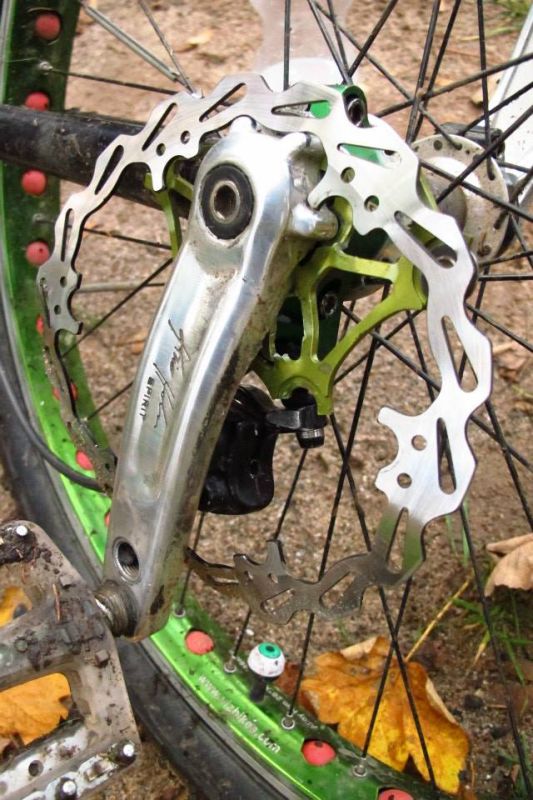
I’m tempted to think that if you’re in the sort of situation where that is likely you probably need the strength of an undished wheel!
Can you post the thread that was in? I’ve been looking for it and can’t seem to locate it. I remember seeing that picture, and have my own thoughts about it, but wanted to go back and read what actually happened.
On this page:
Thank you!
I have both inboard and outboard disc mounts, about 50/50.
Here is my experience of them:
Wheel strength. no difference between the dished and non-dished wheels in reality. Neither have moved enough to need more than a little trueing at the end of the ride to fix… most of the time I don’t even bother with that.
Maintenance. Inboard in considerably easier! no contest. The time it takes to get the bearing housing removed to change an inner with the outboard disc is considerable and when I have to change cranks or even just tighten the cranks. nightmare! The KH are anything but maintenance friendly.
Hitting the rotor. The inboard calliper is 41.5mm and the disc is 30.5mm further in. From my experience, I bend the outboard rotor almost every ride. I have never bent an inboard one. Having said this, they only bend to the point where the heat of a good down hill does not straighten them to the point where they do not rub. Only once have I had to replace the disc. So for me not a big problem, but noticeable.
Roger
1 Like
I would also consider that the crank with an outside disc has to be concentric to the wheelaxle. Otherwise the disc will oscillate in the caliper. An insidedischub is much easier to manufacture concentric than the ISIS drive.
Nobody seems to have a problem making chainrings run straight on cranks, so I’d suggest this is a complete non-issue - the ISIS interface is plenty precise enough to do this - I’d also suggest that it’s no more difficult than getting a disc to run straight when attached to a hub. Not to mention that there is no issue at all with this with Spirit cranks which most people will be using.
in theorie…
according to one of germanys biggest unicycleshops (einradladen.com) it is an issue because you need spacer where the crank is pressed against with the crankscrew. Actually the crank should be force- and formfitting the axle.
It has never been an issue. The spacer is just to save the axial position of the crank so that you do not have to adjust your caliper when crans begin to wear out.
You’re talking about a spacer between the crank and the bearing, which is standard for all ISIS uni cranks, and is actually required to make uni hubs meet the ISIS standard (which has a hard stop in it in order to fix the location of the cranks)? ISIS cranks of any variety should not be fitted without a spacer behind them (except on a Schlumpf hub, but then that doesn’t meet the ISIS spec), as ISIS is not designed to work with the taper stopping the crank. See http://www.isisdrive.com/isisdrive/ISIS_Drive_Standard_Document_revD.pdf
I’m not sure how this is an issue.
Roger, I respect you and the work you do, but I gotta differ with ya on this one.
Dished wheels are less stable laterally than symetrical builds. It’s not a big deal on small wheels and wide rims, but it becomes much more obvious and critical on large wheels and narrow hubs.
This is the reason that rear hub spacing has increased on mtb’s to 150/170/190mm, to increse wheel strength.
It was mostly for the above reason that I went to an external rotor.
What size rim is considered wide? So you are saying that the Oracle hubs are not wide enough for it’s dished wheel? Is there an inboard system that you would use if it was available for a unicycle?
I’m asking because I’m considering a 29" Unicycle for mostly road use.
The move to the 170/190 spacing is mostly on fat bikes. Dishless wheel strength is a benefit, but the primary reason is chainline. The rear cassette needs to move outboard so the chain can remain as straight as possible and still clear the rear tire.
On the disc side, a uni with an inboard disc is still in the realm, dish wise, of what has been acceptable in the biking for a very long time.
In theory, yes, the dishless wheel is stronger. Up to a 29 in the uni world I can see Roger’s point that there’s not much of a practical difference. I don’t think I’d be keen on a 36" inboard disc 100mm wide wheel. The move to the wider spaced hub makes sense there for sure.
All of my disc braked unis are outboard- not because I don’t see inboard as a viable option, but many of them were retrofit and I didn’t want to rebuild wheels.
It doesnt have to be an issue. If the crank doesnt sit coaxial on the axle, because of tolerances the disc will oscilerate. The spacer can ensure the axial position of the crank but not really the coaxiality like the planed male shoulder of the isis drive. Thats what I meant…
If it works fine, its no issue… If the tolerances are miserable it could be an issue. Its much easier to get an inboard disc mount coaxial to the turning axle..
But bikes split the load over two wheels; unicycles are loaded double in comparison. And bikes don’t normally have much side loading, whereas I’m always offcenter on my uni wheel, whether it’s balancing at a standstill, doing corrective hops, landing drops - unis are a lot more demanding.
My Oracle wheel has held up OK, but I’d be happier if it were symmetrical, even if it were just by having the rim drilled offcenter. As it is, the disc side spokes don’t have much bracing angle, the offside spokes are pretty low tension, and they are always creaking and fretting against each other, indicating a lot of rim movement.
The spacer does exactly the same job as a machined shoulder on a bicycle ISIS BB, I’m not sure why you think there would be a difference. This also appears to be a purely theoretical issue which nobody has actually found a problem with.
In which time do you think we live? It’s absolutely no problem to produce cranks where the ISIS interface and the thread pattern for the rotor are coaxial and it would also heve been no problem 20 years ago. There’s even more play in the six holes of the rotor than tolerances of the crank are. Maybe this would be an issue if you hand file the crank from a block. But these are cnc machined parts. And why the hell schould miserable tolerances be an issue at the cranks when they aren’t at the hub? Why should a hub be machined more precisely than a crank? Don’t be mad at me, but this arguement seem to be totally bullshit to me …
Does that sound like there are no problems with tolerances: http://www.unicyclist.com/forums/showpost.php?p=1637258&postcount=104
Oh and btw please stay objective and dont get personal.
I am out…