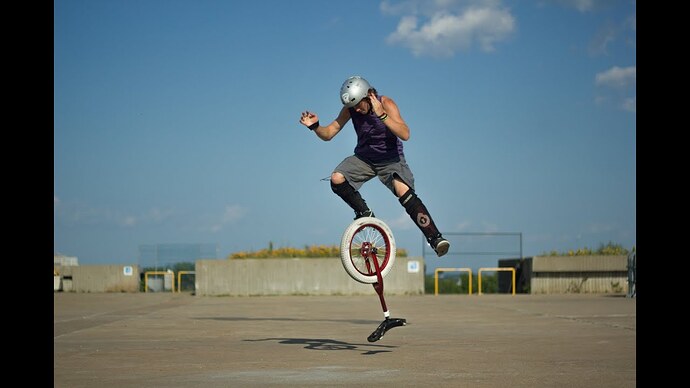
Let’s Master Fixed-Wheel Coasting! Join the Journey to Unicon 2026

Is anyone else out there interested in learning coasting? My long-term dream is to one day coast more than 30 meters at Unicon — but for now, my realistic goal is simply to develop the technique and confidence needed to complete two solid qualifying attempts in the “Track Coasting” event at Unicon 22 in the summer of 2026. The purpose of this thread is to find others who want to learn or improve their coasting so we can go on a learning journey together. I also hope that experienced coasters will share tips and offer feedback.

For the past 14 months I’ve been very into freewheel coasting, practicing a lot and enjoying it tremendously. As I’ve gradually become more comfortable with it, I’ve been looking for new skills to learn. This summer I focused on one-foot riding and wheel walking, and this fall I’ve been working on one-foot wheel walk and coasting on a fixed wheel.

Learning to coast on a fixed-wheel unicycle has been quite challenging for me, and it has taken a long time before I managed to coast even a little. This week, however, I had a small breakthrough. Big thanks to Nakul Mohakar for his fantastic tutorial from 11 November 2025!
https://youtu.be/kbPOb6hWMcg?si=C1t1OjKZ19wv1OSj

My current status: my record on fixed-wheel coasting is 7–8 meters. I’m working on applying the tips from Nakul’s video:

  • Master one-foot riding

  • Initiating the coast (not accelerating while entering the coast)

  • Constant frame angle

  • Frame foot placement

  • The Coasting Triangle

  • Reset after corrections

So far, I find it easier to coast with both feet on the frame, since it feels more similar to the freewheel coasting I’m used to. But I assume that using one foot on the frame and applying “The Coasting Triangle” will ultimately be an advantage and might make it easier to achieve longer distances. Can any experienced coasters confirm or deny this?

I hope others will join this learning journey so we can help each other improve! Here’s a video from my practice session yesterday to show where I’m currently at:
https://youtu.be/x48GqSr8MEw?si=CIAs0EK2Z-BYOYkg

And here’s a video of my freewheel coasting from earlier this year in August:
https://youtu.be/UnlYuwqre4s?si=JpC0Iu1yoKK2zOHO

Here are the rules for Track Coasting from the IUF Rulebook 2019:

“An event to determine which rider coasts the furthest distance. There is a 30 meter
speed-up distance. Riders’ coasting distances are measured from a starting line' with a 5 meter minimum, which will be marked by a qualifying line.’ If the rider does not
cross the qualifying line it will count as a failed attempt. The farthest distance from the
line wins. The distance is measured to the rearmost part of the rider that touches the
ground when dismounting, or to the tire contact point where the rider stops coasting.
Remounting is not allowed. Riders get two attempts. If a rider crosses the coasting line
(tire contact point) not in coasting position, he or she is disqualied in that attempt.
The event should be held on a track or other very level, smooth surface that is as clean
as possible. The track may be straight or curved. Ample time must be allowed for all
competitors to make some practice runs on the course before the ocial start. Crank
arm rules do not apply. Wind must be at a minimum for records to be set and broken.”

6 Likes

For the last few months ive been trying to learn brake coasting on my MUni (not too sure how different this will be to no brake) yet I seem to have hit a wall of not being able to progress any further, with so far my longest coast at around 5ish meters.

To be honest i’m not sure that it’s helping that I have not learnt 1 footed riding, instead gone straight to full coast, but even so, IMHO atleast I think that only makes a difference for the starting of the coast, and I seem to be having trouble with continuing for any distance.

1 Like

Just an observation from a total non-coaster: Your arms are positioned to the front (much like when freewheel coasting) whereas Nakul has his arms more to the side. You probably knew that already.
All the best with your effort to master this. I‘d love to join the group, but I‘m not quite there yet. I think the next thing for me will be freewheeling. Or wheel walk. I‘ve tried this already but so far with zero success. I guess it takes way more determination and practice to change this than I brought up to date.

1 Like

Many years ago I ruined a pair of shoes by the constant braking on the tire, but I still can’t coast. That was before the youtube era, so I never saw someone coasting at that time. Just heard that it works.

1 Like

Brake coasting on a Muni is such a cool skill — awesome that you’re working on it! With brake coasting, you don’t actually need to learn one-footed riding first. On freewheel I’ve practiced a lot of both brake coasting and brakeless coasting, as well as transitioning from brake coasting into brakeless coasting.

One thing that really stands out is that in brake coasting (both on fixed and freewheel) you ride with a noticeably more backward-leaning body position compared to pure coasting without brakes. When you brake, your body naturally moves forward relative to the unicycle, so to stay balanced you need to lean back. The harder you brake, the more you have to lean back; the lighter you brake, the less backward lean you need.

You usually feel safer — with a larger “balance window” — when braking harder and leaning back more, but the trade-off is that you lose speed quickly. I think the key to getting longer brake coasts is experimenting with how lightly you dare to apply the brake. With lighter braking you have to lean a bit more forward, which gives you smaller margins before tipping forward, but the benefit is that you can maintain speed and coast much farther.

I don’t know whether you’re coasting with your legs stretched forward or with your feet on the frame — it’s worth trying both to see what works best for you. Also, in case you haven’t seen it, Finn Harwege has made a really good tutorial on brake coasting:
https://www.youtube.com/watch?v=idg-SBtDE4I&t=394s

I’ll take the challenge too and practice more brake coasting on Muni — let’s keep each other updated on how it goes!

Thank you so much for the feedback — I really appreciate that you took the time to watch both Nakul’s video and mine! And yes, that’s a good observation. I haven’t implemented all of the tips from his tutorial yet. Once I get more comfortable riding with just one foot on the frame, and once the free leg and my arms form more of a proper “coasting triangle,” I think my arms will naturally move further back as well. But it’s definitely something I’ll pay more attention to!

Great to hear that you’d like to learn freewheel and wheel walk! I’m happy to share tips or help if you ever get stuck or have questions. I assume you’ve seen AJ Kinsella-Johnson’s freewheel tutorials? Those are the ones I started with. I also picked up some useful advice from Simon Jan du Voyage about brakeless coasting while sitting on the seat with both arms forward.

For wheel walk, this is a good tutorial (unfortunately for me it’s in German):
https://youtu.be/hjLHDOllkZk?si=o0E07LZwV26BhBXb
And here’s a nice one with Roger from Unicycle.com:
https://youtu.be/82R9qW2ey-k?si=ThjysG5Te7j7LKuG

You should definitely start a “Let’s master wheel walk!” thread of your own! :blush:

1 Like

It sounds like what you practiced back then was mostly gliding.
(From the IUF: “In Gliding, the balance has to be kept all the time by the braking action between one or both feet and the top of the tire.”)
That’s an incredibly cool skill — and one I also want to learn myself.

Some people say it’s best to learn gliding before coasting, while others (including Nakul) say it’s not strictly necessary. I just recently learned one-foot wheel walk, and the natural next step from that is gliding, so I’ll probably be practicing both coasting and gliding in parallel.

Are you tempted to pick up the practice again now that there are so many good tutorials available for both coasting and gliding? I think it would be great if you did!

1 Like

One thing that really stands out is that in brake coasting (both on fixed and freewheel) you ride with a noticeably more backward- leaning body position compared to pure coasting without brakes. When you brake, your body naturally moves forward relative to the unicycle, so to stay balanced you need to lean back. The harder you brake, the more you have to lean back; the lighter you brake, the less backward lean you need.

Yeah, thats definitely something ive noticed, what i’ve found (this isnt advice, take with a pinch of salt) is that you almost put more pressure on the brake if you are falling backwards and reduce pressure if falling forwards, and so far thats how ive neen keeping balance, but this may be causing too much speed loss, as such the length of time i can coast for is decreased.

I don’t know whether you’re coasting with your legs stretched forward or with your feet on the frame - it’s worth trying both to see what works best for you.

So far, ive found the most effective position for my legs is bent behind me, as i find that when i have them in front, the weight pulls me over forward. I would try with my feet on the frame, however the issue i have there is that i ride a hatchet, so with the shape of the frame itself i can’t really put my feet on the frame comfortably.

1 Like

I’ve no experience of this kind of feet on frame coasting personally, but when you watch riders like Mimo doing coasts he’s always got one leg off to assist with balance.

Regarding brake assisted coasting, either on a fixed or a freewheel to go any great distance you a) need a brake with great modulation, and b) need to be going downhill.
I brake coast to a stop a lot as I find it the most controllable way to stop, especially when travelling at speed and on a larger wheel.

1 Like

I wasn’t aware that this was even possible! Not something I will ever be attempting. When I was younger, maybe. It would have been great to have even known someone else that rode a uni back in the day before the interwebs.

Keep at it, you’re well on your way!

2 Likes

I suppose technically everybody does a small coast when dismounting if you think about it :man_shrugging:

I don‘t think so. Will look them up once I get into it more seriously (just bookmarked your post, with a reminder). At the moment I‘m still recovering from a surgery and should avoid falling, thus I‘m not practicing any tricks at all, right now. But by the start of next year I should have fully recovered if there aren‘t any bad surprises :crossed_fingers:.
The german vid and the one from Roger, I‘ve seen a couple times, but thanks for the links anyway. I think I have a decent idea about the theory behind wheel walking - it‘s just that I‘m failing miserably with the practical part :-D.

Just rotate the seat 180 degrees! Ok, the pedals could unscrew if you don‘t swap the cranks, but hey, you wanna coast, so no pedals needed ;-).

1 Like

Good observation. That’s my ultimate goal also, have one leg off.

Just stumbled upon a different variant: one arm to the front, one to the side. I did that often when I learned to ride one foot.

Tank you! That’s a nice video!

1 Like

aren’t BC Wheels the ultimate coasters. No brakes to hold you back.

I’d love to join you on your journey and tell you that I’m going to coast 30 meters at UNICON, but that doesn’t seem realistic (for me).

For my part, a few years ago, I had my first experience of coasting on a fixed unicycle with only one foot on the frame. But since I’ve been coasting on a freewheel unicycle, I’ve tried coasting again on a fixed unicycle with both feet on the frame, and it seems much easier. That said, I often coast between 5 and 10 meters, sometimes between 10 and 15 meters, and rarely more (whereas I regularly coast hundreds of meters on a freewheel unicycle).

I would also like to ride BC. So far, I’ve ride it three times for 15 minutes in the last 2 weeks and managed to do 3-4 meters several times.

Personally, I don’t practice wheel walks or glides. In fact, I’ve already done more than 10 meters of WW, but often I fell heavily on my back… so I stopped :face_with_peeking_eye: . On the other hand, I practiced a lot one foot on both sides.

Good luck with your training!

yeah the falling on my back stopped me from continuing with my freewheel uni. I am not used to using the brake handle. As long as I go forward, it is all dandy, but there comes a time where you need to stop the pedalling for balance. Because a BC wheel doesn’t have a brake at all and there is no seat that is in the way, I am hoping it will be “easier” to get under control. I’ve only felt the balance for a few centimetres last week. Just recognising that balance gives me enough confidence that I will get the hang of it when I practice enough. Like all things related to unicycling, as long as you are persistent you will nail it.

That doesn’t happen to me anymore since I started using plastic pedals (Look Trail Grip). I think it’s dangerous to coast on a freewheel unicycle with pedals that have metal pins. All it takes is one pin to catch your shoe and throw you off balance when you dismount from the back of the unicycle.

I used to fall on my back when doing WW, it’s not my thing. :sweat_smile:

I don’t think I have metal pins on my freewheel uni. It is just the confidence that I normally have to roll back to catch my balance, but then the pedals don’t hit a wall and continue turning backwards while I keep going forwards that makes me lose my balance.
I’ve never tried wheel walk. I already think it is scary taking my feet off the pedals. bye bye control.