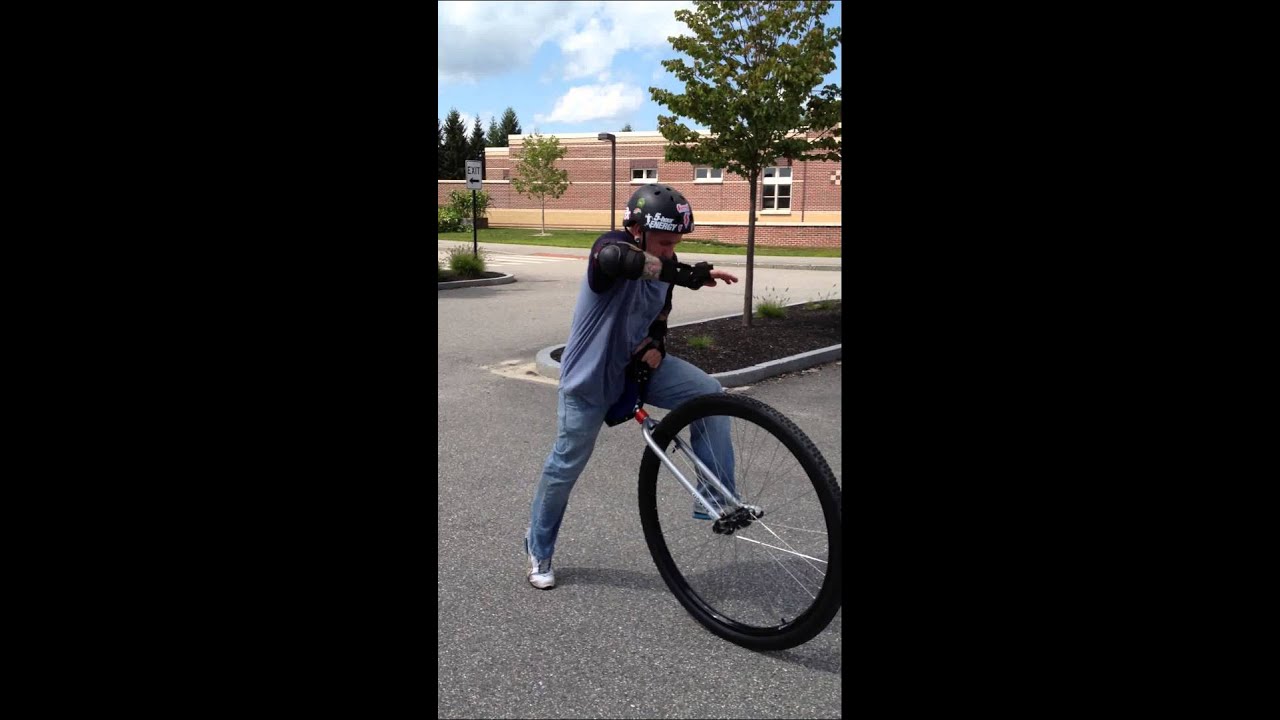
150’s are on that 36. I spent all this time trying to free mount that thing and I let Jyngles borrow it for 5 minutes and he can do it.
After that day I spent hours a day for a week just practicing free mounting. No riding. Just free mounting. It just took some inspiration from Jyngles. Now I can free mount my 20, 24, and 29 almost 100% of the time. As for my 36, I am up to 50% with the rolling mount. For me the trick was to keep eye on the pedal as I plant my dominant foot. I think it convinces me to push down hard when it lands.
Since riding with Jyngles I have gone back to all my smaller unis just to learn the basics. Trying to idle on the 20 and still stand, and riding on rolling single track with the 29. All with the idea that taking the time to learn the basics will help with the 36. Plus it is fun.
Find someone to ride with. It helps. I am sure Jyngles has been challenged by my kids when they talk him into playing follow the leader around the school. We enjoy it.
I have been practicing one foot idling and feel like I do not get any where to fast. Very slow progress, any suggestion from anyone would be greatly appreciated.
I think I figured it out, not sure how I missed it the first time, but if you would like to respond to confirm the way I did it was correct, awesome. Always appreciate feed back.
You take the full youtube link and paste it into your text. If it starts with https change that to http. The forum should automatically imbed it for you when you submit it.
I am wondering how much tire pressure you guys are using? I started out at about 55 and now I’m at 70. I’m riding on asphalt that has a lot of grip. I haven’t tried concrete yet but I bet it will be easier to turn on. The harder tire seems to do better on the asphalt for me.
Jyngles, great job on the 36" free mounting. I wish I could have learned it that quickly.
Over the weekend, two friends who I helped learn ride uni came over and I let them both try out my 36". One of them took off down the street on his first try. Yes, I am jealous of the quick learners.
I run that exact tire (though not on the same uni). I have run it at around 55 psi, and it was plenty hard enough. I run it at a lower pressure to better cope with irregularities and bumps in pavement when I’ve got nearly all of my weight on the saddle. I just went and measured mine for you, and it was only about 20 psi, which is actually lower than optimal (and quite a bit lower than it is rated for), for riding this tire on asphalt streets through residential neighborhoods with a rider plus uni and gear weight of around 170 lb. I go by look and feel, as many here do. 20 psi surprised me, so I’ll be putting more air in it later to try a higher pressure. 20 is enough to not get pinch flats or stress the sidewall too much with the kind of riding I do, though the latter might be a bit iffy. I was thinking it could do with a bit less squishiness. 70 psi is above rated pressure for that tire.
Go ahead and run the tire hard while learning if you want, but you will probably want to lower it when you get onto non-ideal surfaces. I stopped getting ejected by trivial bumps in the pavement so much when I lowered my pressure. Once you learn to turn properly, you won’t be relying on a small contact patch (which high pressure gives you) to let you break friction when you twist.
I don’t know whether it is normal for a round profile tire or whether it is due to running at high pressure, but the middle of my tread has worn a lot faster than the edges. The very edges of the tread, which goes about halfway down the sidewall, won’t wear much at all, of course, since they’re not in my contact patch when I’m not turning, but I’d expect the wear to be a little more uniform across the width of my normal contact patch than it is unless it is related to having run too high of a pressure.
I watched your video when you posted it. Bravo. I only wish I learned so quickly. You remark at one point that the tire deforms a bit. That is normal. It will always do that a certain amount to form your contact patch, and it will do it more than you might be used to from bikes just because all of your weight is on the one wheel instead of distributed between two of them. Twice as much weight yields twice as large of a contact patch (at the same air pressure), and a larger contact patch is formed by your tire flattening more on the ground.
I hate to admit it but I’m just over 195. I am hoping my new flying contraption will help me with that. I tried to ride over a water hose under pressure and went right down. I think a lower pressure will help with bumps in the future. This morning I raised my seat almost 2" and that made a big difference, my peddling got way less jerky. I’m making smoother circles. Does anyone else ride the E-Sport? I haven’t seen much written about it. I picked it thinking a basketball unicycle would be very stable and easy to maneuver.
Weight is just a number. I was 185 or so a few years ago, which might not sound like much, but I have a small frame, and, since I was also out of shape, was fighting to move that around. I didn’t care about the number, but I did care about how I felt. A lot of juggling practice got me into better shape. A simple dietary change I made at about the same time may or may not have anything to do with it. I am about 145 +/-, now, and don’t seem capable of losing more, which is fine, because my BMI is right about what it should be, and the initial problem, having to work too hard to move around, is resolved.
You don’t have to juggle, obviously; that’s just the way things worked out for me. Unicycling will do the same thing by giving you exercise that is actually fun to do and getting you out of a sedentary rut if you’re in one. I haven’t lost much if any weight since I started unicycling, but I am definitely fitter now, so you’ve got that to look forward to too. My partner, who says she’s not into muscles, admits to liking the new ones. If you’re not getting a good enough workout, there are always bigger challenges (hills, in my case).
Riding over a pressurized hosepipe would be a tall order for someone who’s just learning on a narrow tire with high pressure. I don’t know whether I’d be able to do it or not, and I’ve been riding since Spring, having started learning at the end of last year. I did manage a couple of surface transitions (short curbs) about the height of a hosepipe earlier today, albeit with a very squshy tire, so maybe I could. But since you just started, you shouldn’t be too disappointed if it takes awhile. On the other hand, your progress thus far has been remarkable.
If you could raise your seat 2" and still reach the pedals well enough to ride, it was too low. In addition to the differences you noticed (you’re using the muscles in your legs more efficiently now), you could be in for knee pain once you get to riding any distance if you do so with your seat too low. You’ll probably have knee pain temporarily anyway, because that seems to be normal for learners (I am not an exception in that), but seat height is one of the first suggestions people have for knee pain other than that. Why make it worse by having your seat too low? If you get into muni or trials later on, you’ll lower the seat for that.
I don’t know much about the E-Sport, but it does look like a nice solid uni for smooth to moderate surfaces. Vastly better than my craigslist cheapie, but, then, any Nimbus would be. Light muni might even work on it, though you’d have to find out how large of a tire you can fit into that frame if you want more volume than 1.95" for rolling over stuff. I’m guessing the narrow frame might have something to do with the claimed maneuverability.
Well, I haven’t figured out the “maneuver” part yet! I like the seat though. I have to tighten it up this morning as it has gotten loose from slamming into the ground every time I “dismount”!
I finally got the one legged idling down. What an awesome feeling of accomplishment…
<iframe width=“640” height=“360” src=“YouTube” frameborder=“0” allowfullscreen></iframe>