There’s a hill near my house that is steep. I ride up it sometimes on my bi-unicycle. I’m not yet skilled enough to ride more than an arm-width away from the wall in my driveway, or I’d just try to ride up the hill. I asked an AI chatbot if a 20 inch wheel was easier to ride up a hill than a larger wheel (say 24” for the sake of discussion). The AI chatbot said that the 24” offered more mechanical advantage, and was therefore easier to ride uphill … is that true?
So, perhaps I am nerding all wrong, but this is what I was thinking:
If the incline is an angle, theta, the wheel is radius R, and the crank radius is r and I assume that I was supplying enough force (F) to counteract the torque due to gravity, the force required would be:
r F = m g R sin(theta)
Thus:
F = R/r m g sin(theta),
which is another way of saying that less force would be required for a smaller wheel radius (holding the crank radius the same)… right?
Yeah I’m going to disagree with the AI here (they’re not always right of course).
Between a 20” and 24” to climb up a steep hill, assuming the crank lengths are the same, the 20” will have a smaller radius wheel and thus have more torque compared to the 24”. You will have to pedal more revolutions, but the force exerted at the pedals will be smaller. It’s equivalent to being in a lower gear on a bicycle.
Terry “Unigeezer” Peterson normally uses a 24” with 150mm cranks for his hill climbs, I believe. While a 20” wheel should be easier to pedal with the correct (long) cranks, a 24” might seem better to some riders due to the lower number of revolutions necessary. Check out this @UniGeezer video:
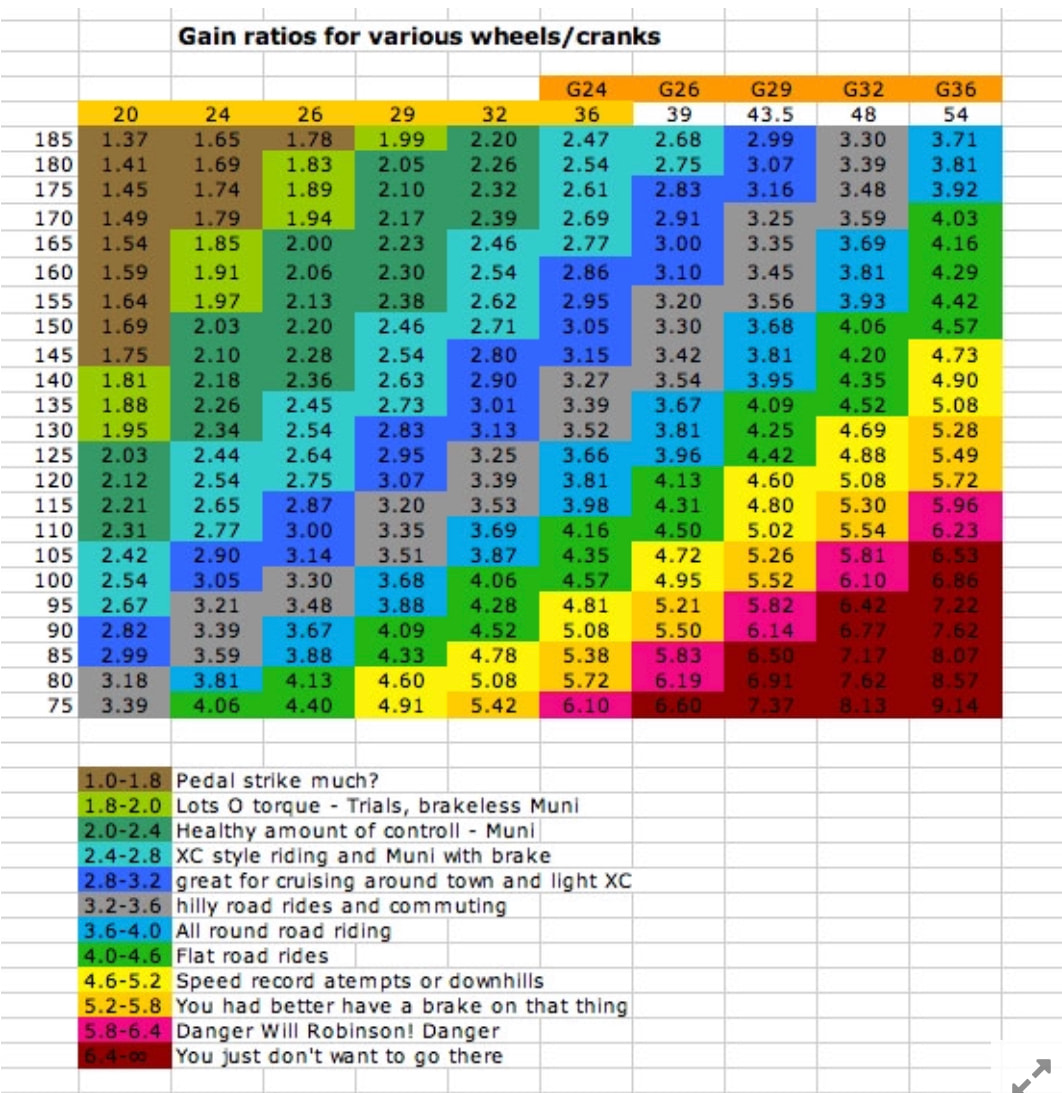
Also, take a look at this “gain chart”, showing how crank length and wheel diameter change the riding experience. My Trials uni has 140mm cranks. For the same experience on my 24”, I would need 170mm cranks.
There are some other factors that needs to be considered, along with personal preferences.
Smaller wheel: the terrain feels bumpier, you need a higher cadence (might feel awkward or out of natural rythm for the rider).
Do you like sprinting up the hill in short lighter steps? Take the 20".
Do you prefer to put more power into each step, “climb” the hill? Take the 24".
Is the surface uneven? Take the 24". Does the hill require Micro-Navigation? Consider the 20".
Are you really strong, and even more crazy? Take a 29" with 100 mm cranks instead. Then you will just float up that hill: https://youtu.be/SCY2Cko9URA?si=RsfzQkgpVX78KkgV&t=522 (watch @SirCranky to the left of the screen, and the wait to see him ride down as well.)
The primary answer is, your skill matters far more than the wheel size.
The secondary answer is, you can ride up steep hills on any size wheel. The heavier the wheel is, the harder it is simply because of weight. The larger the effective gearing (see chart), the more force each pedal stroke takes, but you also get further for each pedal stroke.
If you have enough strength to get up a hill on a 29er or 36er, you won’t find going up on a 20 or 24 substantially easier.
There is ofc a practical limit to the steepness of the hill and what wheel size is feasible even for a strong rider. But indeed, this can be translated to how much force you are able to cope with for how long. Just like on a bike really. Can you climb the entire hill on the that particular gear?
Just remember that the hill is probably only one part of the ride. I would recommend chosing a uni for the rest of the ride and rather struggle with or even walk the particular hill.
What does “easy” mean? Does it mean you gave to push less in average during the ride? Does it mean the ride takes less time, thus you can recover faster after the end? Does it mean you have to spin less to go forward? …
Depending on the meaning of “easy”, you’ll have different answer. I personally wouldn’t ride a hill on a smaller wheel than 27"5, because I feel like it is harder to go forward as you have to spin much more. If I have to chose, I usually go with a G29er or a G36er.
@Maxence There are lots of articles about moment of inertia that explain the physics of rotational axis. The variables are us the rider. How much we weigh, how much force we can contribute, how long we can sustain the effort. How long the levers (cranks) are that we use, etc… I found the info helpful.
I would disagree that there’s a practical limit. I have ridden up some of the steepest streets in San Francisco, which are some of the steepest streets in the world, on a 29er with 110mm cranks. If there’s a practical limit, it’s above the practical limit for street paving.
Given the same wheel size and cranks I have found that a heavier wheel does help on steep hills. When I added about 5 lbs to the wheel of my 24” the total rider/uni weight increase about 3% but the added rotation momentum (flywheel effect) of the wheel made it easier to keep the wheel going from one pedal stroke to the next.
If it’s just about making it up the hill, then a smaller wheel and longer cranks generally make that more possible by improving the mechanical advantage: So yes, your calculation is basically correct.
On really steep climbs >10%, an average/beginner rider will find a 24 way easier than a 29 or 36 with the same crank length. Likewise easier with 125-170mm cranks than short 110-125mm cranks.
In practice it depends on a lot of factors with rider skill being the most significant. A lighter unicycle and/or wheel can help but as above sometimes the heavier wheel helps with inertia.
As far as getting up quickly, usually the largest wheel/shortest crank combination that the rider can still “spin” is optimal (i.e. faster cadence so momentum is preserved).
For example, I tend to feel fastest uphill on a 29” with 110 cranks if I can muscle it up the incline. Even shorter cranks don’t help uphill (flats yes) and on the 36 I have to go longer, say 125mm and there is more weight.
Yes, but to keep perspective for the other readers out there: Maxence is a world class uphill specialist and trains as such. Only a few top unicyclists who train frequently can ride a G29/36 up steep hills.
@Tom: Although I know you’re a strong uphill rider, I also have to disagree: Physcis still exists.
There are some steep hills around 20% that I cannot make up on my 36 with 125mm cranks that I can barely ride on a 29 with 110s or my 36 with 150s that i can easily ride on a 29 with 150s. And even “easier” on a 24 with 150s.
It is physically possible to climb extremely steep, paved hills on a large wheel with short cranks. It’s easier with longer cranks, sure. In some cases it may be easier on a smaller wheel. But there’s not a physical limit.
In my opinion, the odds you will ever enjoy riding a unicycle uphill is low.
The odds you will avoid it whenever possible are very high.
The physics are against you as a unicycle is not configured well for cranking down on the peddles and long duration, steep hill climbing .
Oh I’m sure you could train for it, work out hard and make better progress than I ever did.
Uni’s are great for mostly level travel, downhill and minimal uphill.
I live in Vermont now, there are steep hills everywhere. I seek out level ground to ride on, I can’t peddle up mountains or constant long uphill grades. Even if I could, which I doubt 1 in 100 or fewer uni riders could, Wheres the fun in that?
My point? Consider where you ride. And if this is a problem you need to resolve by changing the Uni you ride, or just changing where you chose to ride.
My main riding habit is muni on forest paths around my home and it is quite hilly here.
For me riding uphill is a fantastic challenge. I have been learning riding uphill for over one year now and the learning process is still ongoing.
I can ride uphill longer sections on asphalt if it is not too steep. On forest path and gravel, uphill is quickly very exhausting and i guess there is a lot i can improve. Especially if the path is narrow or you have to avoid obstacles my skills are very limited.
But i love it and i think it is a good training for the overall riding skills. As i encounter so many different little challenges on my rides, i often have success experiences which motivates me again.
So for me learning to ride uphill is great fun!
My first thought with this thread was that of course smaller wheels would be easier to ride uphill with, because a smaller wheel is less heavy to rotate, but then yesterday I took the 19" trials to the dike I tend to have some shorter rides and there is a steepish path to get up the dike. With a smaller wheel it does take longer and it is more twitchy to ride up. With the 26 and 29" wheels, you’re on top before thinking about it. They somehow feel more stable while riding upwards. Generally I can keep one hand on the seat when riding up, but some weeks back in the forest on a cycle path it was so steep, that I need to throw both hands in the air for forward balance and then fight with my legs to ride up. Then still I would prefer the 26" over the 19"
Interesting thread for sure. As a lot of average riders (I guess), I struggle with steep hills. Since you need to almost stand on the pedals to have enough force, I find it hard to not put back pressure on the up pedals (for stability), so of course it cancels a lot of the energy from the down pedals.
Any tip welcome!
Each of course has his own opinion. However, I would disagree and argue that a unicycle can actually be better uphill as it has fewer limitations: on the flats your speed is limited without gears, and you can only reach higher speeds through the combination of larger wheel and shorter cranks, but without a Schlumf you’re still limited (and a Schlumpf is expensive and brings other issues like maintenance and weight and play).
With the appropriate grade and choice of wheel size and crank length, riding uphill can be quite good and relatively efficient. Sure, the same individual will almost always be faster on a bike but a fit rider can come close to or above the uphill speed of an average bicyclist. I overtake non ebike riders frequently (they then usually pass me on the next flat or downhill section).
Riding uphill can be quite fun, and the top riders are quite good (see uphill muni races like at Unicon Grenoble or in South Tirol). I am looking forward to the 2 uphill muni races in South Tirol in the spring and at Unicon in Styer. The Naturns race is more cardio (longer around 120m vertical but not so steep) and Villanders is short but super steep with 56 meters climbing in only 320m: https://www.einrad-villanders.it/images/beitraege/2024/2024_Streckenplan_UH_Expert.JPG