I’ve been chasing some handling problems with my Club 26” for a while now. When I ride it I feel like I have to constantly twist my body slightly, and regardless of road camber I seem to always be looking at the right side of the wheel.
Here’s what I’ve done so far:
I’ve re-dished the wheel. Last time I trued the wheel I didn’t properly dish it, but that has since been corrected.
I found that the seat post was bent. It was the unicycle I learned on so it’s been dropped a lot. I replaced it with a known straight post and it did improve the ride slightly.
I’ve ridden it with two similar width tires from different manufacturers, with the tire installed forwards and backwards. The tilt is largely the same
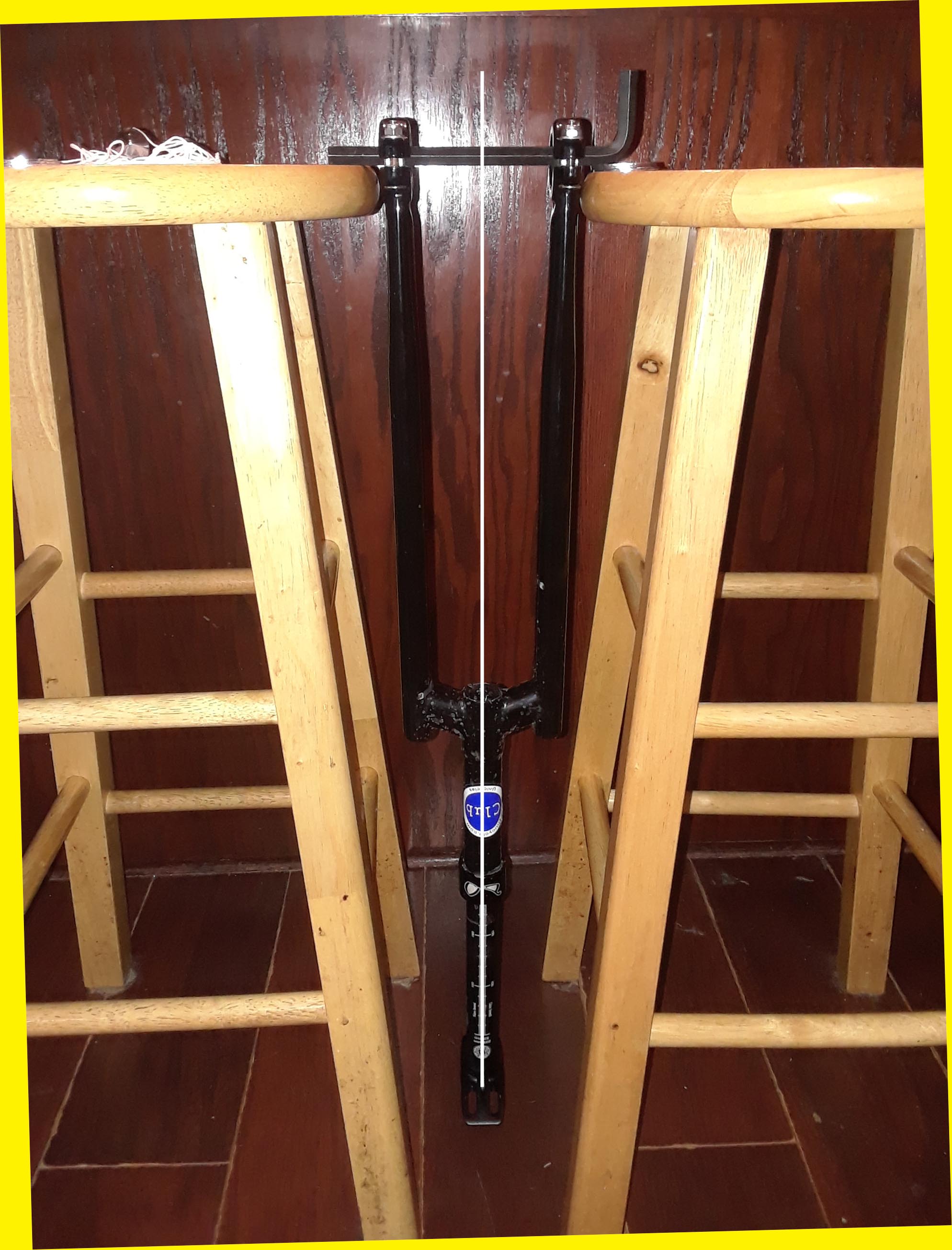
I tried measuring the frame to make sure it’s straight. I installed bearings into the frame and hung it on a straight, level bar (I used an allen key) and used a plumb bob centered at each bearing cap to see if the saddle mount was off-center. I found it was noticeably closer to the left side of the unicycle I have a feeling that best explains my right side tilt.
Does that setup to measure the frame seem reasonable/valid? How would you go about making sure things are straight?
If the frame is bent, how should I correct it? I already have a few shims on the left side bearing caps, but I feel like it would take a lot of shims to get the saddle mount where it should be (I’ll run it with shims if I need to). Getting a new frame is an option of course, but I’d like to see if this one can be corrected.
When I took your photo, leveled the allen key then drew a line perpendicular to the allen key and centered on the seat post, it looks like your frame is centered and correct.
If you flip the wheel L/R, is it still centered?
That’s how I found out my wheel was fine but my KH frame was slightly longer on one leg. Ended up shimming between the bearing and the frame with a thin layer of aluminum from a can.
You used a plumb for the vertical. Did you use a level for the horizontal? If so, and if the bearings were installed properly, your approach is valid in my opinion.
Shims are the obvious remedy, though they only take you so far. If that’s not enough you could theoretically start to remove material from the other bearing holder. The difficulty is to do this properly (most people don’t have a big enough mill with a boring head).
If removing material was necessary I would probably use a Dremel with a rather large (for a Dremel tool) diameter cutting disk[1]. That’s what I used to make two frames Schlumpf compatible - but that didn’t involve working on the surface that “hugs” the bearing, just on the shoulders that guide the bearing. You’d end up with a less than optimal surface. That can be optimised by using the bearing like a touching plate and the Dremel like a scraper. A Sharpie helps to identify the hills that need to be removed. Additionally, when enough material is removed for the frame to work, the surface of the bearing holder could be smoothed by the use of liquid metal or something similar.
That’s what I was considering to do with a crooked frame, but thankfully shimming the other bearing holder did the job. Once you start using a Dremel you risk to damage the frame to a point where it becomes completely unusable, so I’d only do that if you’re very desperate and/or really skilled in doing such work.
Careful with aluminium! I’ve read that it can clog cutting disks and break them when it expands due to friction heat. ↩︎
It might be just in my mind, but it looks bent in your photo – it looks that the seat tube is bent towards the left hand stool. That was my impression before I read that you had measured it to be bent so it wasn’t influenced by that. It looks like you have a spacer on the right hand stool, is that to level the Allen key or to try to correct the plumbness of the hanging frame?
Does the seat post pass freely through the seat tube? If it binds it is likely you seat tube is bent, which could be possible if the seat post was bent. If that is bent then trying to straighten it is going to be pretty difficult, but you could try bending it back using your old seat post like a mandrel.
You could also probably work round this by clamping the seat tube in a vice (with a seatpost in to stop the tube deforming) and bend the frame legs to realign them to the axis of the seat tube. You’d have to do both exactly the same distance though, so you’d probably need some “jig” setup on a board or something so you could check the amount of bend you’d put in. Doing that with a steel frame should be relatively straightforward, you’d just need to take it easy, a little bit at a time, and be careful and check it against your “jig” until you are satisfied that you’d got it the right distance.
Of course starting to do this could mean that you completely fubar the frame (!), but I’d probably give it a go myself it it was way off.
If it isn’t all that far off you could try some washers between the seat and the top of the seat-post at one side to see if that makes it ride any better. You could always take a file to the holes in the seat post if you need to elongate them so you can get thicker spacers/washers in.
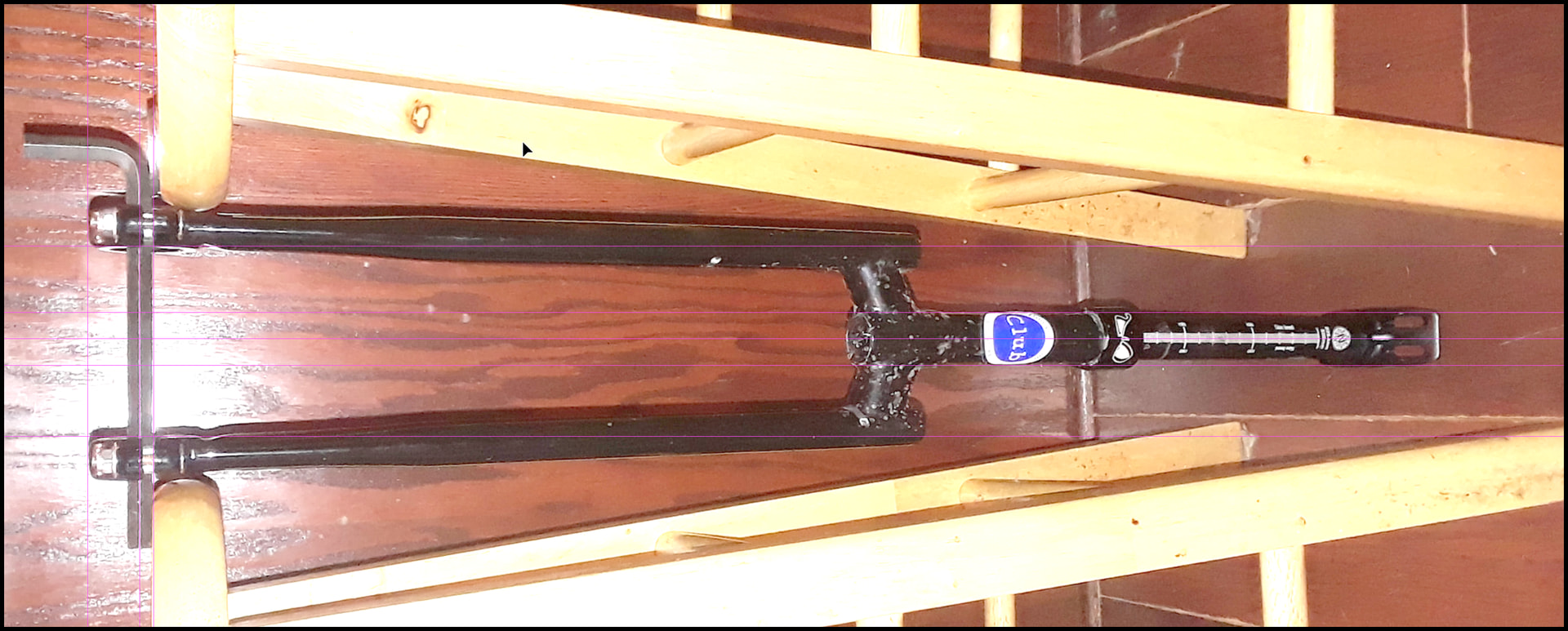
I put your image in Photoshop, camera angles can play tricks on imagery.
However, I rotated the image as carefully / accurately as I could to try and make it level with the rulers and grid lines built into Photoshop. The grid lines 100% vertical or horizontal in orientation.
I had no problem placing grid lines along the hex wrench that matched , the end of the tubes and the inside of the tubes next to the wrench.
There are 3 horizontal lines in the center of the Allen wrench, the outer 2 line up with the outer edges of, the bottom of the seat post “ Shaft ? “ I don’t know what to call the area, its where the tire arms are welded to the seat post. And the seat post is would bottom out at.
Anyway, The center line is perfectly centered between the outer lines at that location. At the Allen wrench, its off center by 5 or 6 pixels.
However, at the top where the seat attaches, It’s off by 9 pixels. You can see it with your eyes. The seat eyelets are shifted to the right, the white depth gauge on the seat post, the line runs on an angle through it.
This may all be a trick of the camera angle, but it looks suspect to me. I think the seat post may be bent.
Regarding your setup:
If the Allen key is tilted (bent, a slight height difference in the stools, or due to the curvature of the Allen key short end) or the bearing caps have uneven surface, the frame would rest slightly sideways and not hang straight down. The error “propagation” would be quite visible on the far end of the uni. The uni isn’t really suspended by gravity, it leans on a surface you don’t really have precise control of. Even a Spirit level (bubble in fluid) would not eliminate all possible errors here.
This is why the approach with lines and grids are way more reliable, nice job folks

 I have a feeling that best explains my right side tilt.