Which do you use cycling computer or phone to track distance and speed
Both (ish…)
I use a Garmin watch for more accurate tracking but have an old Cateye dumb computer (Strada Cadence) on the bars to give me rough on the spot speed and cadence. At some point I’ll probably add a wheel sensor to connect to the watch.
I use a Garmin Forerunner watch. It gives me speed and distance measurements, which is enough for me
I have a Bontrager GOTime mounted on my 36er. I would use it in combination with a phone-based tracking app but my phone is a fossil  But for the purposes I need it for, the cycling computer works well enough. Only finnicky part is making sure you have the correct wheel diameter set in the computer[1]
At least if you have an oddball wheel size that isn’t a preset in the cycling computer. Nonetheless, whether it’s a common wheel size or not, I always manually measure the circumference of the wheel to try to get the most accurate reading possible ↩︎
I simply record with Strava. It isn’t always the most accurate, but it’s sufficient for all my purposes.
1 Like
I put an app on my phone Goals-Fitness. I don’t care so much about how long it takes. I always lose some time at the cold free-mount, but it has been good enough to show me the distance. Also there I don’t care super precise readings. Im only interested in number of kilometres. However last month I looked for a smart watch which I thought I had found, but then the website that had it turned out to be a fake. And then I lost interest in finding something else.
I have computers on the 29ers and the 36er, but not on the 20er. That one is mostly used to practice tricks and stuff. I may add a computer to it, though, partly because it features the same black-red theme as the uni… The 26“ fatty isn‘t equipped with a computer either, at the moment. I think I will change that at some point because it‘s kinda interesting to know the distance of a muni tour.
The big advantage of Strava etc. is that you not only know how far and how fast you‘ve ridden, but also where and when.
GPS watch (suunto in my case). I like that it’s universal for me, I use it on a uni, on my bike or running.
It doesn’t do much that my phone doesn’t do, but it’s nice that tracking activities doesn’t depend on my phone’s battery charge.
It’s going to depend on what info you want or need. A $25 gps cycle computer will give you all you need at your fingertips and can be placed on your touring bar for easy viewing. The cyclepro i have gives me all the info I need on my rides and has a easy to read screen very long battery life. I also use a garmin watch for fitness tracking. The problem with garmin is it has no category for unicycle. I do not like logging my unicycle rides as cycling because it screws up my bicycling stats. I usually log my unicycle rides as running since I do not run there is no overlap. I have mounts for my cyclepro bike computer on all of my unicycles and bicycles so I can switch between cycles. One draw back of the watch is that it gets covered up by my wrist guards which makes it very difficult to access while riding
1 Like
Man genius idea to log uni rides as running!
I also don’t run, but logged unicycling as bike activity. I’ll change that asap!
Many thanks!
1 Like
I also use a smart watch (Garmin) to record my uni rides and I have extra cadence that I sometimes run on my unis. I dual ran my cycling computer when I did a distance event last year which turned out to be a wise move since I accidentally paused my watch at some point. Would have had to ride a few extra laps to hit my target.
I’m waiting as well for Garmin or Strava to add a unicycling category, but for now all my cycling rides are grouped together. At least selecting gear lets you keep track of totals separately.
I often forget to set my watch at the start of a ride or pause it by accident. In never fail to turn on my bike computer.
I think we need a wiki for this! I know my dumb computer is a little off but i’m sure as a group we can get a much better set of ranges put together.
That would have to include the rider‘s weight (or rather, the system weight), the internal rim width and the tyre pressure. Possibly even the state of the tread in case of knobbly tyres. Not sure it‘s worth the effort.
Just remembered, I borrowed a unicycle for track racing last unicon and they had a computer mount on the seatpost. Nice way to do it if you don’t need to look at your info. I have extras of those so I may try that out. I have noticed that heart rate on my watch is not nearly as accurate as using the cycling computer with a strap.
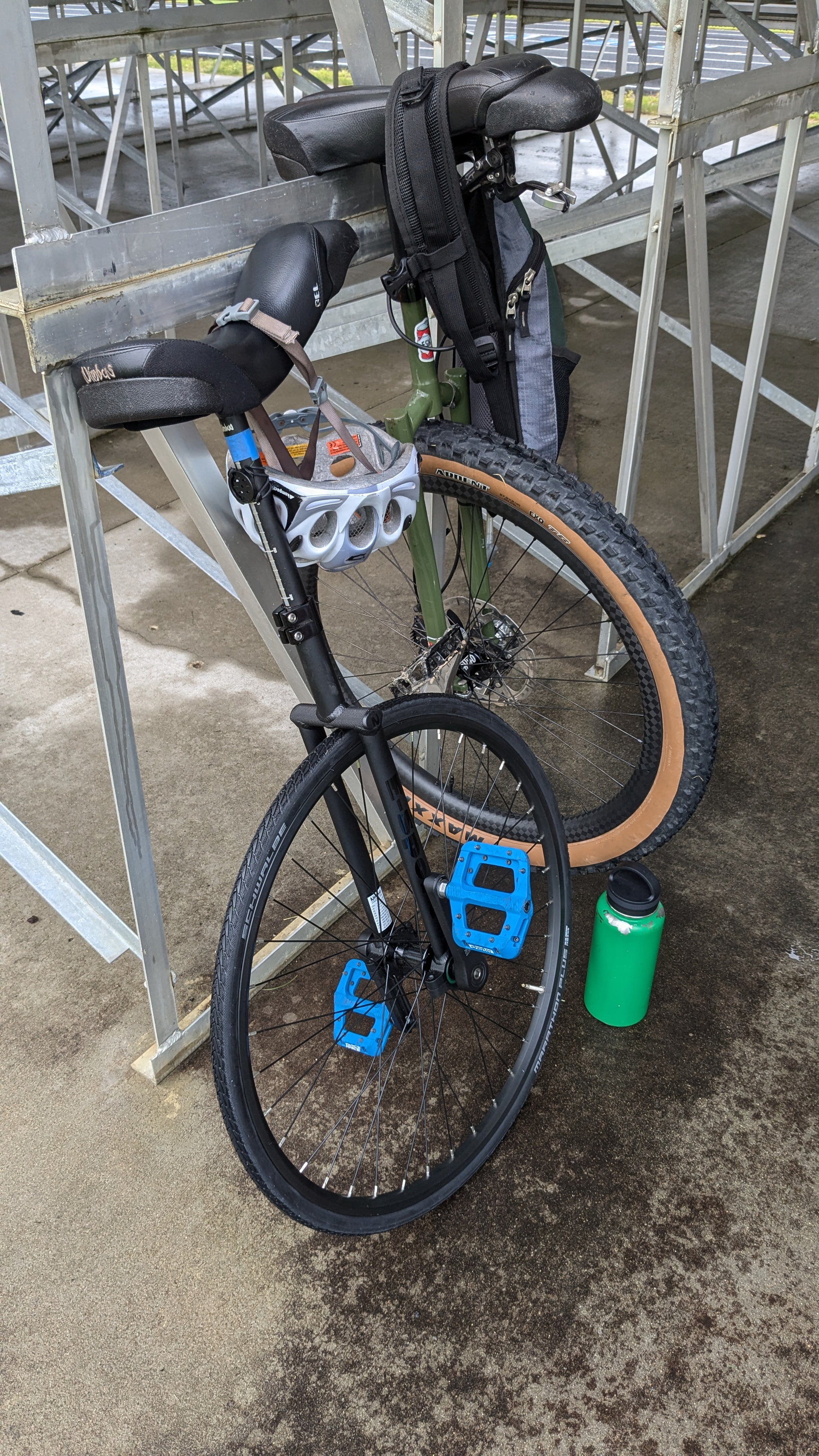
Your welcome
Really? Is a heart rate reader on a watch not accurate? I figured with it being strapped on ur wrist it would work very well. Good for me I haven’t bought a smart watch yet then.
Had one installed the same way for a while. Then I started using Strava. Which is convenient as the phone is always in my pocket. But a bit frustrating because it’s completely insane when it comes to peak speed - as if I could hit 40kmh on a 24"! I might reinstall the bike computer on the 29", out of curiosity for my real top speed.
What if the reading is correct? 

On a more serious note, I have/had lots of obviously false Vmax readings with my computers. Can happen when e.g. mounting the uni, or idling, if the magnet happens to be in vicinity of the sensor and the wheel rocks back and forth. The remedy is to add a second magnet (with 32 spokes) or even a third one (with 36 spokes). I‘ve done this on my G29 and the 36er. In case of the latter the magnets aren’t exactly 180degrees apart (due to it being a 36 spoke wheel [1]) so there’s a minimal inaccuracy. I would‘ve preferred to add even a third magnet, but the cycling computer I use doesn‘t allow a smaller wheel circumference than 1m, and the 36er has only 2.75m. When are they finally going to make bigger wheel unis? 
The 2nd or 3rd magnet doesn‘t prevent false readings, but their effect is limited. In my case I often had readings in the 30 to lower 40 km/h range. With two magnets that would drop to the 15 to 20km/h range, thus within or below top speeds that I actually regularly achieve with the 36er and the G29.
A wheel is usually built in groups of 4 spokes. 32/4=8, an even number. That means that 2 spokes are perfectly diametric to each others, the magnets thus 180 degrees apart. 36/4=9, an uneven number. That makes 3 spokes perfectly 120 degrees apart, and all on the sensor side. ↩︎
2 Likes
I can only comment on my experience with my Garmin Venu SQ2, but I find it not very accurate at higher heart rates. There have been times on the trainer where my heart rate strap will be reading in the 160s but when I look at my watch it’ll be something like 92.
I do find the watch pretty accurate for resting and less stressful activities. If I record a kayak ride or pickleball session the charts look more like I would expect. For whatever reason though, cycling seems to overwhelm it.
Other watches may have better sensors and I have thin wrists, so it’s possible it doesn’t lay optimally. I still use it for uni rides because of the convenience factor.