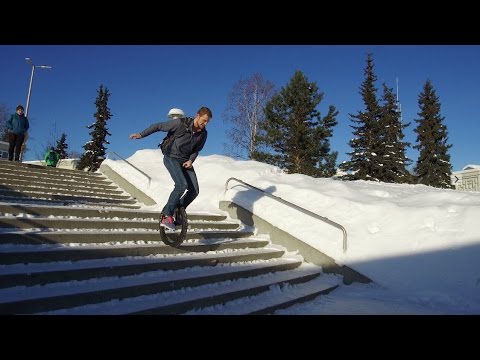
That’s a good question. In Freestyle competition, Mastery is a component of your score.
Not a bad way to define it. When you watch (the majority of) professional unicycle performers, you will typically see a lot lack of mastery. Not because the performer is a crappy rider, but because they do want to make it look hard. This makes it look more dramatic, or more amazing that they are staying on.
In my own shows I would usually start with some sort of a parody of how to get going on the thing, followed by some out-of-control riding. But then I would usually snap into a relaxed, smooth-flowing series of swoopy moves, and go on from there. After all, I was generally billed as a unicycle expert, so I couldn’t fake it too much…
In Freestyle competition, Mastery is defined along with some other scorable qualities, into a pretty long and detailed description:
7D.2.2 Mastery And Quality of Execution
Mastery is the amount of control shown by the rider(s) during their execution of the skills and transitions. The body form should demonstrate good control and Mastery of the unicycle. If a rider is showing good style during difficult skills, the Mastery score should be high. Mastery of the unicycling skills is also required to perform the “additional non-unicycling skills”, such as juggling, dancing, and acrobatics.
There are several viewpoints to check the Quality of Execution, such as Stability, Duration, Speed, Synchronization, and Fluidity of Transition. These viewpoints don’t have to be evenly weighted, but required to check.
Duration: Holding a skill for a longer amount of time and distance also indicates a higher level of mastery and difficulty for that skill.
Stability: High scores should not be given if unintentional jerky body movement, or a wandering spin or pirouette is shown occasionally.
Speed: High score is given when the rider controls the speed (faster or slower) of turns, spins, and transitions excellently.
Synchronization: Being synchronized with the rhythm of the music and timing accuracy should be judged. High scores are awarded for a routine if timing of the skills is well planned and accurate.
Fluidity of Transition: High scores are given for transitions when the rider performs a skill straight into another skill quickly. Low scores are given for transitions if several revolutions, idles, hops (or other setup-type skill) need to be performed before performing the more difficult skill - unless it is obvious that these are used to increase the overall choreography and timing of the routine.
So there is a lot to it, but in general, it’s performing a skill neatly, in “proper” form (which can depend on many factors in Freestyle), in a way that indicates you are comfortable performing it. Duration shows mastery; 10 revolutions of coasting is a lot harder than half a revolution. It’s quite a lot to explain!
 )
)