Another beginner - Devon UK

I’m with you on that. Count or don’t count, ride to a destination or off into open space, think about where your toes are pointed or not; your body is figuring it out as fast as it can, and the other stuff might just keep your mind from getting bored meanwhile. But that’s cool too.

It sounds like it’s coming along just fine.

The same thing happened to me as a beginner; strangers gave me advice. I don’t recall it ever being bad advice. The kid who mentioned (to Spinningwoman?) that the unicycle wasn’t a free wheel … was onto something … most people don’t quite get that, and as a result, they think unicycling is more dangerous than it really is. A stranger just asked me, yesterday, if we freewheeled going downhill. I told him that freewheeling represented a super high-level form of technique, something I may never be able to do.

Slipping back: as a beginner, it took me 30 minutes to be able to replicate my successes from the previous day.

Spinningwoman: It’s hard to get advice which is timed exactly right. I’m interested in your distance limit. If it were a matter of each pedal stroke having a certain probability of success, then I would expect you to have experienced a few, randomly long launches. But, instead, there is the limit. So, the question is, why?

Do you tend to fall toward the left or right at the end of your rides? Do the balancing motions of your arms get larger from the moment you launch to when you dismount? Does your speed keep increasing during the ride? Do you tend to end your short rides with either the left or right foot in the downward position? Is there any hint of left-right steering currently in your technique? Are particular muscles tiring out during your short runs?

At the expense of repeating what’s already been said, here are some take-or-leave suggestions, based on what worked for me:

During the period when I couldn’t control my speed, it helped to launch into a slight uphill. The added resistance of the slope helped control speed and get more feedback between my feet and the pedals.

You might consider counting “complete” pedal circles, rather than 1/2 cycles. It is possible this could change the cyclical motions of your body while you’re riding.

Start practicing idling: Don’t expect to learn to idle…but idling forces you to feel the physics of having the unicycle out too far in front of you, then making a correction. During idling, that correction is performed by pedaling backwards; while riding forward, back-front correction is more subtle, involving a letting-up of forward pressure, or a small amount of back pressure, on the pedals. Make sure to hold onto something, at this point, while practicing idling. Most beginners are way more accustomed to the physics of fall-forward = pedal-faster. Practicing idling may help you learn the feeling of letting-up/backward pressure on the pedals. When my 13 yr. old neighbor rode 50 feet, I noticed that, on some of his more successful runs, he briefly stopped pedaling partway through the ride, letting his inertia and his outstretched arms momentarily keep him balanced; then he started pedaling again, riding further. Otherwise, he kept getting faster until he lost control.

Spinningwoman: sounds like you’re more consistent right now. That is good news!
I didn’t mean any criticism by the comment about the timing of the advice. Quite the opposite - if something doesn’t match my experience today, it’s very likely it will next week or next month. So keep it coming - it’s all good stuff.

I don’t think you are right about the ‘distance limit’ thing at the moment though, on a few levels. For a start, I think you misunderstand what level I’m at. I’m not doing a number of pedal strokes (like 9) regularly and failing to get beyond it. My ‘success’ rate follows a pretty classic curve - a few ones and twos, more threes, quite a lot of fours and fives, a few less sixes, a few sevens and very occasional eights and nines. The bulge is the fours and fives and the eights and nines are the outliers - a week ago, that was the sixes, so the curve is moving.

Second I don’t think the maths is right anyway. If it is actually true that ‘each pedal-stroke has a certain possibility of success’, and if that possibility is currently quite low, as it clearly is for me, then mathematically, randomly long launches are going to be disappearingly rare, just like the odds on an ‘accumulator’ bet on the result of a sequence of races are really long even though you might bet on the favourite in every race. And in this case, I suspect that every pedal-stroke in a sequence actually has a diminishing possibility of success, since mistakes in the adjustment of balance are cumulative and it becomes harder to recover. Plus, muscular and mental tension builds and it probably becomes harder and harder to keep your conscious brain from interfering.

And third, that’s not what I see watching people’s video records or reading their stories of learning. Although they are mostly progressing much more quickly than me, I think their curves are a similar shape. They don’t just hit random long runs in the middle of nowhere. Once they hit a new maximum distance, that new maximum gradually becomes the new normal, until they finally get to the magic point where yes, something ‘clicks’ and although they may still struggle for consistency, they are no longer limited by specific distances or pedal-counts.

I almost invariably swoop to the right and end coming off forwards with my right foot coming off the pedal at 12 o’clock because I’m already falling too far forwards to chase the pedal back down for another turn. I don’t feel any particular muscle tiredness, but I literally cannot make my feet pedal round any faster.

I’ve actually been doing that, ever since getting the 16" and finding I could almost freemount it. The smaller circumference makes the idling motion much easier - I can feel the pendulum motion with my head as the pivot and occasionally actually manage a few back and forth idles unsupported.

Don’t lean so far forward. Perhaps you are over-compensating for fear of falling backwards.

I suspect you are too focused on the idea that speed overcomes balance issues. You lose the opportunity to make corrections. Ultimately the momentary still stand is the panacea to many problems.

I would also encourage you to look closely at seat height. It is far easier to balance when the seat is the right height and most beginners err on the side of too low because they feel safer close to the ground.

A higher seat results in straighter legs, greatly reducing the amount of mass waving around in a stroke and allows you to accelerate faster when required.

It extends the window where the centre of mass is inside the base of support.

Tip top advice there, my seat height is probably too high, but it seems to fit me well despite all the teachers… tyre pressure are another thing to enter into the equation, I am now about to reduce the pressure by about 50% to prevent hardness on lumpy surfaces. I tend to experience the momentary still stand quite often, and it usually helps to correct things, albeit rather speedily. I must be doing things roughly correctly… !!

Yes, I totally agree with this. at first, the only way I could make a few revolutions was to get a bit of momentuum going, and I was hearing the advice to pedal faster to bring the uni back under me, but I think that’s a false path. It is when I get that moment of still-stand that everything falls briefly into place. One of the reasons why I like aiming for count rather than distance, is that aiming for a place makes me subconsciously lean forward for it.

I’m pretty sure my seat height is highish rather than lowish. I pedal with the ball of my foot and I notice that if I mount and get my midfoot on one side by accident I lurch to that side because I can’t pedal to the bottom of the stroke without my weight shifting. But I do keep playing with seat height as my 20" tends to adjust itself on a regular basis!

Spinningwoman: thanks for clarifying your riding and your willingness to say I’m wrong. No offense. Throw an idea against the wall … it either sticks or it doesn’t.

I am curious, where in the cycle of the pedal stroke your count goes. I wonder how counting strokes at the 3/9 position might be different than at the 12/6 position.

Back to OneTrackMind’s quote: Still stands might be the cure for some of the (correct or incorrect) advice you’ve gotten from other riders.

Performing a still stand, even for a split second, at the 3/9 pedal position, allows you to, prior to the still stand, get the wheel too far out in front of you. Now, if your mass is already too far forward, you’re going to perform a front-dismount upd right after attempting a still stand. After practicing this for a few times, however, you’ll figure out how to get the wheel in front of you, then pause, letting the momentum swing your body forward. This creates a kind of “reset” of your riding, helping to control your speed. Once you stop and swing past the center of gravity, you can start riding forward again.

Day 48/40

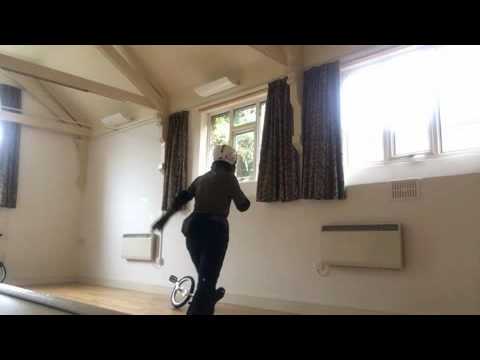
After a couple of days with no opportunity to practice other than idling while watching TV, I was really excited to try my new early morning practice space in the village hall. The first half hour was quite poor, but then I decided to make a specific effort not to lean forward, even though I didn’t feel as if I was. But as I kept coming off the front, presumably that meant I must be, as someone pointed out. So I sat up until I almost felt I was leaning back, and it made an immediate difference. Shortly after this I realised than now I was inside, in private, it was a lot easier to film myself. I had tried at the skatepark but what with feeling self-conscious and worrying about my phone, I never managed to film myself doing anything except fall off immediately. This time, it worked quite well and I got a representative video of where I am, so it would be great to have some comments and suggestions once I get it uploaded. It is quite long, but my best run comes at about 6:45 I think.

You definitely have a strong tendency to turn right. There may be a problem with the uni.

Turn the seat around and ride it the other way to see if that makes you turn to the left. (Don’t do it too many times or the pedals may come loose.)

The other possibility is that you have been learning on a side slope.

It’s the same whether I’m on the 16" or the 20" so I think it’s me. I’m assuming it is just that my right leg is naturally stronger. Actually, the sitting back thing actually improved it somewhat.

Thinking about it, tomorrow I might go across the hall so that there aren’t any side walls to exercise a magnetic attraction. The width of the hall is a feasible distance, and I could set a marker to try and keep me straight. I hadn’t really thought about it before, but of course the right hand curve is one of the factors limiting my distance, as I kind of spiral into UPD.

Going off to the right may just be a habit at this point. Try looking forward and to the left, focusing on something in that direction and intentionally trying to gradually go left and that may help straighten things out.

I think you might do well to try a different tyre.

Some tyres have an aversion to running on the centre and will flick to one side or the other. If you have the slightest bias, then a tyre like that will grab it and run to the side. It isn’t noticeable on a bike but can easily overwhelm a novice rider on a uni.

An example of such a tyre is the Maxxis Ringworm. It has a series tread blocks that cross the centreline that force it to run several degrees on one side or the other. Never upright. It was the first replacement tyre I bought from a local bike shop for my 20 and it was unrideable. Some tyres have an elliptical profile (“pointy” in the middle) and tend to behave similarly.

I replaced the Ringworm with a Maxxis Hookworm which has a lovely rounded profile and is a fabulously stable tyre on a 20. I would highly recommend it for you, though I don’t know about its propensity to mark.

Nobody else ever mentions the Hookworm for a 20 inch. Maybe because it has a ridiculously conservative (IMO, just plain wrong) load rating of 75 kg moulded into the tyre. It is one of the most robust tyres I have ever seen for a 20 and I wouldn’t hesitate to load it at 150 kg on a decent rim.

Ironically, the Hookworm is recommended by some riders for 24s and 26s despite it being absolutely horrible on hard surfaces in those sizes due to the strong tendency to run down the slightest camber, especially at low pressures. It is supposed to be a good crossover tyre but definitely doesn’t do well at all on hard surfaces.

Moreover, the Hookworm is a very heavy tyre which is a bad thing on larger wheels and a good thing on small wheels where the momentum actually helps smooth out the power pulses.

Spinningwoman,
Just saw the video, and you’re doin’ great. On that first attempt, and on several others, you looked like a seasoned rider until the upd at the end, and you made it all the way to the wall as well. Cool!

I couldn’t see your feet or when you started, and other aspects are obscured in the video, but it looked like you were leaning forward 1st and then pedaling, almost as if you were leaning forward to get your momentum going and then pedaling. It could also be that you weren’t straight when hanging onto whatever you were hanging onto before you started, and that you were just straightening yourself up before you started pedaling.

Most people seem to take a slight pause between mounting and pedaling, likely to get adjusted before moving forward, so I think that’s perfectly natural, but in most cases, I see the seatpost leaning backwards, not forwards as seems to be the case from your video. It could be a number of things that I’m mis-reading, but it just seems a bit off to me.

If you are leaning forward to get your momentum going and then pedaling, I could imagine how you could be starting off balance and fighting to regain balance until you upd. I may be way off on this. It’s just a thought. Anyone else see that or care to comment?

If you think there’s any merit to this observation, maybe you could get another video of yourself so we could see your feet and the angle of the seatpost, and generally as much of yourself and the unicycle in the frame as possible for best analysis.

That said, I think repeated practice is probably more valuable than too much analysis (although, encouragement is worth its weight in gold.) Take the advice for what it’s worth, but realize that the body and cerebellum are going to do all the hard work in the end, and very little of your conscious thoughts are going to help much beyond gross commands, and even those can get in the way. We are our own worst enemy! Just keep at it, and you’ll eventually get there. You’re doing great.

Thanks - another time I will take a proper tripod so I can get a better angle on a video. I would like to see it better in my head. ‘Thinkers gonna think’ as it were - I don’t think I can avoid trying to analyse what’s going on so I will just have to hope that while my head is doing that, my body will be getting on with the job.

Most certainly I am no expert, but Bradford seems to be on to the right track. Although the camera angle etc is difficult to analyse proceedings, the very last attempt on your video clip shows, I think, the seat post/frame leaning slightly back instead of ramrod straight. When I watch unicyclists on Youtube, this slight deviation from the exact vertical seems to be a correct manner of riding. Perhaps I am wrong, but I do make a conscious effort of keep my frame slightly leaning backward, as though my backside was a bit too far behind me. I did meddle with the slotted retaining holes on the saddle for a bit, and whether or not that helped, is a mute point, but I tend to have the rear of the seat as far forward as possible by these slots.
I also noticed you correcting the seat straightness with ease. I have a dickens of a job moving mine unless I loosen the seat bracket considerably. Maybe the banging on the floor moved the seat, but it seems rather on the loose side to me, but again, I may well be wrong.
I found myself holding my breath every time you launched away, but the successful ride, and the little self congratulation at the end made my day, excellent, well done…

It does look like the unicycle itself is leaning forward (from that camera angle). Try allowing the unicycle to lean slightly backwards while you lean slightly forward (as Regina Wrecks suggested).

I do find it surprising that there are no gender-specific saddles. I can’t help feeling that the requirements must be somewhat different.

Trying to be genteel here, when I get my shin/knee guards so that I can engage in free mounting proper. I am looking forward to getting myself comfortable before mounting. The fear of not doing so far outweighs tardiness in not doing so. Unicycles are certainly not male friendly from my experience if treated wrong. Specific seating is a simple seat/support without too many embellishments for either sex. I did examine this briefly a couple of weeks back, others, more expert than I, have re-designed, manufactured, issued all sorts of types over the years, but they all fall into the same design overall. I notice those on Chinese Giraffe circus acts, throwing bowls about etc, have a rather thicker padded seat of various hues, but even they look very much of a muchness… I will say the Muni I invested in recently, is altogether more comfortable than the cheaper 20".