I wrote this post some weeks ago in a bout of enthusiasm at a unicycle idea I had. Since then I’ve been wondering if I’ve actually got the correct idea of what splines are because some recent posts seem to be saying that splined cranks aren’t particularly easy to take on and off.
However, here’s the post in its original form, it’s about an idea for adjustable cranks, all comments welcome.
==============================================
The most obvious way to make adjustable cranks is to simply have extra holes for the pedal to screw into, this has the benefit of simplicity but also several drawbacks: -
- when in ‘long mode’ the inner hole is a weak area for the crank
- changing length necessitates unscrewing the pedal and rescrewing it into a different hole i.e. inconvenient if changing a lot and also, I suspect that there is a limit to how often they can be changed before the threads start taking damage
The other method, and one used in commercial models, is a sleeve arangement; it works and seems to be intended for tandems, but involves compromises between strength, ease of adjustability etc.
The few tests of available adjustable cranks by unicyclists seem to have not been successful, with the cranks breaking; though we should differentiate between cranks used for commuting/transport and those used for muni/trials (with big drops etc).
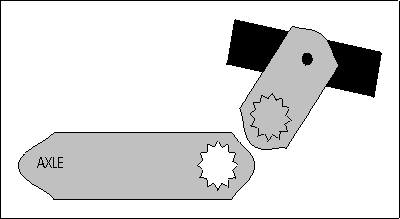
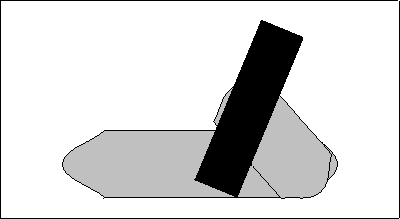
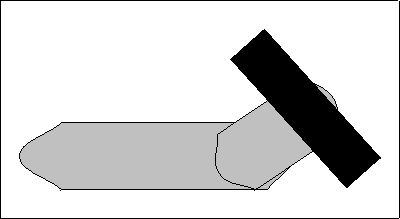
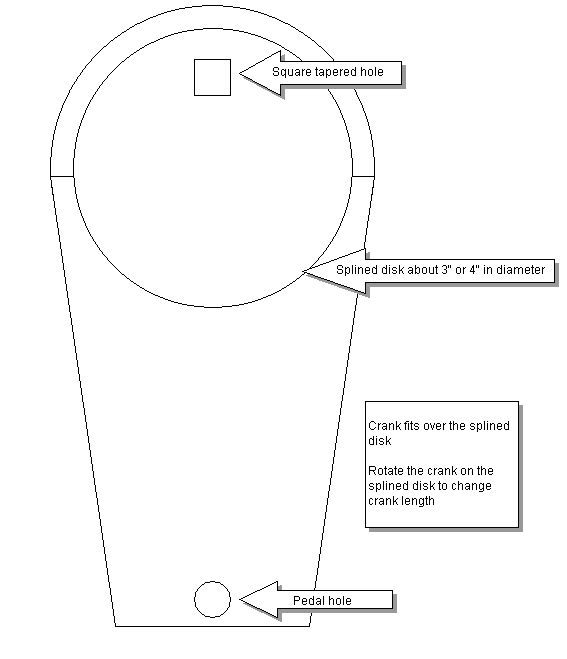
So here’s my idea, in theory it looks like it should work well, but, lacking the tools/knowledge necessary to make a prototype, I’m not able to make and test it out. (see attached image)
The idea is, rather than adjusting the actual length of the crank, the distance betweeen the crank and pedal is altered by a mechanism that effectivly creates a bend in the crank.
So, if it is set to ‘125 mode’, the pedal axis is 125mm from the wheel axle, creating the same leverage effect as if a 125mm crank is used.
The benefits of this system is: -
-
Use of present unicycling technology; splined axle/cranks are becoming commonplace and the same tools could be used to create the elements of the adjustable crank.
-
Strength. I’m no engineer, but, given that splined axles/cranks are used in top of the range muni/trials unis, and, as far as I can see there is no reason why the stress on pedal/crank splines should be greater than the present axle/crank splines; then this setup should be strong enough for all uses of uni.
-
Ease of changing length. As all the stress of riding should be mainly in the direction of the circumference of the spline hole, rather than at right angles, it shouldn’t require a hefty mechanism to hold the pedal in the crank hole. This means that something as simple as a hole drilled through the protruding spline part with a retaining pin should sufice, enabling quick and easy changes.
Like I said, I’m no engineer so maybe there’s some flaws I’ve missed and it’d be great if someone with experience in making uni parts/engineering gave some feedback.
It’d be nice if it did work because one of the things I love about unicycles is their mechanical simplicity. As someone whose experienced the pros and cons of different crank lengths for a given wheel size, i know that a workable variable crank would be a great boon to unicycling.
Of course, it looks like geared unicycles will soon be on the market, but my feeling is that they will have issues of cost and lack simplicity.
While gears may have the edge in terms of a large range, I would be quite happy with a crank that adjusted from 150-125mm, and I see no reason why a range of 100-175mm should not be feasible with a splined angle crank mechanism.