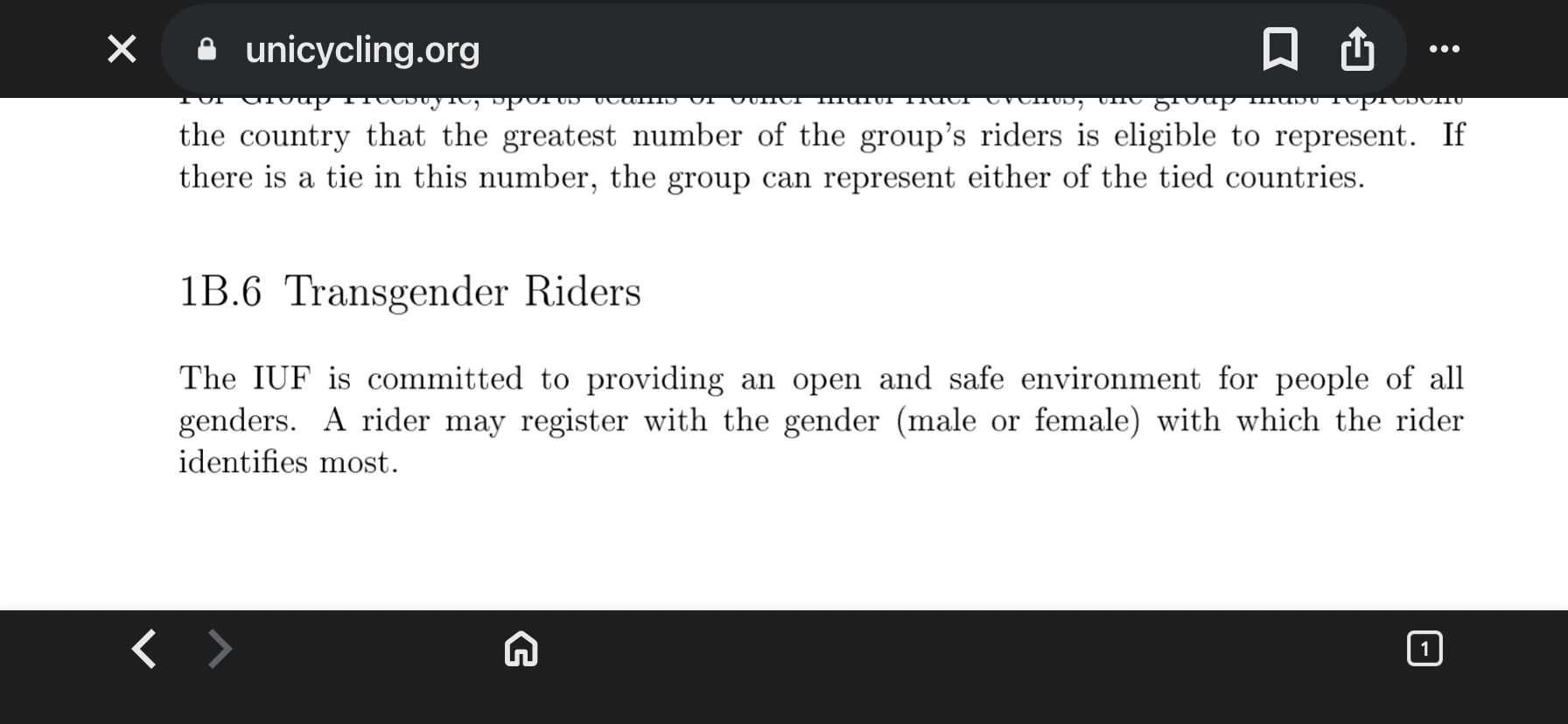
To speak a little more broadly about the conversation, when you really get into it, meaningful sex determination is actually really quite difficult. We did look at what a ruleset would look like if the competitive category would be based on government documents. There are big problems with that approach. Many locales offer a process to amend a birth certificate. When I applied for my passport, the US would have issued me one with an X gender marker if desired. So not only does this approach not handle verifying assigned at birth gender, it changes what category you may compete in depending upon your country or state’s laws.
This is also not the fairest way to handle the situation. Imagining we could determine assigned birth gender accurately, if you used that as the criterion it would force trans men to compete in women’s categories.
To be clear, the science on absolute performance of trans women is far from settled. Very few studies even have a meaningfully high activity level population, let alone a competitive athlete population. Trans athletes have a historical reason to distrust those who seek to do these studies as well. Trans athletes were allowed to compete in the olympics for over 20 years provided they meet certain eligibility requirements, and that has not resulted in dominant performances, which really casts doubt on the idea that they are fundamentally that advantaged.
Trans men are literally women. There is nothing that can change a man into a woman. It’s not physically possible. So I don’t think it would be unfair in the least to put trans men with women, or trans women with men.
So i take this to mean you are opposed to transgender people on an ideological level, rather than as a matter of fairness in sport. I don’t think we will see eye to eye on that matter.
I’m both. I don’t like how transgender people, especially in women’s sports, have made sports unfair and in some cases, unsafe. Sports should be divided male and female, no crossovers.
And yes, I believe transgenders are mentally ill, and need treatment, rather than being affirmed in their illness. But that’s not the issue at hand. We’re talking about gender equality in sports, and this doesn’t have to turn into a boxing match.
I don’t think there is much evidence at all that transgender women have a meaningful advantage in unicycling disciplines over cisgender women. Further there is evidence that a transgender man would possibly have an advantage. Maybe you have contrary information, but otherwise I can’t really justify a ruleset asking transgender individuals to compete in a gender other than the one they live every day within.
Again, this discussion is not related to our proposal but rather the rules as they have existed for years. We aren’t proposing a change to the rule as the rulebook committee came up with in the 2019 rulebook that has been used for dozens of competitions
Have you informed yourself on the topic? Trans men that fully transition, most likely go under HRT (hormone replacement therapy), meaning they take estrogen blockers (as long as they still have their gonads) and more important: they take a lifelong medication with testosterone. This has a huge impact on building up muscle mass, strength and bone structure. Every woman taking testosterone on levels used for HRT would be banned for doping. As already said: It’s not as easy as it seems …
Okay, now it’s clear: you have very, very little knowledge on the topic. Please do yourself and us a favor and inform yourself before you post such things.
(That’s a bad as in the times, when homosexuality was considered a mental illness that needs treatment. And even further back in time, it was female sexual arousal that was considered and treated the same way …)
The other side of the medal is that we had queer participants in Steyr being confronted and discomforted by anti-queer behaviors and thus not having a great time at Unicon. Queer people still have to fight their whole lives for being treated equal. Nothing is taken away from non-queer people by the fact that we continue to advocate for the interests of queer people, and that we demonstrate and remind others of this. I guess, no cis hetero participant was confronted with anti-cis or anti-hetero behaviors at unicon.
Yes, I have researched it. You cannot physically change your biological gender. A women who tries to transition can’t get rid of the XX chromosome that makes her a woman. She will never have functioning male genitalia. She can take lab created male hormones, but her body will continue developing female hormones. Of course she will start looking more masculine and bulking up, but her underlying composition is female.
Living as your preferred gender is very doable these days, but physically changing your genetic makeup is impossible.
Your’re overseeing, that many of the gender related body characteristics aren’t controlled by the chromosomes, but by the hormones.
clearly, the chromosomes will never change. But what do we want as a measure of categorization for fair competitions? Chromosomes that have no big influence on physical strength? Makes no sense at all.
And, by the way: do all XY-chromosomed men have functional male genitalia? Aren’t they men, when they don’t? And what does it have to do with our topic? Do we want genitalia function as a measure for categorization?
“Yes sir, if you want to compete in the male category, please fill out this form, jerk into this container and good luck at the competition!”
And now I can’t get rid of the image in my head of over a thousand participants at Unicon cuing up for cabins to showcase their genitalia function in.
Okay now that’s going too far. Genitalia isn’t the only qualifier, it’s just one very obvious way to tell a man from a woman. Or at least, it used to be before things got all mixed up. It wouldn’t be viable to use genitalia to categorize genders in sports, you’re right about that. But that also doesn’t mean that I’m not right that a woman can’t become a man and vice versa.
Also, do they ban masculine women from womens sports simply because they have more masculine features? Look at the sport of powerlifting. Many of the women in that sport are more masculine, yet they are accepted as women. They have merely have a genetic advantage over the average woman.
If women athletes were taking testosterone, they would be considered to be on performance enhancing drugs and unless doping was allowed in their chosen sport, they would be excluded from competing. This is, of course, if the sports were separated into birth gender. So the question is, is it fair to exclude an athlete from competing if they are on performance enhancing drugs?
I’m pretty sure I know the history of coolness. What I meant is that if people said something like :
It might create some deserved shitstorm.
You’re right, I haven’t heard a single cis het person getting confronted because of that. And it is a shame that queer people received that kind of treatment. But I still don’t like the fact that the flag gets showed that often.
I perfectly understand why it is here, and I’m sure including everybody is the thing to do. But I don’t feel comfortable with the way it is done. It might be linked to my point of view on transidentity though I don’t think it is a mental illness, but yet, I feel like for way too many of them it isn’t a good thing. I won’t elaborate more about that, it isn’t the topic of this discussion..
Anyway, back to the main topic, I see several answers to the “problem” of trans athletes in sport :
trans persons don’t exist, you cannot change a gender
trans men (ftm) compete with women, trans women (mtf) compete with men. The first ones are basically on performance enhancing drugs, there is no way the second ones are competitive.
trans women (mtf) compete with men, trans men (ftm) are banned because they are on performance enhancing drugs.
trans persons are of the “desired” genre
trans men (ftm) compete with men, trans women (mtf) compete with women. The first ones are likely to never win (due to a bone structure not built like the one of “real” men) or could be considered doping, the second ones might have an advantage (they went through a male puberty).
trans people compete in their own category. It creates a discrimination, and their isn’t enough trans people anyway to create a real competition. And how do you define who has achieved a transition ? Could a buffed man compete among women because “they decided they are a woman today” ?
we remove male and female category. It invisibilises women once more.
we add an overall category. It would most likely still be a men podium, thus invisibilising women.
Please note that some of the sentences used are not what I think, but a way of describing the rule / idea behind the rule.
I don’t even know if there is a solution. Maybe the solution would be to stop competitions, but that would also be sad.
Yes. In fact, it is happening at all levels of sport that masculine-appearing girls and women are dealing with the horrible consequences of being accused of being trans. Including becoming internationally known because their names are plastered across transphobic right-wing media.
I appreciate the multi time world champion sharing his thoughts here! It is highly valuable when someone with your experience and background takes the time to explain his perspective and reasoning.
While the discussion is about who is “enough male” or “enough female”, you are bringing up an interesting side question of being “enough adult” I completely agree that some age limits may be necessary, but I wonder how we define “too young” in a fair and consistent way. It seems to me that we immediately run into the same kind of eligibility questions: who decides the threshold, what criteria are used, and how do we deal with exceptional athletes?
A recent example in Unicycle Basketball comes to mind. At a Unicon not long ago, a 14 y.o. rider was initially not cleared to compete in the adult Tournament A. An exception was eventually granted, and he went on to win bronze in what was probably the strongest competition Unicycle Basketball had seen to date. The kid did make an impact and went on to demonstrate on the court that the exception was not just a hypothetical case. There was also a nice bit of irony: some of the people involved in making that decision later had to face him on the court. And he gave them a very convincing argument for his eligibility. This year, we saw another 16 y.o. kid on the podium — he would also require an exception to play as an adult if the Youth Tournament had materialized (in fact, both of them would require an exception this year).
So even with something that looks much simpler than gender categories, the practical questions become surprisingly complicated.
And this is an interesting one as well. There is a deaf athlete in the community who competes in Unicycle Basketball with a helmet to protect his hearing devices from impact. The problem is that helmets are prohibited by the Unicycle Basketball rules for safety reasons — the safety of “other people”. So in this case, his health condition is obviously his concern, but whether he can wear a helmet is a big question for the community. He competed with a helmet under a conditional exception for four years, and the safety concerns turned out to be unjustified. Now the 2025 rules have been adjusted to explicitly allow helmets.
To me, this is an example of why “it is the rider’s concern” does not quite work as a general principle. Sometimes an individual condition intersects with the rules, and then it necessarily becomes a concern for the organizers and the other participants as well.
And this one raises another question for me: who and how defines a “technical competitive event”? Are IUF Slalom or 50m 1-foot technical? What about Unicycle Hockey and Unicycle Basketball (again)?
I can easily imagine arguments either way. I see Lisa Hanny and Mirjam Lips being fast enough to make finals, or even podium, in many male Slalom competitions. So maybe Slalom should be considered technical? Unicycle Hockey has quite a few female, and probably trans female, riders on the champion team — is that technical enough? Then we have Unicycle Basketball, with lots of female participation at the lower competition levels, but only two women in the final four. Same story: how do we define when a competition is “technical enough” for gender not to be considered an influence?
It seems to me that once we try to turn the general principle into an actual rule, we immediately need another definition and another set of criteria. And that definition may be surprisingly difficult to make objective.
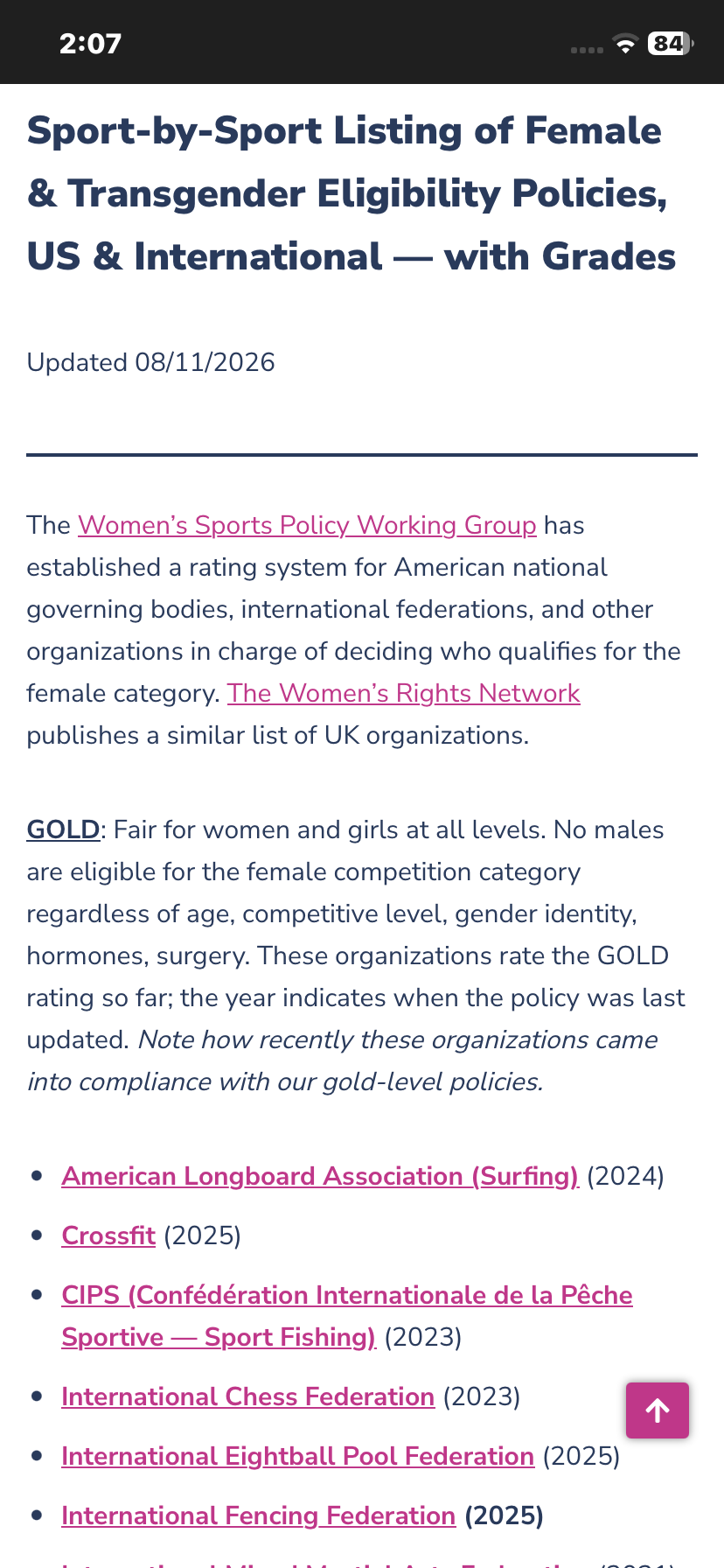
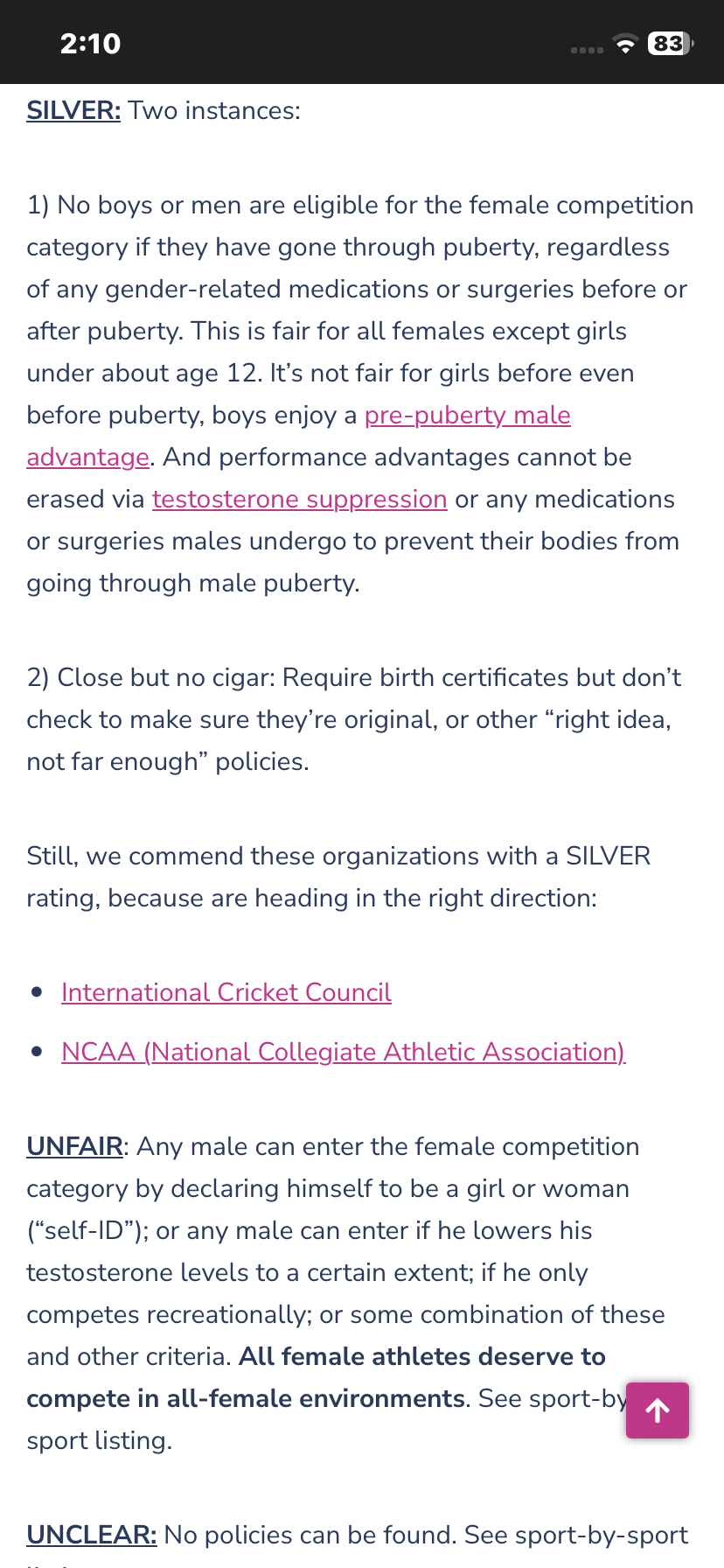
I would urge caution with this Women’s Sports Policy Working Group. They are a substack newsletter, do not appear to have any peer reviewed publications, and may be ideologically driven towards a specific outcome. I won’t spend hours on every detail, but as I read something they had produced it cited a .02% rate of intersex conditions, which doesn’t align with prevailing science. Luckily they linked to a source, which was a court testimony that showed an infographic from a twitter post asserting that claim. The witness who produced said infographic is an entomologist who has not published anything peer reviewed about human sex. I think any reasonable person could agree that this specific instance is a bad-faith citation
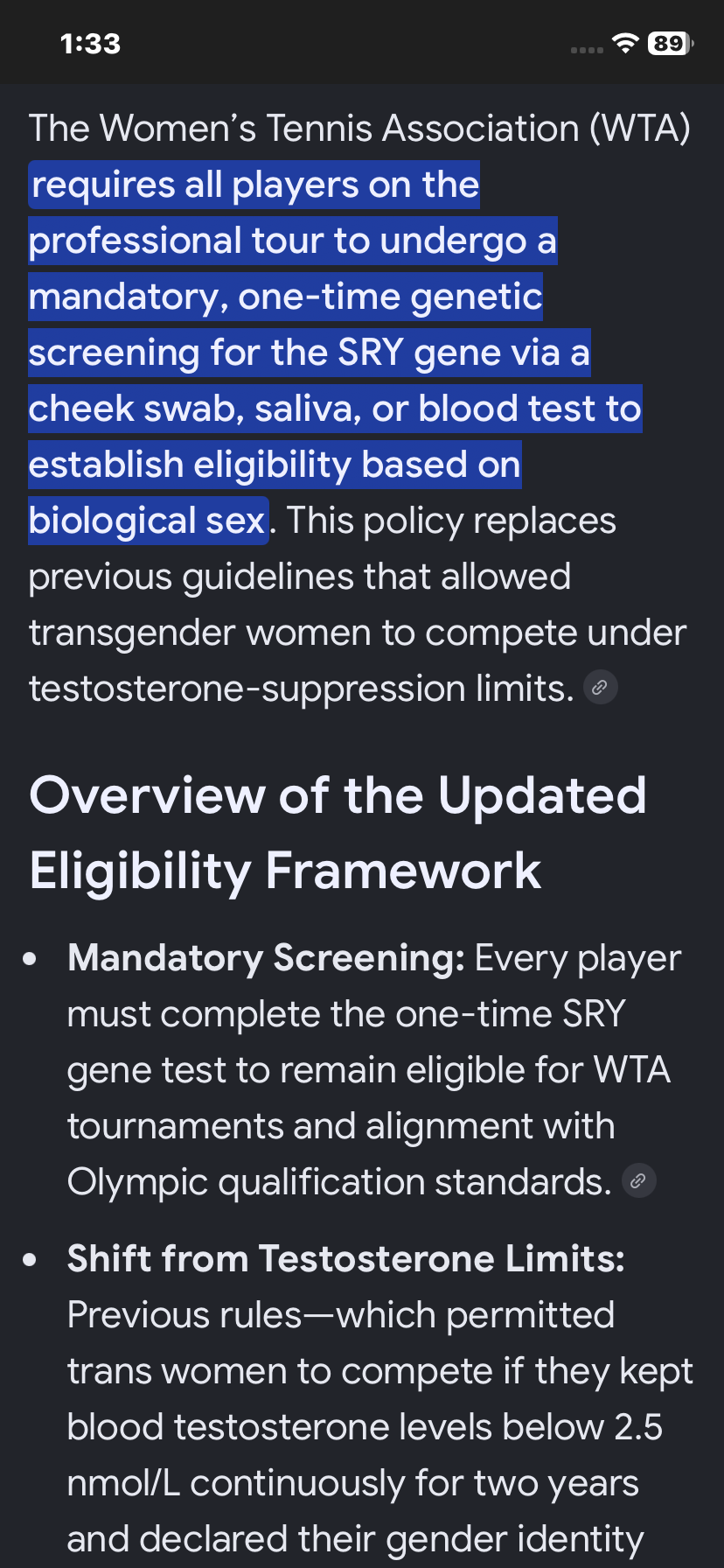
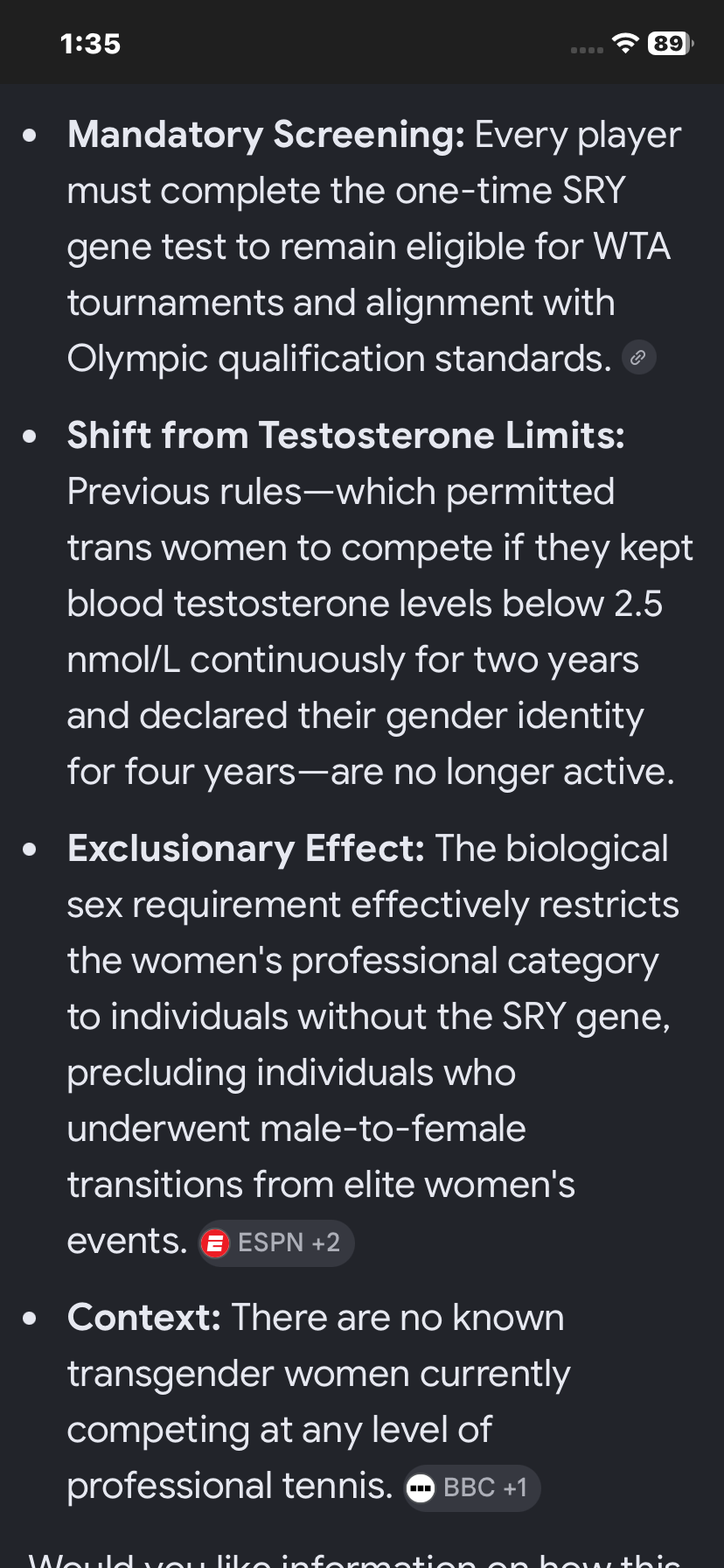
Thanks for sharing AI slop about some arbitrary sports here. It is not clear, though, what your stake in Unicycle Hockey is, or what you suggest should change regarding restrictions on players’ participation in Unicycle Hockey.
Though it may be ai, that is all useful information. And if dont want to hear it from that, look at the citation or ask to see the sources. If you look it up you’ll find the same info on official real websites


 I completely agree that some age limits may be necessary, but I wonder how we define “too young” in a fair and consistent way. It seems to me that we immediately run into the same kind of eligibility questions: who decides the threshold, what criteria are used, and how do we deal with exceptional athletes?