Pete… I had a chance to go through all of the posts this weekend regarding your amazing geared 36" uni and I am blown away by what you’ve done. I agree with you completely that this is the future of high-speed unicycling and I believe that your technology could really elevate the sport and give it much more appeal to the general public… who like things that are fast! As a result of using my Coker as my exclusive form of urban transportation here in NYC, I have become quite maneuverable on it… due to all the practice I’ve had weaving in and out of traffic and avoiding bicyclists, pedestrians, cab doors (did get taken out once… and did a fifteen foot “superman”, pot holes, and other obstacles. On straights, my cruising speed is quite high and I just slow down a bit to dive the Coker around turns (which usually ellicits quite a response from onlookers who never expect me to lean the thing over so far). I’ll be posting some video next week to demonstrate a little bit of my current level of maneuverability on the standard Coker… but I am quite curious if I would be able to achieve the same level of maneuiverability of the geared 36" with adequate practice? Anyway… if your amazing geared unicycle should ever become available for sale to the public… I’d love to be amongst the first privileged people to buy one… because as soon as I get my hands on that thing, you can be sure that I’ll be at the velodrome several times a week to see how fast I can go and how high I can get up the banking! I won’t be happy with anything less than 35mph… but 40mph is my ultimate goal!
Thanks for the vote of confidence Hardcore! But I’m still experimenting in this unknown environment, and I have no intent myself to produce geared unis for sale. Having posted all this in the public forum, I will leave production to others who are more set up for that. But I’d be happy to talk to anyone interested in making the parts, I’m sure we can do it economically as a kit with instructions or something like that (to keep the costs down).
There’s still alot of sorting out to do, but the 1.5 overdrive is clearly insufficient for fast riding on the flats. I’ve had no problems with maneuverability; it feels just like a bigger wheel in speed, but still acts like a 36 in steering. I can’t turn on a dime, but maybe you could!
The only non-normal factor from a regular uni is that John Childs demonstrated the theoretical lever effect on the frame. But I have had no problems whatsoever riding up short hills. Climbing dynamics feel pretty much the same. But I will do more hill testing when I get the chance.
My next step is to bump the ratio on this model up to 1.67, and I have a v.2 still in the planning stage using belt drives and a 1.85 ratio. So until I start finding the limits of rideability, I’m not gonna have anything other than prototype parts in my garage. Anyone interested in making and selling jackshafts?? I could probably write instructions & specs on how to assemble all the after-market parts.
I’m confused about shifting. How do you get this in 1.5 mode. Are the parts off the shelf items that need some modification or are they custom made? Maybe someone like Tom Miller at the Unicycle Factory would be interested in producing these if the capital investment is minimal.
yes, it’s one of many problems. and the drawing i worked up is scaled to a 24" wheel so it would sit a little lower but still an issue. it’s not likely to ever happen and it it did it would be mostly a novelty.
sorry about the late reply, i was in Orlando for a week and this last week i have been busy getting my car running
Do you think it would be possible to make this design shiftable? I am thinking that you could have some way to lock the hub to the spindle and disengage the cogs if you wanted 1:1. Is this possible, and would it be worth doing?
I can’t think of a way to make it shift, short of a bad-ass miniature shiftable jackshaft (but then why have the jackshaft…). This is fixed-gear only. No matter to me, as it’s still very rideable.
Greg Harper (Mr. Blueshift) lives nearby and has seen this, but we haven’t yet discussed the design possibilities of combining the different approaches.
So today a few of my friends took their first spin on Purple Phaze. Then, it was Mr. HARPER’s turn. True to his reputation, he spun the locktighted and lock-ringed jackshaft cogs on his very first mount attempt, a running-leap-on type. PP is back in the shop for a re-design…
Oh well, if a uni ain’t Harper-proof, then it’s NO DAM GOOD!!
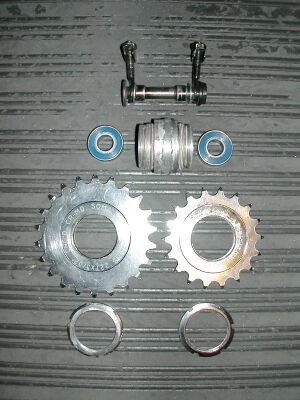
For those interested, here are the “exploded” parts of the jackshaft assembly:
I’m not sure if I understand this. (In fact I’m sure I don’t understand this.) The lockrings are the bottom parts in your exploded view, right? The picture is almost too small, but the lockrings seem to have three little indents on the outside which I assume match (lock on) three notches on something else. On what? And what exactly spun with respect to what?
The indentations in the lockrings are there so you can fit a lockring spanner on to tighten or remove the lockring.
Here’s a picture of a Park Tool bottom bracket lockring spanner (wrench). A lockring spanner for a rear cog (as used on track bikes) is typically different and usually only has one tooth. But this picture is good enough to give you an idea how a lockring spanner fits on a lockring. Park Tool bottom bracket lockring spanner
Here’s a picture of a different style of lockring pliers (wrench/spanner). Tools for track racers
John is correct as always. There are 2 kinds of lockrings, a track type with as few indents as possible for strength, and the 6-notched, as I have, which are meant to be removed & re-installed more often.
Klaas, Harper reverse-spun the big cog on the central cog body, a common problem with any other track cog setup (and a problem on most giraffes - that’s why we weld the cog to the hub). His response was “Get some 24-hour epoxy, that’ll take care of it!” True, but it will also take care of any hope of ever changing the gear ratio on the jackshaft by using a different size cog!
Could you do what we did on the new Nimbus Giraffes? We use a hub body designed for disc brakes, but use the bolt holes to bolt on the sprocket (with some thread lock). It has been 100% reliable so far and we implemented the design last April.
Thanks for that suggestion, Roger. Problem is, how to set up the hub section and drill the cogs so that they are perfectly concentric. How do you accomplish that? Then there still must be room for insertion of sealed bearings on each side of the “hub”.
My other idea for a jackshaft was to weld the 2 track cogs to a steel tube (1.375" OD), and somehow insert the sealed bearings and axle. Same issue though, how do you set up these parts so the sprockets will be concentric? Weld them on a lathe (he asks, not being a machinist…)?
Harper suggested using 2 freewheel sprockets and a freehub body, but every sprocket I’ve seen fits pretty loose and would be hard to weld concentric.
I am very pleased that I was able to break something other than my own leg. I had to beg Ryan Atkins to break Steve Howard’s splined axle because I couldn’t do it myself. I feel like I’m back in business. Especially pleasing is the knowledge that JC was denied a ride because of my excessive abuse.
Another notable: Irene Genelin is the first to have ridden both versions of geared Cokers (jackshaft and internal) and is the only living human who can make a comparison.
The holes are batch produced so my guess is that there is no flash tooling. But it works! My guess is the number of holes help.
When I was designing it I was thinking it needed a machined inner ring that fits on a machined section on the hub. Although this was not possible due to way the hub was built. In then end it was not needed.
On the matter of fitting a bearing, I would have thought it was better because these hubs are front hubs. Some are fitted with sealed bearings and have a 20mm shaft through the centre. It may be that these could be used with less adaption than using rear ones.
Ha! I thought ahead and brought a small child to distract Harper and JC so I could get a turn first!
Pete was good enough to let me abuse his arm and shoulders to mount and get started, I think it took about four house lenghths to finally launch. Pete’s best advice was “pedal slowly”. Your natural inclination when starting out is to push down too hard and lean too far forward and fall off the front.
I finally got rolling and did OK for a block until I lost it towards the top of a small hill. After several failed freemounts I remounted at a mail box and made it back without incident. The sensation is very similar to the first time on a Coker or my geared up giraffe: You spend most of your energy and concentration just trying to stay on top.
Granted two blocks hardly qualifies as a test run but it ran very smooth and picked up speed very steadily. I’d like to try it on an open road with the propper protective gear.
I could see the merrits of a shiftable Coker with the higher gear for flats and rolling hills. I wonder if the Schlumpf will be affordable.
I visited Tom Miller this weekend and I believe he would willing to build one of these for someone. I gave him a paper copy of this thread because he has no internet access, but he already knew about it because he provided the spokes for this project.
Just thought I’d post an update on this project. The first gear ratio tried was 1.5, using 22t drive cogs and 18t cogs on the small sides. Then I went to 17t cogs, which was a 1.67 ratio. Now I’m using a 16t cogs, which is a 1.89 gear ratio. It’s getting easier to ride the more time I get on it, but still takes some getting used to. Freemounts are indeed possible! My speeds have increased with each increase in the gear ratio, but not quite in proportion to the gear.
Another issue is crank lengths. With the 1.5 ratio I used 150mm cranks. With the 1.67 I went to 170mm, and noticed a lot more control. Now with the 1.89 I currently have a set of 172.5, but will soon be installing a set of 175s.
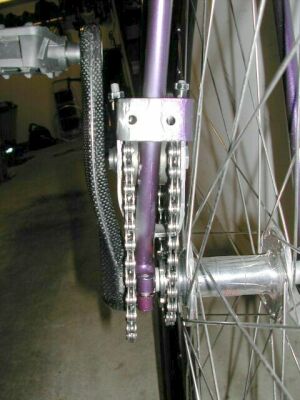
I also cut & re-welded the jackshaft cage to make it narrower, and re-positioned the jackshaft axle about 3/4" lower in the cage. This all but eliminates any torque effect on the frame.
Here’s the current frontal view: