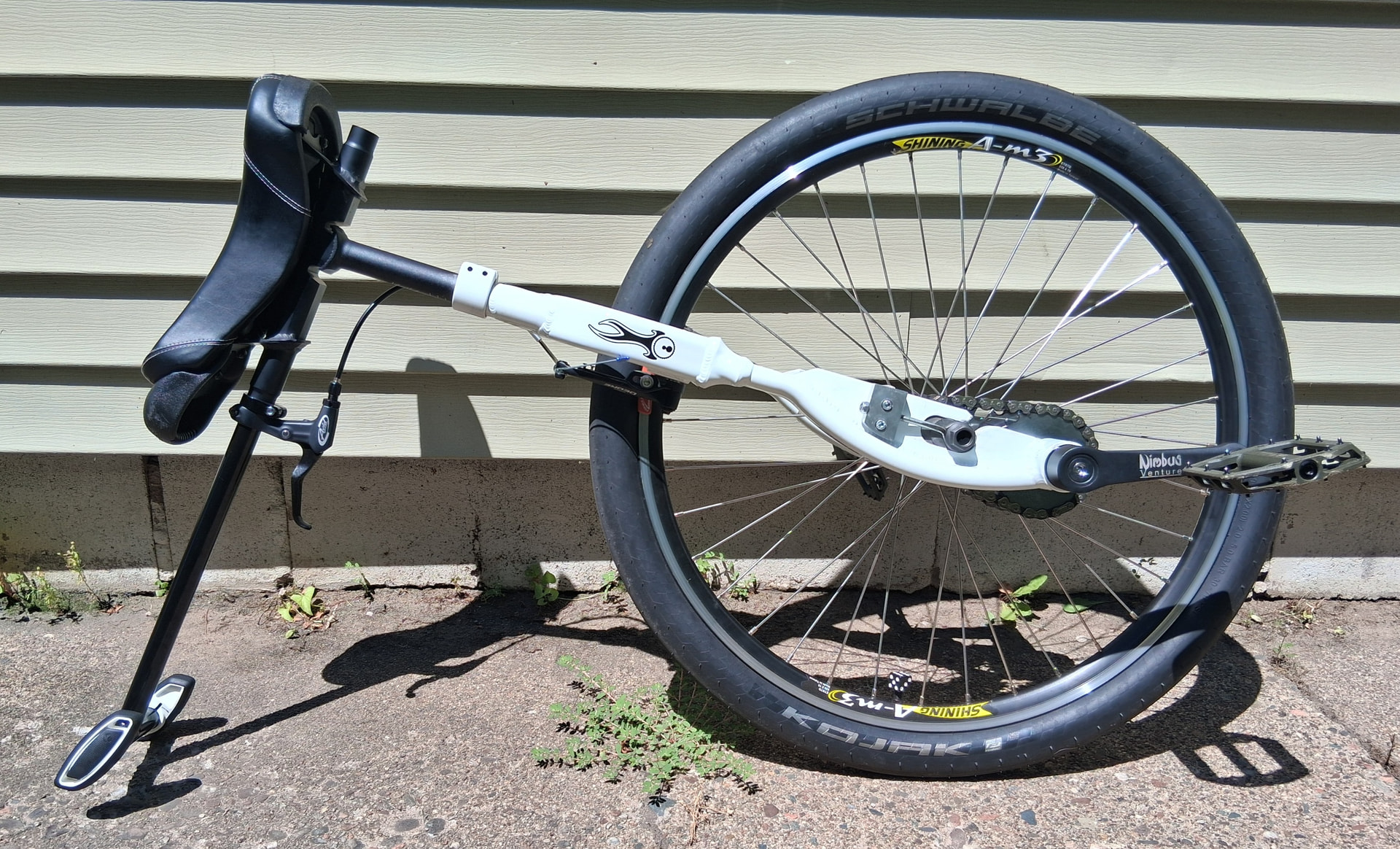
I’ll dig up this thread to add on my thoughts on the Huni Rex and write my own review on it. I’ve done about 300 miles on it so far and I feel like I’ve gotten familiar with the ride feel and some of it’s quirks 
My Current Setup
- Nimbus Stadium Saddle
- Nimbus Shadow Bar System
- Kris Holm 27.2mm Pivotal Seat Post
- Avid FR-5 Brake Lever
- Shimano Deore BR-T610 V-Brake
- Kool Stop Salmon MTB Brake Pads
- Schwalbe Kojak 26x2.00" (ETRTO 50-559)
- Schwalbe Lightweight Butyl Tube
- Nimbus Venture 125mm Cotterless Cranks
- KMC K1 Chains
- Trek Line Elite Pedals
Quick Facts
- Weight: 17.8 lbs (8.1 kg) (Fully equipped, not out-of-the-box)
- Q-Factor (I measured from the outside face of the crank roughly to centerline of wheel, then multiplied by 2): ~280mm
- Gear Ratio: 24/16 (1.5x)
- Can fit up to a 57-622 tire (At least going off of some pictures I’ve seen on the Huni Rex website)
- Has two pairs of brake boss mounts. The lower pair is used for the 26" wheel, upper pair can be used for a 27.5" wheel. Longer reach V-Brakes are likely needed for a 29" wheel. The bosses use M10x1.25 threads
The Review
Like I mentioned at the beginning of the post I have already ridden over 300 miles on the Huni Rex so far, and I think I can say I’ll probably continue riding it for many more miles  Compared to most other unicycles it might be an acquired taste—and it can be finnicky in many ways—but once it’s set up right it can easily be as fast as a 36er.
Almost immediately after I got it out of the box I decided to swap some parts out. The saddle that comes with the Huni is an older Nimbus-style saddle (Velo base) that has too much curve for my liking, so I swapped that out for a newer Stadium saddle. The pedals that came standard were metal platform pedals; I swapped them for plastic pedals with more aggressive pins for more grip. Another small thing that needed correction was that the wheel was slightly off-center. It took me a bit to get it roughly centered while also keeping the chain tension at acceptable levels, but I made it work.
My first few attempts at riding the Huni went well. I was already comfortable riding a 36er before trying the Huni so I was used to the pedal feel and riding at higher speeds. My first impressions:
- It’s a wide unicycle
- I feel like I’m riding so low compared to most other unicycles
- It still rides like a regular unicycle… Surprise surprise

I’ll say freemounting is somewhat easier than mounting a 36er, but still more difficult than mounting smaller wheels. It’s low enough to simply step onto the unicycle, rather than having to launch yourself on top of the wheel like a 36er. The downside is that it’s still effectively a big wheel, and without the forward momentum from a 36er mount it can be a bit more effort to get going. Of course after a while, it’s something you’ll get used to
Cornering is easily the Huni’s biggest weakness. It didn’t take long for me to induce my first pedal strike induced UPD, so afterwards I’ve kept hard cornering to a minimum. Tight corners and hairpins are still doable, but they have to be taken at reduced speeds. Tight corners I can smash without second thought on a 36er, I have to ride carefully on a Huni  Evasive maneuvers, riding on very cambered surfaces, and strong crosswinds might also inadvertently cause pedal strikes!
Although pedal strikes are definitely something that you need to be conscious of while riding, most of my time spent on the Huni is riding on relatively straight bike paths where hard cornering is rare. Open roads, paved multi-use paths, and bike paths are where the Huni performs the best.
I’d say to extract the most amount of performance out of the Huni, I would absolutely recommend adding a brake and a bar to it. Most brakes nowadays are disc brakes, so if you haven’t used rim brakes on a unicycle before it might be a bit of an adjustment. I find that I still have plenty of braking power with a rim brake, but modulating the brake force is somewhat more difficult. The bar should help with stability and make it easier to put power down without the unicycle rotating under you.
Compared to a 36er, Pros & Cons
36er Pros
- No risk of pedal strikes
- Better cornering
- Less complex, less maintenance, reduced chance of mechanical failure
- Q-Factor in a reasonable range
- Feasible to use off-road if desired
- Greater freedom in crank lengths, specifically longer cranks
- Easier to change a tire/tube, pretty straightforward process
- Larger wheel size = better rollover for obstacles
36er Cons
- Can be difficult to mount due to wheel size, saddle height
- Limited tire options
Huni Rex Pros
- Easier to mount due to low saddle height
- Greater variety of tire options (considering 27.5" and 29" also viable as well)
- May be faster on paved roads
Huni Rex Cons
- Wide Q-Factor may be uncomfortable
- Pedal strikes can cause UPDs
- Risk of pedal strikes greatly reduces cornering ability
- Changing a tire/tube can be somewhat difficult, may not be feasible to repair on a roadside
- Drivetrain requires maintenance and adjustment to work properly (+ additional tools needed)
- Drivetrain utilizes proprietary components, making repair options limited
- Crank length is effectively limited to 125mm maximum
Q&A
Is it difficult to ride uphill?
It is slightly more difficult to ride uphill compared to a 36er. It’s possibly a combination of the slightly higher gearing and wide stance that doesn’t feel optimal for putting power down
Does the play/slack/slop in the pedals cause any difficulty in riding?
It’s noticeable for sure, but it’s something that can get used to. Occasionally if it feels too excessive the chain can simply be readjusted to have less play.
Is the Q-Factor uncomfortable? Do you get used to it?
At first I was concerned that the wide Q-Factor would cause some knee issues, but so far I’m actually not too bothered by it at all. Sure it still feels quite different than other unis, but at least the Q-Factor isn’t causing any issues for me. I’m standing at roughly 5’11" though, this might be an issue for riders with a shorter inseam.
Does the smaller wheel size make road obstacles more difficult than on a 36er?
On good pavement the Huni rides just fine, though on rougher pavement I do find myself riding more carefully than on a 36er. I generally avoid sticks and stones that I would normally ride over on a bigger wheel
Is previous experience with a 36er recommended?
I think it would be very beneficial to have a feel for riding a bigger wheel before riding a Huni. That’s not to say I wouldn’t recommend it for people that have ridden only smaller wheels before, but it’s going to feel very different than most unicycles. As long as you’ve had plenty of saddle time on a regular unicycle, you’ll probably be able to ride a Huni with some practice.
What is maintenance like?
If you’ve ever worked on a single speed bicycle, it’s probably not too different. It’s a matter of fiddling with the chain tensioners to get the wheel centered while at the same time maintaining the right amount of chain tension on either side. Then of course you have to make sure the chain is properly lubricated and cleaned occasionally. I should emphasize that you need to watch your fingers when cleaning the drivetrain. If the wheel and cranks are spinning, the drivetrain can easily chew a finger off if you’re not careful. Thankfully not talking from experience  Just something to keep in mind.
I mentioned earlier in the post about the difficulty of changing a tire or tube, and most of that difficulty comes from the wheel centering and chain tension management. Getting the wheel itself out isn’t too bad, but might be somewhat confusing doing it for the first time. You must flex the frame apart to allow the cogs to clear each other for wheel removal.
How are UPDs?
I’ve had a few UPDs with it so far. I don’t think being lower to the ground hinders the ability to land on my feet; I haven’t yet had a UPD where I didn’t have enough time to land on my feet. That’s not to say I haven’t had a UPD where I’ve fallen down, but that’s more because of speed
Is the crank offset noticeable? Does riding lower help with stability?
I don’t notice much of a difference in the ride feel compared to a regular unicycle, despite the cranks being offset from the center of the wheel. I don’t think it helps or hinders stability, not counting pedal strikes of course.
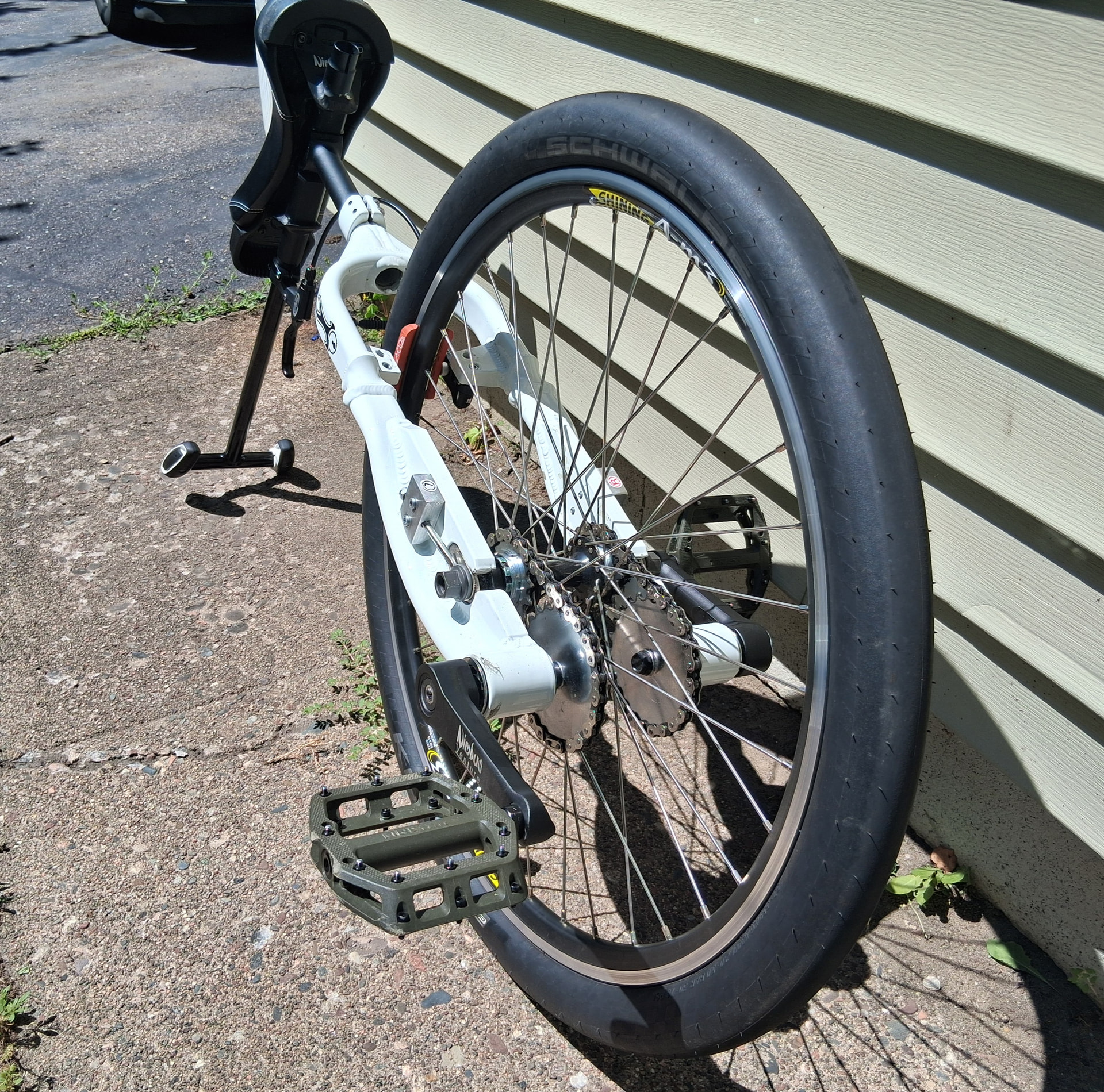
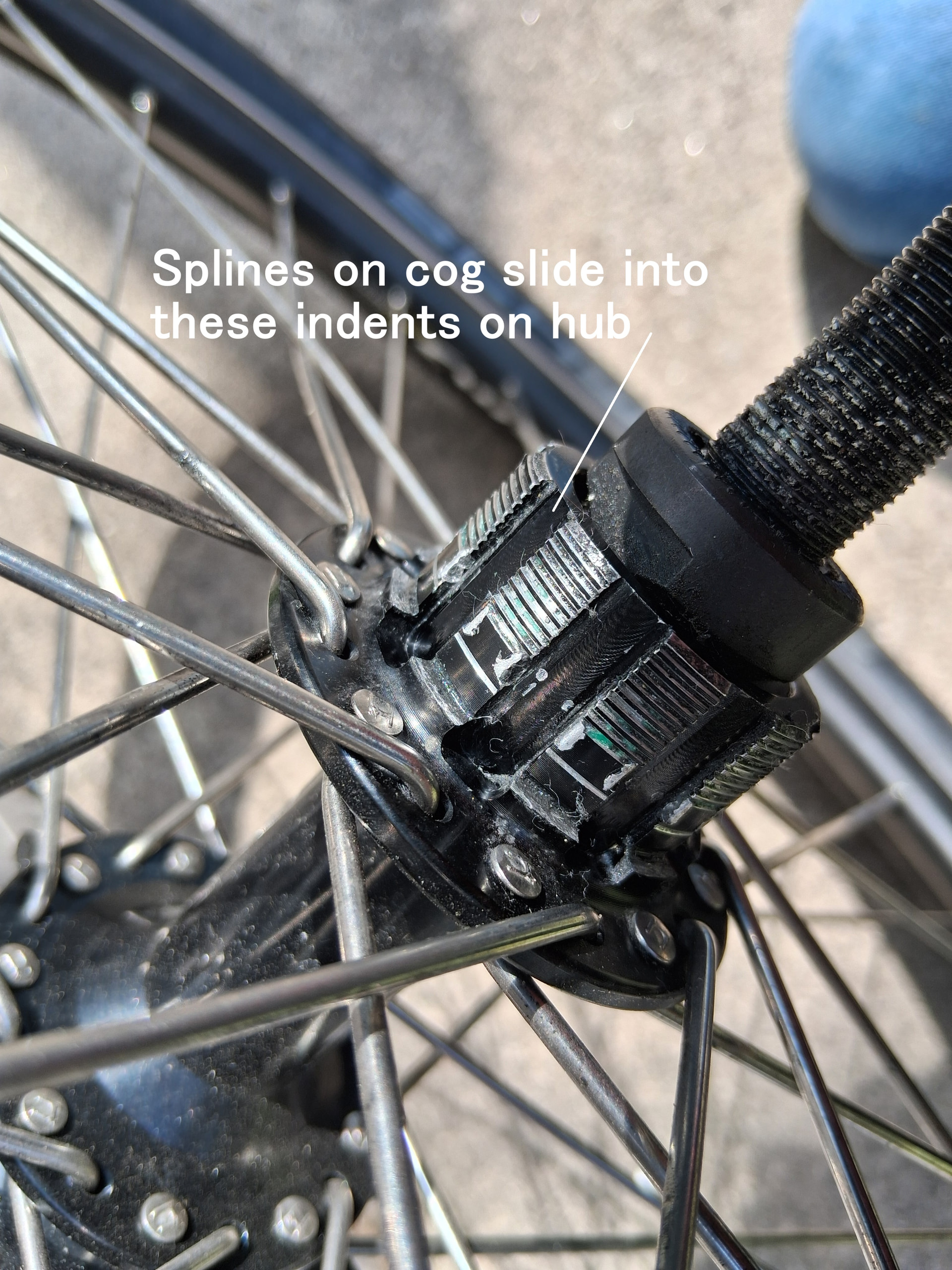

 It was still rideable, but I consciously took it easy on the way back. I think the movement of the cog on the hub may have chewed up the splines somewhat.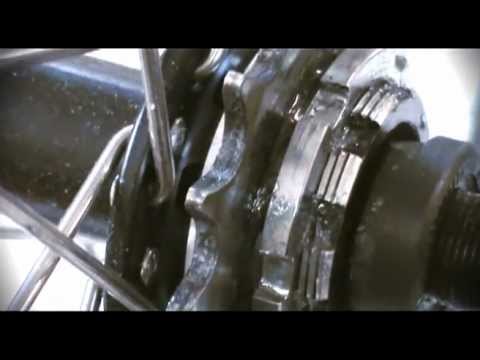
 I suppose the loctite helps the lockring grip the cog better, as well as hinder movement of the cog on the hub